




European Customers Now Running Fuso eCanter Electric Trucks
Daimler Trucks has begun delivering its Fuso eCanter, which it calls the first all-electric truck in regular production, to fleet customers in Europe, the company announced.
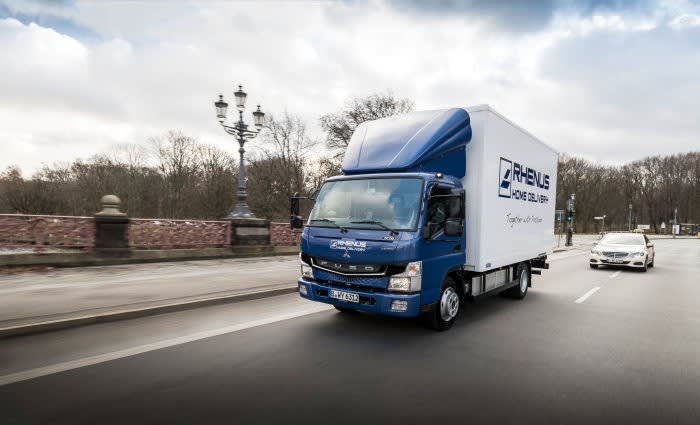
Photo: Daimler Trucks
Photo: Daimler Trucks
Daimler Trucks has begun delivering its Fuso eCanter, which it calls the first all-electric truck in regular production, to fleet customers in Europe, the company announced. The OEM said drivers will be specially trained to operate the electric trucks and each customer is obtaining their vehicles via a 24 month long-term rental from Mercedes-Benz CharterWay, a captive rental and leasing firm.
The first to receive the Class 4 trucks on the continent are global logistics firms Deutsche Post DHL, DB Schenker, Rhenus, and Dachser. However, Daimler noted these firms will be running the eCanters in diverse applications. For example, the six trucks for DHL will be used in two distinct operations. Two eCanters will provide inner-city deliveries of heavy cargo for DHL Freight’s Berlin branch while DHL Paket will use four trucks to deliver goods to businesses. For this role, the eCanters will replace trucks powered conventional drivetrains. Similarly, DB Schenker will run use its trucks to collect and deliver general cargo in the inner city of Berlin.
By contrast, Rhenus Group will deploy three eCanters to deliver furniture, consumer electronics, and home appliances from a central warehouse to residents of Berlin’s inner city while Dascher will use two electric trucks to collect goods and to complete last-mile deliveries.
The OEM stated that “after years of thorough development and testing,” the eCanter is now fully integrated in the conventional Fuso Canter production line. Production of the electric model began back in July in Tramagal, Portugal. All eCanters for the European and U.S. markets will be produced there.
Daimler added that, over the next few years, its Mitsubishi Fuso Truck and Bus Corporation subsidiary plans to deliver 500 eCanters of this first production generation to select customers, with large-scale production slated to start in 2019. UPS announced in September that it will be putting three of the medium-duty electric trucks in service in North America for evaluation. And in Japan, convenience-store chain 7-Eleven and Yamato Transport each have committed to operate 25 eCanters.
The eCanter has a range of approximately 62 miles and a load capacity of two to three tons, depending on body and duty cycle, according to Daimler. Its electric powertrain uses six high-voltage lithium-ion battery packs, with 420 volts and 13.8 kWh each, and a permanent-magnet-engine that can produce 180 hp via a single-gear transmission in the rear axle. Daimler said its continuous output allows the truck “to accelerate almost like a passenger car and that’s available from the first second of driving.”
According to Marc Llistosella, CEO of Daimler Trucks Asia, the eCanter is the OEM’s answer to the need for a zero-emission, zero-noise truck designed for inner-city distribution. He added that “over 90,000 kilometers of testing in everyday operating conditions [makes us] secure that we are handing over a reliable and economical vehicle to our customers. With the eCanter, our customers now operate not only quietly and without locally emitted carbon-dioxide, they also save money on operating costs. This is the future of urban distribution transport.”
More Global Fleet

GeoFencing Adds to Your Truck Security Arsenal
Geofencing is a familiar fleet tool today, but its early adoption marked a major shift in vehicle tracking, route monitoring, and the debate over employee privacy.
Read More →
Holman Takes Full Ownership of ARIZA in Mexico
Holman is bringing its Mexican fleet management operation fully under its own brand after more than 30 years as a joint venture. The change gives multinational fleet customers a single Holman operation across the U.S., Canada, and Mexico.
Read More →
5 Tire Maintenance Tips to Help Prevent Work Truck Downtime
Regular tire checks can do more than extend tread life. These five maintenance practices can help work truck fleets catch problems early, reduce costs, and prevent downtime.
Read More →

Proven Ways to Reduce Work Truck Downtime
The age-old problem of downtime will always be a reality, but with new strategies at hand, fleets have more ways to keep trucks on the road longer.
Read More →


Cameras, Safety and Insurance: From Reactive Claims to Real-Time Prevention (Part 2 of 2)
Part Two: Commercial auto remains one of the most challenging and costly lines of coverage for fleet operators and insurers alike. Continue learning more about how to effectively address these issues from Onur Aksan, Enterprise Business Development Executive, Geotab
Read More →
Cameras, Safety and Insurance: From Reactive Claims to Real-time Prevention
Commercial auto remains one of the most challenging and costly lines of coverage for fleet operators and insurers alike. Learn more about how to effectively address these issues from Onur Aksan, Enterprise Business Development Executive, Geotab.
Read More →
Fleet Costs Are Rising: Here’s How Leaders Are Responding
Fleet leaders are under pressure to reduce costs, adapt to economic uncertainty, and make smarter decisions. See how peers across North America are responding with real data, proven strategies, and forward-looking insights. Download the 2026 Market Pulse Report to benchmark your strategy and uncover where you can gain an edge.
Read More →
Enterprise Fleet Management Surpasses 900,000 Vehicles in U.S. & Canada
Enterprise Mobility connects with mobility solutions around the globe
Read More →