





IIHS Requests Automakers, Fleet Operators to Promote Speed Limiters
Automakers Fulfill Autobrake Pledge for Light-Duty Vehicles
Fulfilling a commitment from 2016, 20 automakers have fulfilled the voluntary pledge to equip nearly all light vehicles with automatic emergency braking.
December 26, 2023
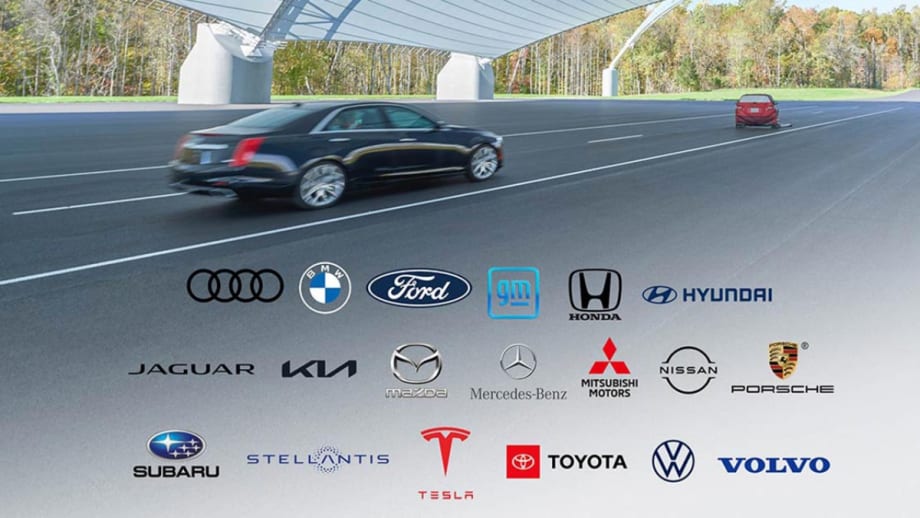
The AEB must either be able to slow the vehicle by at least 10 mph in one of two tests conducted at 12 and 25 mph or by 5 mph at both speeds.
Photo: IIHS
5 min to read
The Insurance Institute for Highway Safety (IIHS) announced that all 20 participating automakers have fulfilled a voluntary pledge to equip nearly all the light vehicles they produce for the U.S. market with automatic emergency braking (AEB).
Five new manufacturers installed AEB on more than 95% of the light vehicles they produced between Sept. 1, 2022, and Aug. 31, 2023, to meet the deadline set in the agreement. General Motors, Jaguar Land Rover, Maserati, and Porsche all dramatically increased the proportion of their vehicles equipped with the technology to meet the target.
Kia, which was already close last year, also crossed the finish line.
“The successful completion of this milestone shows what can be achieved when automakers and safety advocates work together toward our common goal of eliminating as many crashes as possible,” said David Harkey, IIHS president, in a recent news release.
Audi, BMW, Ford/Lincoln, Honda/Acura, Hyundai/Genesis, Mazda, Mercedes-Benz, Mitsubishi, Nissan/Infiniti, Stellantis, Subaru, Tesla, Toyota/Lexus, Volkswagen, and Volvo fulfilled the voluntary commitment in previous years.
The 2016 commitment was brokered by the IIHS and the National Highway Traffic Safety Administration (NHTSA). In it, the automakers pledged to equip at least 95% of their cars and trucks up to 8,500 pounds with the technology by the production year that ended Aug. 31. Consumer Reports agreed to assist in monitoring the pledges.
“This is significant progress, and it sets the stage for the strong federal safety standards that have been proposed,” said William Wallace, associate director of safety policy for Consumer Reports.
To fulfill their commitment, manufacturers must attest that the AEB system on their vehicles meets certain performance standards.The forward collision warning feature must meet a subset of NHTSA’s current requirements on the timing of driver alerts.
The AEB must either be able to slow the vehicle by at least 10 mph in one of two tests conducted at 12 and 25 mph or by 5 mph at both speeds — the level of performance needed for an advanced rating in the Institute’s original vehicle-to-vehicle front crash prevention evaluation.
“Thanks to this cooperation, automakers made this safety feature standard equipment years before there was a legal mandate requiring them to do so,” Harkey said.
NHTSA unveiled a proposal on May 31 to require that all new passenger vehicles, trucks, and buses with a gross vehicle weight rating of 10,000 pounds or less to have AEB capable of braking to fully avoid a crash with another vehicle at up to 50 mph, with a four-year grace period from the date the eventual rule is adopted.
If the regulation is adopted in its present form, vehicles will also have to be able to stop for pedestrians from speeds up to 40 mph. Pedestrian detection will have to work in dark conditions — a requirement for which IIHS had petitioned.
In June, the agency proposed a regulation that would mandate AEB capable of preventing crashes with other vehicles for trucks and buses with a gross vehicle weight rating of more than 10,000 pounds.
Pedestrian detection has been part of IIHS award criteria for several years running, and, as of 2023, a nighttime test was added to the battery of evaluations needed for TOP SAFETY PICK+. Next year, the Institute plans to introduce a higher-speed vehicle-to-vehicle AEB test that involves motorcycle and large truck targets as well as passenger cars.
Consumer reports currently award additional points to a vehicle’s overall score for models that have AEB with pedestrian detection as standard equipment and for AEB that operates at highway speeds. To be named a CR Top Pick, a vehicle must have both.
Automakers Look to Meet AEB Threshold
Under the commitment, automakers have slightly longer to meet the 95% threshold when vehicles with manual transmissions and heavier vehicles are included in the calculation.
By the production year that begins Sept. 1, 2024, automakers will need to equip 95% of all their light vehicles, whether automatic or manual, with AEB. By the production year beginning Sept. 1, 2025, they will need to meet the threshold for their entire production volume, including those vehicles in the 8,500-10,000 pound category.
More than three-quarters of the automakers already meet the 955 threshold with manual-transmission vehicles included in their production totals.
Four of the five automakers that produce 8,500-10,000 pound vehicles for the U.S. market — Ford, General Motors, Mercedes-Benz and Nissan — already meet the threshold with those heavier vehicles included. Stellantis is closing in on the target.
Some manufacturers are reaching the overall benchmark while still leaving many of their 8,500-10,000 pound vehicles unequipped, however. So far, only Mercedes-Benz and Nissan have equipped all of their 8,500-10,000 pound vehicles with AEB, while Ford has equipped 78% and General Motors just 6%. Stellantis, which has yet to reach the 2025 goal, has equipped 47%.
“We urge the automakers with heavier vehicles to make AEB standard right away,” said CR’s Wallace. “Whether you buy a small sedan or a large pickup, everyone should have the protection that AEB provides on the road.”
IIHS expects the voluntary commitment to prevent 42,000 crashes and 20,000 injuries by 2025. The estimate is based on IIHS research that found that front crash prevention systems with both forward collision warning and automatic emergency braking cut rear-end crashes by half.
Vehicles Produced with AEB
Here is the complete list of how many vehicles each automaker produced with AEB, as reported by manufacturer for light-duty vehicles with gross vehicle weight of 8,500 pounds or less. May exclude vehicles with manual transmissions.
Honda/Acura – 100%
Hyundai/Genesis – 100%
Kia – 100%
Mercedes-Benz – 100%
Mitsubishi – 100%
Nissan/Infiniti – 100%
Subaru – 100%
Tesla – 100%
Volvo – 100%
BMW – 99%
Jaguar Land Rover – 99%
Ford/Lincoln – 98%
General Motors – 98%
Maserati – 96%
Porsche – 96%
Stellantis – 96%
Audi - >95%
Mazda - >95%
Toyota/Lexus - >95%
Volkswagen - >95%
More Safety

Sponsored•October 1, 2026
Fleet Manager’s Ultimate Playbook: Navigating the New Standard in OEM Connectivity
Rising operating costs, driver safety concerns, and unplanned downtime are putting unprecedented pressure on modern fleets. Discover how fleet managers use embedded OEM connectivity and real-time vehicle data to cut TCO, prevent downtime, and protect drivers without aftermarket telematics hardware.
Read More →
From Driver Well-Being to EV Charging | AF News Recap
Mental health belongs in the fleet safety conversation. This week, we’re looking at five ways fleets can support employee well-being before a crisis, plus Holman’s expansion in Mexico, new one-day Fleet Forward passes, and why EV charging demand is outpacing infrastructure growth.
Read More →
Nexar-Nauto Merger Aims to Give Fleets Better Safety Intelligence Through Larger Driving Dataset
Stefan Heck tells Automotive Fleet that combining more than 10 billion miles of driving history with Nexar's AI models will give fleets deeper insights into driver risk and roadway conditions than either company could provide independently.
Read More →
Don't Wait for a Crisis: 5 Ways to Build Mental Health Into Your Fleet Safety Program
For Suicide Prevention Month, fleet and safety leaders have an opportunity to put mental health where it belongs: at the center of workplace safety.
Read More →
How Camera Data Can Strengthen a Fleet’s Insurance Renewal
Insights from a commercial insurance carrier and a broker show how fleets can turn video telematic data, driver coaching, and improved claims results into a stronger case at insurance renewal.
Read More →
The Safest Fleets Aren’t the Ones with the Most Technology
You’ve made the telematics investment. Here’s how to capture the other half of its value and build the safest fleet on the road.
Read More →
Sponsored•August 7, 2026
Hidden in Plain Sight: Fleet Compliance Risks
Fleet compliance isn't just about having policies — it's about consistently enforcing them. This practical guide reveals six hidden compliance risks common in public sector and shared fleet operations and outlines proven strategies to improve visibility, accountability, and audit readiness
Read More →
NETS Sets 2026 Fleet Safety Benchmark Conference for Indianapolis
The Sept. 15–17 program will feature fleet benchmarking data, case studies, emerging technologies, and implementation strategies while running alongside the NSC Safety Congress & Expo.
Read More →
Off-the-Job Crashes Account for 43% of Employers’ $61.7 Billion Crash Burden
NETS quantifies costs dispersed across fleet, risk, HR, and other departments while providing new per-crash benchmarks for employers.
Read More →
Ram Recalls More Than 1.27 Million 1500 Pickups for Seat Belt Anchor Issue
The recall affects certain 2019-2026 Ram 1500 pickups that may have improperly attached second-row seat belt buckle anchors.
Read More →