




Speeding: Top Causes, Tough Consequences
For every 10 mph a driver travels over 50 mph, their risk of being involved in a fatal collision doubles. So why do drivers continue to speed? An expert explores the subject.

Moser says there are three primary reasons why people speed: It’s a bad habit they’ve acquired, they’re in a rush, or they’re distracted.
Photo: pexels/Harrison Haines
Editor's Note: This content was originally published in January 2023. It has been reviewed and updated to remain relevant.
According to the National Safety Council, in 2023, speeding was a factor in roughly 29% of all traffic fatalities in the U.S., resulting in 11,775 deaths. This is 32 deaths per day. Many of us have heard scary statistics before. So why do people continue to speed?
There are three primary reasons drivers speed: it is a habit, they're rushed, or they're distracted. No matter the reason, speeding is clearly dangerous and should always be avoided.
Consider this: For every 10 mph you travel over 50 mph, your risk of being involved in a fatal collision doubles. There are some additional insights you can share with your drivers. Let them know that if they’re involved in a serious collision at high speed, there isn’t an airbag or belt system that will save their life. That’s a tough consequence no one wants to face. Couple this with the fact that if they’re speeding, they may not be able to react in time to avoid a collision. The faster your driver is traveling, the less time he or she has to react.
Now let’s address the three reasons for speeding.
A Bad Habit
For some drivers, speeding may be a habit; it’s what they’re used to doing. A person may be so used to speeding that, when they drive the speed limit, it feels like they’re going too slow. Here is what you need to reinforce with drivers who have this feeling: “You’re not traveling too slow; you’re obeying the speed limit.”
If speeding is a habit, the driver needs to recognize it and fix it. It will take time and effort to change, but given the consequences, it is absolutely worth it.
The Rush Job
Do you know drivers who are constantly running late? If you answered yes, tell those drivers to look in the mirror and consider how they are scheduling their day.
Trying to make up time by speeding is a lesson in futility. It doesn’t work. Any minutes a driver makes up will be taken away at the next red light or traffic jam. Also, as anyone who’s ever run late knows, with every red light and traffic jam, frustration builds, which distracts. Numerous studies have shown that speeding will not help you arrive on time. In fact, if you get pulled over for speeding or crash, your arrival time may be delayed, or you may not make it at all.
If a driver is running late for an appointment, they should find a safe place to park and call ahead. In the worst-case scenario, they may be told to reschedule. In the best-case scenario, and more likely, the person on the other end will thank the driver for calling and reassure them that they will be there when the driver arrives. Now the pressure is off.
The bottom line is that fleet operators must encourage drivers to build enough time into their schedules so that they don’t get tempted to speed. Remind your drivers to stop rushing and make safety a top priority.
Unwitting Distraction
Put yourself behind the wheel for a moment. Have you ever looked down at the speedometer and realized that you were traveling well over the speed limit? That’s an indication that you were distracted and didn’t even realize it.
It’s something that happens to fleet drivers from time to time. Maybe they were using their phone, or maybe they were daydreaming. No matter the cause, the result is speeding. And what’s even worse, they were speeding at a time when they were distracted. This is a highly dangerous and unacceptable combination.
Fleet operators need to clearly communicate with drivers about eliminating distractions. Remind them to stow away items that could distract them. Make sure you tell them to avoid using their cell phones, texting, or eating while driving.
And here’s a trick to teach your drivers. Tell them that if they find their mind wandering, they should start verbalizing their driving environment. For example, every time they see a speed limit sign, they should say it out loud. The idea is that if a driver speaks what they see, it will force them to pay attention to their driving. Verbalizing the speed limit signs will make them aware of the limit and their current speed.
Paying attention and avoiding speeding need to be top priorities.
A Word about Speed Limits
Speed limits are established with one thing in mind: safety. Can you imagine how unsafe it would be if our roadways had no speed limits? Fleet managers must impress upon drivers the importance of obeying speed limits — for their own safety and that of all road users.
More Safety

Fleet Manager’s Ultimate Playbook: Navigating the New Standard in OEM Connectivity
Rising operating costs, driver safety concerns, and unplanned downtime are putting unprecedented pressure on modern fleets. Discover how fleet managers use embedded OEM connectivity and real-time vehicle data to cut TCO, prevent downtime, and protect drivers without aftermarket telematics hardware.
Read More →
From Driver Well-Being to EV Charging | AF News Recap
Mental health belongs in the fleet safety conversation. This week, we’re looking at five ways fleets can support employee well-being before a crisis, plus Holman’s expansion in Mexico, new one-day Fleet Forward passes, and why EV charging demand is outpacing infrastructure growth.
Read More →
Nexar-Nauto Merger Aims to Give Fleets Better Safety Intelligence Through Larger Driving Dataset
Stefan Heck tells Automotive Fleet that combining more than 10 billion miles of driving history with Nexar's AI models will give fleets deeper insights into driver risk and roadway conditions than either company could provide independently.
Read More →
Don't Wait for a Crisis: 5 Ways to Build Mental Health Into Your Fleet Safety Program
For Suicide Prevention Month, fleet and safety leaders have an opportunity to put mental health where it belongs: at the center of workplace safety.
Read More →
How Camera Data Can Strengthen a Fleet’s Insurance Renewal
Insights from a commercial insurance carrier and a broker show how fleets can turn video telematic data, driver coaching, and improved claims results into a stronger case at insurance renewal.
Read More →
The Safest Fleets Aren’t the Ones with the Most Technology
You’ve made the telematics investment. Here’s how to capture the other half of its value and build the safest fleet on the road.
Read More →
Hidden in Plain Sight: Fleet Compliance Risks
Fleet compliance isn't just about having policies — it's about consistently enforcing them. This practical guide reveals six hidden compliance risks common in public sector and shared fleet operations and outlines proven strategies to improve visibility, accountability, and audit readiness
Read More →
NETS Sets 2026 Fleet Safety Benchmark Conference for Indianapolis
The Sept. 15–17 program will feature fleet benchmarking data, case studies, emerging technologies, and implementation strategies while running alongside the NSC Safety Congress & Expo.
Read More →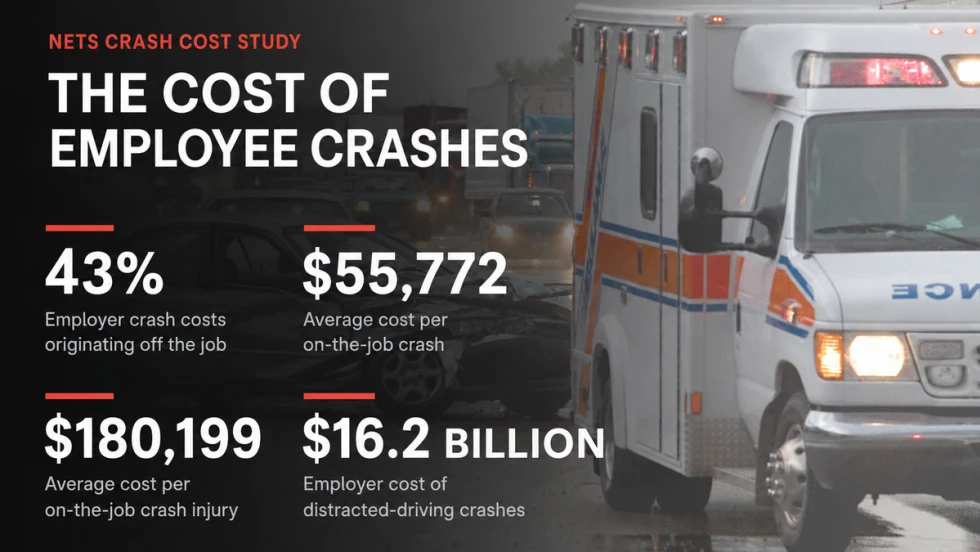
Off-the-Job Crashes Account for 43% of Employers’ $61.7 Billion Crash Burden
NETS quantifies costs dispersed across fleet, risk, HR, and other departments while providing new per-crash benchmarks for employers.
Read More →
Ram Recalls More Than 1.27 Million 1500 Pickups for Seat Belt Anchor Issue
The recall affects certain 2019-2026 Ram 1500 pickups that may have improperly attached second-row seat belt buckle anchors.
Read More →