





Related: Winter Driving Safety for Fleet Drivers: Managing Risk Across North America
FLASH Weather AI Launches First Deep-Learning Hail Prediction Model With High-Resolution Forecasting
FLASH Weather AI has launched a first-of-its-kind hail prediction model capable of forecasting hail size and arrival time at 1-kilometer resolution up to 55 minutes ahead, giving fleets and insurers critical time to prepare for severe storms.
May 13, 2026
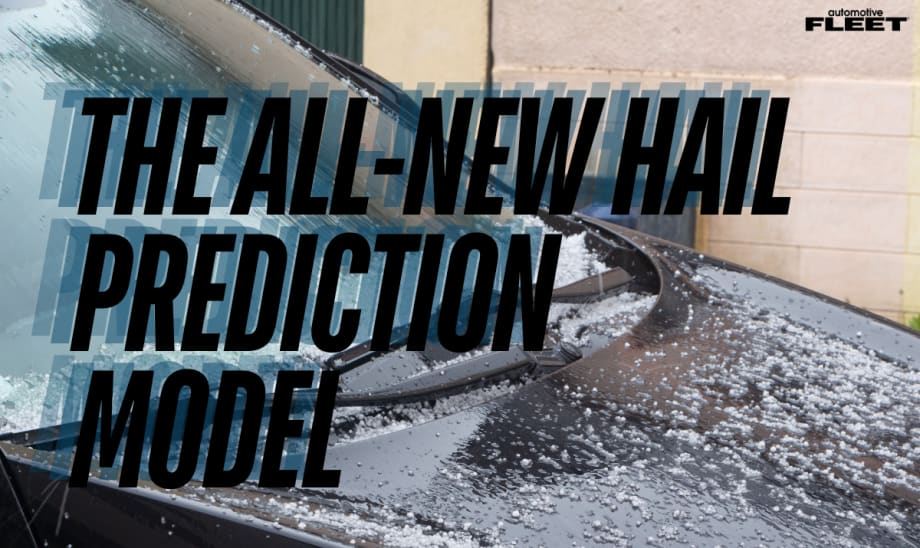
FLASH Weather AI’s new 1-Hour Hail Swath Prediction Model gives fleets and insurers high-resolution forecasts for hail size and arrival time up to 55 minutes in advance.
Credit:
Automotive Fleet
3 min to read
- FLASH Weather AI introduces a novel deep-learning model to predict hail with high precision.
- The model forecasts hail size and arrival time up to 55 minutes in advance at a 1-kilometer resolution.
- This technology provides crucial lead time for fleets and insurers to prepare for severe weather.
*Summarized by AI
FLASH Weather AI announced the launch of its 1-Hour Hail Swath Prediction Model, the first high-resolution hail prediction model. The deep-learning system forecasts hail size and arrival time at 1-kilometer resolution, refreshed every five minutes, with predictions extending up to 55 minutes into the future.
Trained on four years of U.S. convective storm data spanning 2021 through 2024, the model produces deterministic forecasts of hail size in inches or millimeters, predicting down to the hundredth of an inch. A companion Hail Arrival Time product estimates when quarter-size or larger hail will reach any location in the forecast window. Following a month of beta testing across multiple severe weather events, the model has demonstrated significant accuracy and operational usability, with verification examples available on request.
The product begins rolling out this week via API and inside the FLASH Weather Command Center (WCC), the company's web-based operations platform, with native integration into the FLASH mobile app following in the coming weeks.
"For the first time, insurers, fleet operators, and infrastructure managers have a tool that doesn't just tell you a storm is coming; it tells you exactly where hail will fall, how large it will be, and gives you enough lead time to act,” said Jason Deese, founder and CEO. “That's not an incremental improvement. That's a fundamental shift in how the world manages hail risk."
Why Hail Prediction Matters
According to Cotality's 2026 Severe Convective Storm Risk Report, more than 43.5 million U.S. homes (roughly 42 percent of all analyzed properties) now sit in moderate or greater hail risk categories, representing 17.8 trillion dollars in reconstruction cost value. The same report concludes that a single severe hailstorm is now capable of generating insured losses approaching 30 billion dollars at a 50-year return period, rivaling the financial impact of a Category 4 hurricane. In 2025 alone, State Farm paid out more than 5.6 billion dollars in hail claims, and Cotality recorded 142 days of damaging hail across the United States, the highest total in over two decades.
Exposure is concentrated, but no longer regional. Texas leads with 3.1 trillion dollars in at-risk reconstruction value, while the greater Chicago metro now ranks as the most financially exposed city in the country at 1.0 trillion dollars. Losses cut across property insurance, roofing, construction, agriculture, automotive fleets, solar energy, and outdoor sports.
Until now, the industry has relied almost entirely on radar-based detection, which only confirms hail after it has already begun to fall, or on broad convective outlooks that lack the precision required to protect a specific job site, fleet yard, solar array, golf course, or rooftop. The FLASH 1-Hour Hail Swath Prediction Model closes that gap with location-specific, minute-by-minute forecasts.
"Hail is one of the toughest convective hazards to forecast at high resolution. Getting size and arrival time right at a 1-kilometer grid, refreshed every five minutes, is a leap forward in convective forecasting. After a month in beta, I trust this model the way I trust our proprietary lightning prediction, and that's not a comparison I make lightly."
More Safety

What’s Next for Fleet? Safety, AI & Industry Recognition | AF News Recap
Could your company's culture be encouraging distracted driving? This week, we're exploring how workplace expectations affect driver safety, what AI, EVs, and autonomous vehicles could mean for the future of fleet management, and how fleet professionals can strengthen their award nominations.
Read More →
Does Your Fleet's Culture Encourage Distracted Driving?
What happens when the people responsible for enforcing safety rules are the ones setting the wrong example? The answer may reveal why some of the biggest risks to fleet drivers have little to do with what's written in the employee handbook.
Read More →
Sponsored•October 1, 2026
Fleet Manager’s Ultimate Playbook: Navigating the New Standard in OEM Connectivity
Rising operating costs, driver safety concerns, and unplanned downtime are putting unprecedented pressure on modern fleets. Discover how fleet managers use embedded OEM connectivity and real-time vehicle data to cut TCO, prevent downtime, and protect drivers without aftermarket telematics hardware.
Read More →
From Driver Well-Being to EV Charging | AF News Recap
Mental health belongs in the fleet safety conversation. This week, we’re looking at five ways fleets can support employee well-being before a crisis, plus Holman’s expansion in Mexico, new one-day Fleet Forward passes, and why EV charging demand is outpacing infrastructure growth.
Read More →
Nexar-Nauto Merger Aims to Give Fleets Better Safety Intelligence Through Larger Driving Dataset
Stefan Heck tells Automotive Fleet that combining more than 10 billion miles of driving history with Nexar's AI models will give fleets deeper insights into driver risk and roadway conditions than either company could provide independently.
Read More →
Don't Wait for a Crisis: 5 Ways to Build Mental Health Into Your Fleet Safety Program
For Suicide Prevention Month, fleet and safety leaders have an opportunity to put mental health where it belongs: at the center of workplace safety.
Read More →
How Camera Data Can Strengthen a Fleet’s Insurance Renewal
Insights from a commercial insurance carrier and a broker show how fleets can turn video telematic data, driver coaching, and improved claims results into a stronger case at insurance renewal.
Read More →
The Safest Fleets Aren’t the Ones with the Most Technology
You’ve made the telematics investment. Here’s how to capture the other half of its value and build the safest fleet on the road.
Read More →
Sponsored•August 7, 2026
Hidden in Plain Sight: Fleet Compliance Risks
Fleet compliance isn't just about having policies — it's about consistently enforcing them. This practical guide reveals six hidden compliance risks common in public sector and shared fleet operations and outlines proven strategies to improve visibility, accountability, and audit readiness
Read More →
NETS Sets 2026 Fleet Safety Benchmark Conference for Indianapolis
The Sept. 15–17 program will feature fleet benchmarking data, case studies, emerging technologies, and implementation strategies while running alongside the NSC Safety Congress & Expo.
Read More →