





How Fleets Are Planning Smarter After Supply Chain Disruptions
Order-to-Delivery Times Stabilize, but Challenges Remain
Fleet vehicle delivery times have improved since the height of the pandemic, but persistent constraints continue to test supply chain resilience.
June 10, 2025
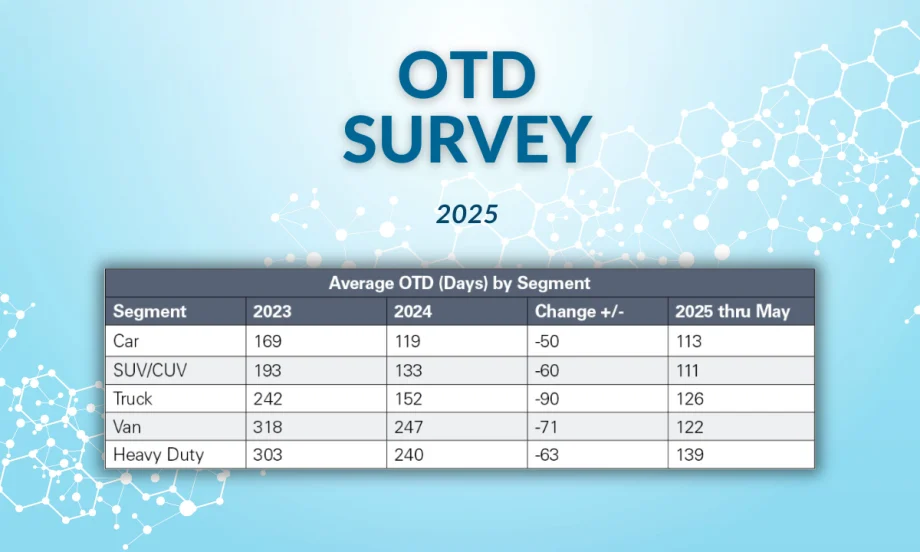
In 2025, both production lead time and transportation time are lower across nearly all vehicle segments compared to post-pandemic years.
4 min to read
Fleet operators are finally catching a break in 2025 — at least compared to the worst of the pandemic-era chaos.
Order-to-delivery (OTD) times have improved dramatically in 2025 compared to the supply chain disruptions of just a few years ago. According to newly compiled data from Enterprise Fleet Management, Holman, and Mike Albert Fleet Solutions, OTD averages across all major fleet vehicle categories continue to decline. Yet there are signs that the pace of improvement may be slowing.
These are some of the findings from Automotive Fleet’s 2025 OTD survey, returning for the first time since 2021.
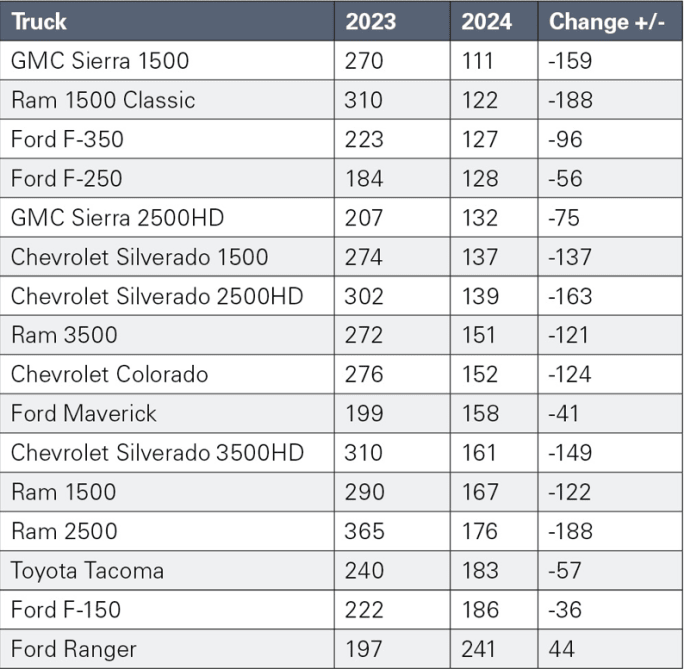
Heavy-duty and full-size pickups rebounded faster than mid-size trucks.
OTD Trends Positive
“Throughout 2024 and early 2025, overall order-to-delivery times have continued to trend in the right direction,” said Patrick Doyle, director of supply chain solutions at Holman. “Both production lead time and transportation time are lower across nearly all vehicle segments.”
Doyle remains cautiously optimistic: “Given current supply chain conditions, Holman anticipates this trend will continue to gain momentum throughout the remainder of the year and early indications point to further improvements to OTD times in 2026.”
Mike Albert reported that order-to-delivery (OTD) times decreased from 18 weeks in 2024 to 15 weeks in 2025 to date. Pickups and vans are running longer at 20 weeks, while OTDs for cars and SUVs have decreased, according to Jason Kraus, VP of operations.
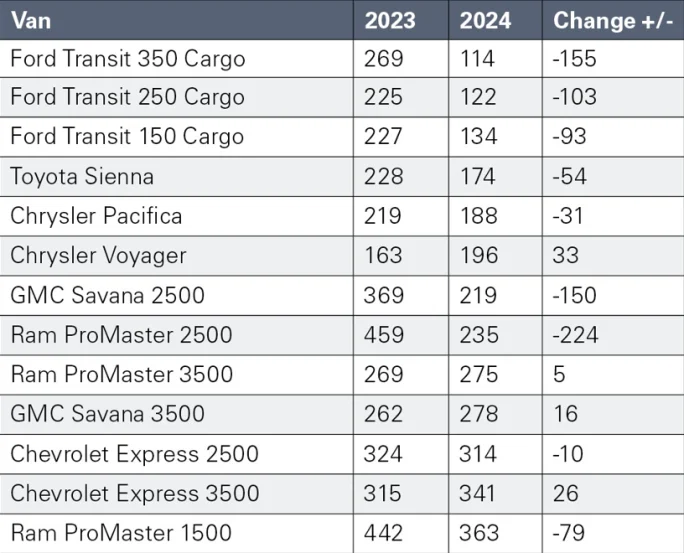
While most van models improved, a few are still lagging, especially those with lower volume or heavier upfitting demands.
Lingering Risks
However, Kraus noted that further improvements in OTD are unlikely this year based on the potential impact of tariffs on the automotive supply chain.
While parts availability remains a constraint, “these instances are limited on a model and option basis and not constant across all manufacturers,” he said.
Doyle also warned of lingering risk: “The automotive supply chain is extremely complex, relying on a multitude of factors to flow seamlessly, and even minor disruptions could quickly result in unexpected delays.”
Doyle highlighted upfitting and logistics as areas of focus. During the last 12-18 months, he said, the average upfit lead time has decreased from four to five months to much closer to three months, with an additional month for post-production transportation in most scenarios.
On upfitting delays, Kraus observed, “We have seen encouraging signs of recovery in upfitting operations year over year since 2022. It appears that the backlog that once plagued production lines has eased significantly.” He added that 85% of upfit units were completed early or on time recently.
“Clients have been adjusting specifications to components like wheels on ½-ton, ¾-ton and 1-ton pickups to achieve faster production dates,” he said.
Would fleets still make use of bailment pools? “OTDs in general have been decreasing, meaning that there is overall less interest in pool/stock vehicles, which were valuable previously due to their immediate availability,” Kraus said.
“While some clients like the immediacy of pool units,” he said, “the limitations on spec and upfit flexibility mean they will never be as popular as they were pre-pandemic.”
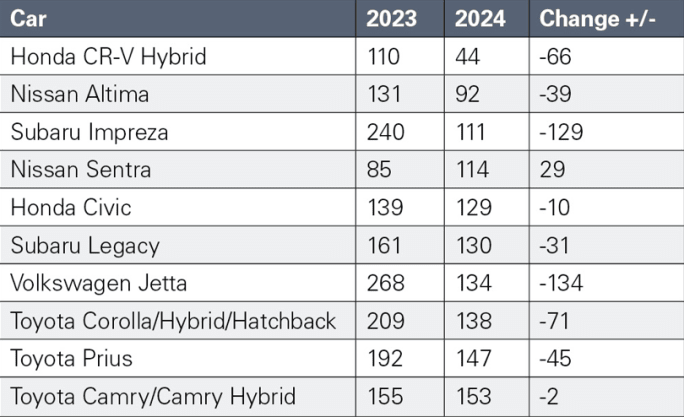
While sedans generally improved, Sentra and Camry suggest that production cycles or allocation changes may be at play, along with increased demand.
Planning Ahead in a Shifting Landscape
Holman advises customers to plan for four- to six-month lead times for factory orders without upfitting, and a minimum of eight to twelve months for upfit units.
Compared to 2021, when chip shortages and labor issues sent OTD times soaring, 2025 marks a significant recovery. But with new variables such as tariffs and evolving transportation logistics, fleets must remain agile and informed.
In analyzing OTD issues in 2020, the heart of the pandemic, an expert from Mike Albert said, “The COVID-19 pandemic just made OTD worse with some models taking five to six months or more to be delivered.”
That observation seemed alarmist back then, though fairly standard today.
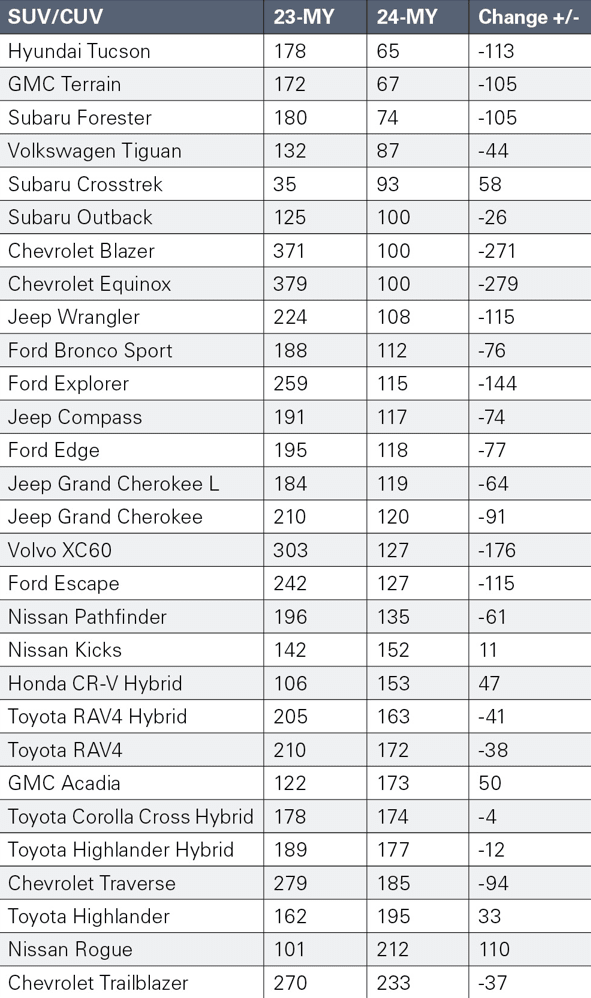
The majority of SUVs/CUVs saw big OTD reductions from the 2023 to 2024 model year.
OTD Data Takeaways
Across all five segments, average OTD times decreased significantly from 2023 to 2024, reflecting recovery from supply chain constraints.
The most substantial improvement came in truck OTD (-90 days), followed by vans and heavy-duty segments, which historically have longer build cycles. While improving, car and SUV segments had smaller deltas, likely because they were already showing signs of stabilization in late 2023.
While most van models improved, a few are still lagging, especially those with lower volume or heavier upfitting demands.
Heavy-duty and full-size pickups rebounded faster than mid-size trucks. Ford Ranger was one of the few to rise (+44 days), and the F-150 showed only a modest 36-day improvement.
While the majority of SUVs/CUVs saw big OTD reductions, hybrids are experiencing longer lead times.
While sedans generally improved, Sentra and Camry suggest that production cycles or allocation changes may be at play, along with increased demand.
Consistency is returning across OTD timelines, but pockets of delay remain, especially for certain trims or powertrains (hybrids and high-upfit models).
With timelines stabilizing, clients are increasingly prioritizing factory builds over pool or stock purchases to control costs and spec flexibility.
Yet caution is still warranted: Tariff uncertainty, parts availability, and upfit lead times still pose risks, particularly for work trucks and complex builds.
Subscribe to Our Newsletter
More Operations

Here's When You Should Make an Exception to Fleet Policy
Fleet policies are designed to create consistency, but not every driver or situation fits neatly within standard rules.
Read More →
AI-Native or AI-Acquired: What Should Fleet Managers Look for in an AI Platform?
Six questions can help fleet managers look beyond AI marketing claims to evaluate integration, data access, and real-world operational performance.
Read More →
Sponsored•October 14, 2026
A buyer's guide to fleet management software in 2027
Buying fleet management software in 2027 means looking beyond features and price. As fleet operations, technology and expectations evolve, this guide explores what today’s fleet professionals should consider when choosing a system that can deliver value now and adapt to what comes next.
Read More →

What Will Shape the Next Era of Fleet Management?
EVs, AI, and autonomous vehicles are reshaping fleet management. Discover what’s ahead—and how fleet leaders can prepare for the next era.
Read More →
How Fleets Can Recruit and Train Veterans for Technician Roles
Here's how the technician shortage has affected uptime for fleets, and what to do about it.
Read More →
Avis Budget Group Deploys Neology Toll Management Technology Across Major Brands
Neology’s neoFleet platform will manage toll transactions and toll-authority operations for vehicles across Avis, Budget, Payless, Budget Truck and Zipcar.
Read More →
Fleet Personal-Use Charges Edge Higher in 2026
Nearly eight in 10 surveyed fleets allow personal use of company vehicles, while just over half of respondents report charging employees for the privilege.
Read More →
The Future of Fleet + What’s Changing Right Now | AF News Recap
Could developments overseas offer a preview of what’s coming for U.S. fleets? This week, we’re looking at the future of AI, autonomy, and electrification, plus Ford Pro’s new certified pre-owned program, smarter vehicle offboarding, and a new way for fleets to manage toll expenses.
Read More →
How to Handle Vehicle Offboarding
What do fleet managers need to do when a driver leaves?
Read More →
Sponsored•October 1, 2026
Fleet Manager’s Ultimate Playbook: Navigating the New Standard in OEM Connectivity
Rising operating costs, driver safety concerns, and unplanned downtime are putting unprecedented pressure on modern fleets. Discover how fleet managers use embedded OEM connectivity and real-time vehicle data to cut TCO, prevent downtime, and protect drivers without aftermarket telematics hardware.
Read More →