




Improving Order-to-Delivery Times: You Want That Truck When?
When it comes time to acquire a new truck, small fleets need it "yesterday." Here are seven tips to help shorten the order-to-delivery process.
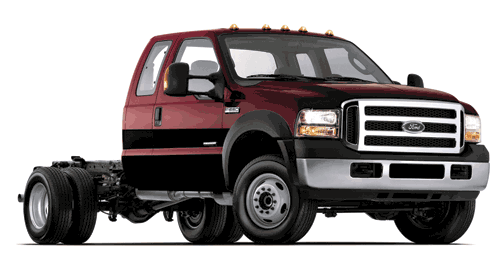
For commercial trucks, use body company truck pools if possible.
Photo: Ford Motor Co.
Is it time to order your new work truck? Concerned about order-to-delivery times? Check out these seven tips:
The end user should plan at least 90 days in advance of when a vehicle is needed. Some advanced planning by the end user will save hundreds and maybe thousands of dollars in acquisition costs by not having to buy a vehicle out of stock instead of using a factory order.
Have the dealer or fleet management company check the manufacturer's downtime at the plant. This can be invisible to the end user, but can add weeks to the total delivery time.
Before ordering a specific model, have the dealer or fleet management company double-check with the manufacturer to see if any options or standard components are on hold or in short supply. This can hold up an order for weeks or months.
For commercial trucks, use body company truck pools if possible. The fact that the truck is sitting on the ground and in stock at the body company can save eight to 12 weeks alone on total delivery time.
Use the vehicle manufacturer's vehicle pools if possible. One of the best-kept secrets is that both Ford and GM have pool vehicle access for select cars.
Make sure the dealer or fleet management company sends a purchase order immediately to the body company for any upfit that will be installed on a factory-ordered vehicle. They should tell the body company the approximate delivery date so that the body company can get the equipment ordered before the truck arrives. This alone will save many weeks or months.
Whenever possible, have truck equipment installed by a truck body company close to the delivering dealer. Though factory ship-thru systems are extremely convenient, placing a truck back into shipping traffic can add a week or two to the shipping time, especially for medium-duty units. In this way a truck can be upfit after it arrives at the end destination and doesn't need to be re-shipped. This works best with smaller orders of one to 10 units.
Glossary of Ordering and Shipping Terms
Bailment pool: A "pool" or inventory of already-built vehicles on consignment at body companies, awaiting sale and upfit by dealers or leasing companies.
Body company: A fabricator that manufactures and installs special equipment for vehicles. Also the location where a vehicle is shipped to be upfit with equipment not installed at the factory.
Completed vehicle: A fully manufactured truck, including the chassis, body and usable cargo area.
Factory order: A new vehicle order placed directly with the manufacturer by the dealer or leasing company to meet the user's exact specifications.
Incomplete vehicle: Vehicle chassis that is completed by adding specialized equipment.
Lead time: The anticipated length of time between an order's placement and delivery.
Ship Thru: The process of shipping a vehicle from the manufacturer to a body company for equipment installation. The completed vehicle is returned to the manufacturer and then sent to the delivering dealer.
Ship To: The vehicle is shipped from the manufacturer to a body company. The completed vehicle is then transported directly to the delivering dealer or customer location.
Upfitting: The addition of equipment on a vehicle not installed by the manufacturer.
Originally posted on Work Truck Online
More Vehicle Research

EV Realty Names Henrik Holland President as Charging Platform Expands
The former Prologis Mobility and Shell executive will help expand EV Realty’s truck charging business and move its power-first infrastructure model into autonomous vehicle depots and other fleet sectors.
Read More →
Mercedes-Benz Introduces Electric GLC With Up to 350 Miles of Range
The GLC 400 4MATIC Electric features an 800-volt architecture, 330-kW DC fast charging and a 94-kWh battery, along with Mercedes-Benz's new MB.OS operating system.
Read More →
Fleet Has a Talent Pipeline Problem, not a Talent Problem
Where will the next generation of fleet leaders come from, and what does the industry need to do differently to find them?
Read More →
Fleet Hacks: What Are You Still Doing Manually?
From daily recaps to repeatable workflows, fleet professionals share how AI can cut through busywork while keeping human judgment at the center.
Read More →
How One Fleet Manager Put a New Spin on Safety Training
Joe Lewis turned a pre-trip inspection lesson into an AI-assisted song, then four safety albums. The experiment also revealed why human oversight matters when AI enters driver training.
Read More →
2027 Ram ProMaster City Starts Under $40K
Ram is returning to the smaller commercial van market with a new ProMaster City aimed at delivery, service, trade, and passenger applications. Starting at $39,995 with destination, the 2027 van offers up to 2,000 pounds of towing capacity, more than 2,000 pounds of payload, and multiple cargo and passenger configurations.
Read More →
New Tariff Threats & a Leadership Change at Wheels | AF News Recap
A new tariff threat is creating more uncertainty for fleet ordering, Wheels has named a new president, and we’re asking whether certification is really worth the investment.
Read More →
Certification: What’s in It for the Fleet Manager?
From smarter fleet decisions to stronger career credibility, certification can give fleet managers knowledge they may never gain inside a single operation.
Read More →
Wheels Names Matthew Cole President
Cole brings more than 30 years of automotive and technology experience to the fleet management company, including leadership roles at Aptiv, Visteon and Johnson Controls.
Read More →
AI is changing what fleet managers can build & 849,000 vehicles recalled | AF News Recap
Fleet managers are learning how to build their own AI-powered tools, Stellantis is recalling nearly 849,000 vehicles, and this year’s Fleet Manager of the Year finalists have been revealed. Additionally, we’re examining how to identify repairs that warrant a second look. Here’s what you need to know this week.
Read More →