The Insurance Institute of Highway Safety (IIHS) has raised the bar on frontal crash protection with a fifth safety test. Vehicles that perform well in all five categories can now earn a higher level of recognition: Top Safety Pick+.
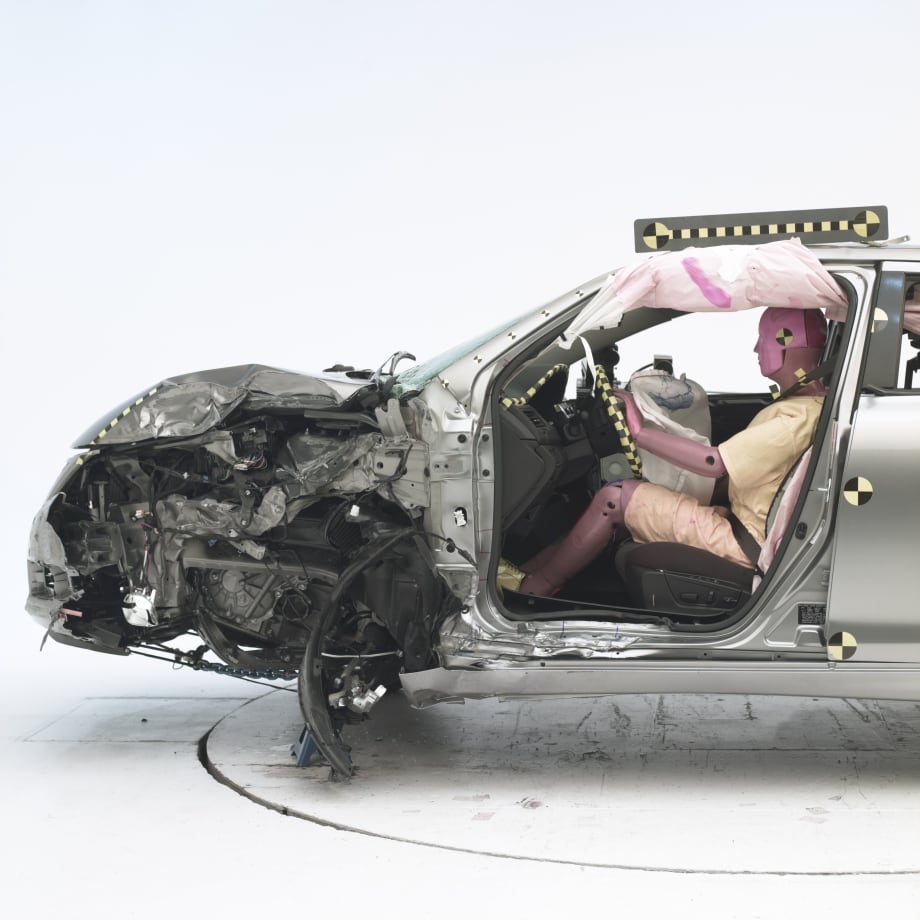
The dummy’s position in relation to the door frame, steering wheel, and instrument panel after the new small overlap frontal test indicates that the driver’s survival space was maintained reasonably well, according to the IIHS.
5 min to read
The dummy’s position in relation to the door frame, steering wheel, and instrument panel after the new small overlap frontal test indicates that the driver’s survival space was maintained reasonably well, according to the IIHS.
At a Glance
Earning a Top Safety Pick+ designation means a vehicle has excelled in these five IIHS crast test categories:
Ad Loading...
● Moderate overlap frontal: Assesses occupant protection and vehicle’s structural designs when part of the front crumple zone is engaged.
Ad Loading...
● Small overlap frontal: Assesses occupant protection and vehicle’s structural designs when most of the front crumple zone is bypassed.
● Side: Assesses occupant protection when vehicle is struck in the side by an SUV or pickup.
● Rollover: Assesses vehicle roof strength for protection in rollover crashes.
● Rear: Focuses on how well seat/head restraint combinations protect against whiplash injuries.
The bar has been raised for the Top Vehicle Safety Pick designation. New for 2013, vehicles that excel in the Insurance Institute for Highway Safety (IIHS)’s new small overlap test — in addition to earning good ratings in the Institute’s four other safety tests — will earn Top Safety Pick+ status. The addition of this test has already prompted automakers to make design changes to meet the new requirements, and will likely reduce head, chest, leg, and foot injuries.
Ad Loading...
The Next Step in Improving Frontal Crash Protection
According to a 2009 IIHS study of vehicles with good ratings for frontal crash protection, small overlap crashes accounted for nearly a quarter of frontal crashes involving serious or fatal injury to front seat, belted occupants. These results prompted the addition of the new test and Top Safety Pick+ designation.
Currently, vehicles are rated based on four safety tests: moderate overlap frontal, side impact, rollover/roof strength, and a rear impact test to evaluate whiplash protection. The new small overlap frontal test adds another dimension to safety testing in frontal crashes. This test is designed to replicate what happens when the front corner of a car collides with another vehicle or object, such as a tree or pole.
In moderate overlap frontal tests, 40 percent of the total width of a vehicle strikes a barrier on the driver’s side. In the small overlap test, just 25 percent of a car’s front end on the driver side strikes a 5-foot-tall rigid barrier at 40 mph.
“Nearly every new car performs well in other frontal crash tests conducted by the Institute and the federal government, but we still see more than 10,000 deaths in frontal crashes each year. Small overlap crashes are a major source of these fatalities,” said Adrian Lund, IIHS president. “The new small overlap test program is based on years of analyzing real-world frontal crashes and then replicating them in our crash test facility to determine how people are being seriously injured and how cars can be designed to protect them better. We think this is the next step in improving frontal crash protection.”
[PAGEBREAK]
Ad Loading...
Preventing Serious Injuries
Most modern cars have safety cages built to withstand head-on collisions and moderate overlap frontal crashes without serious damage. But, because small overlap crashes mainly affect a car’s outer edges that aren’t well protected by crush-zone structures, serious leg and foot injuries can result.
Head and chest injuries can result, too. In small overlap frontal crashes, seat belts and air bags are especially taxed.
“When cars strike the test barrier, they tend to move sideways away from it, and the interior structures — including the driver door, side window, and A-pillar — move in the same direction,” Lund said. “The test dummy, however, keeps moving forward into the path of the sideways-moving interior structures. At the same time, the steering column and driver air bag move inboard in many vehicles because of the way the front end and occupant compartment deform. If the dummy misses the air bag or slides off it, the head and chest are unprotected.”
Even though front air bags deploy in small overlap crashes, side air bags may not. Because they are designed mainly for true side impacts, such as so-called “T-bone” crashes at intersections, they don’t always inflate early enough or extend far enough forward to provide enough protection.
“The result is an air bag gray zone with gaps between what front air bags cover and what side air bags do — if they deploy at all,” Lund said. Without air bag protection, people involved in small overlap frontal crashes can sustain head and chest injuries.
Ad Loading...
“Vehicles are safer than ever. There is no question that people are walking away from serious crashes today when they wouldn’t have 10 years ago,” Lund said. “But, IIHS research of real-world crashes indicates that small overlap crashes are a significant source of the serious injuries and deaths that still occur in frontal crashes. The new small overlap test will make future vehicles even safer.”
Lund noted that automakers are already making changes to meet the Institute’s new small overlap requirements. These changes include extending crash structures further into the corners of vehicles and stiffening occupant compartments to resist intrusion.
“Automakers have largely been positive about the new test, indicating they plan to make changes to meet this new challenge,” Lund said. “Engineers at some manufacturers have indicated they are adjusting air bag algorithms to deploy side air bags in small overlap frontal crashes.”
More Requirements on the Horizon
The new small overlap test will not be the last advancement in Top Safety Pick+ requirements; the Institute plans to tighten the requirements further in the future. For example, vehicles may be required to have crash-avoidance systems, which research indicates can prevent crashes from happening in the first place.
“The Institute is studying the real-world effectiveness of some of these features to see which ones are working and which ones aren’t to prevent crashes,” Lund said. “The Institute is raising the bar. People who are looking for vehicles that afford the best overall crash protection should look for those earning the IIHS Top Safety Pick+ designation.”
Rising operating costs, driver safety concerns, and unplanned downtime are putting unprecedented pressure on modern fleets. Discover how fleet managers use embedded OEM connectivity and real-time vehicle data to cut TCO, prevent downtime, and protect drivers without aftermarket telematics hardware.
Mental health belongs in the fleet safety conversation. This week, we’re looking at five ways fleets can support employee well-being before a crisis, plus Holman’s expansion in Mexico, new one-day Fleet Forward passes, and why EV charging demand is outpacing infrastructure growth.
Stefan Heck tells Automotive Fleet that combining more than 10 billion miles of driving history with Nexar's AI models will give fleets deeper insights into driver risk and roadway conditions than either company could provide independently.
Insights from a commercial insurance carrier and a broker show how fleets can turn video telematic data, driver coaching, and improved claims results into a stronger case at insurance renewal.
Fleet compliance isn't just about having policies — it's about consistently enforcing them. This practical guide reveals six hidden compliance risks common in public sector and shared fleet operations and outlines proven strategies to improve visibility, accountability, and audit readiness
The Sept. 15–17 program will feature fleet benchmarking data, case studies, emerging technologies, and implementation strategies while running alongside the NSC Safety Congress & Expo.