




How to 'Right Spec' Your Trucks and Vans
Downsizing to a smaller truck or van can improve your total cost — if you can afford the downgrade in capabilities.

We've all heard the word "downsize" a bit too much in the past year. Mostly, it's in reference to a friend or family member losing a job. But it's also relevant to our new environmental consciousness and using only as much as we need.
This holds true for fleets: In addition to reducing our carbon footprint, high gas prices have caused fleets to take a harder look at spec'ing trucks and vans for the job.
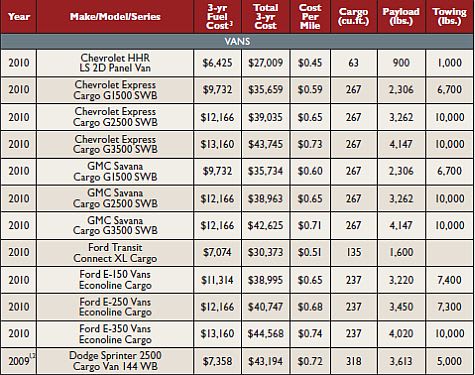
With the help of the lifecycle analysis experts at Vincentric, we have performed a hard-numbers analysis to aid in your vehicle spec. Vincentric has calculated lifecycle costs for common light-duty truck and van models in different weight classes.
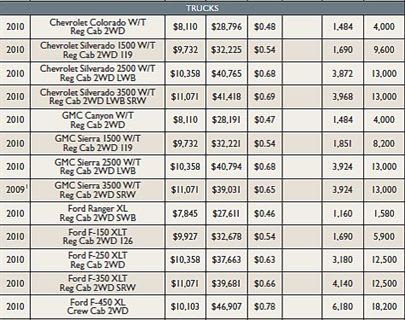
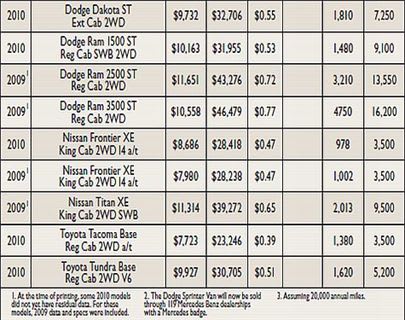
We have included cargo, payload and towing capacities for each model. With a comparison to lifecycle costs, you can estimate how much you'll be outlaying - or saving - by moving into a different weight class or model.
Vincentric calculates nine factors in its lifecycle analysis: estimated cap cost, depreciation, fees and taxes, fuel, maintenance, repairs, insurance, financing and opportunity cost. Vincentric calculated total costs for each model after three years, as well as cents per mile. We have broken out total estimated fuel cost to highlight how downsizing can save in fuel expense.
We have made our best attempt at apples-to-apples comparisons, though capacities and lifecycle costs vary, even within weight classes.
Cost Savings for Downsizing
Almost all models in this analysis realize an overall cost savings when moving to a smaller weight class.
Downsizing from a 1-ton (350/3500) pickup to a ¾-ton (250/2500) pickup can save 1 cent (GM products) to 5 cents per mile (Dodge Ram)
Downsizing from a ¾-ton pickup to a ½-ton (150/1500) pickup can save 8 cents (Dodge Ram) to 14 cents per mile (GM and Ford)
Downsizing from a ½-ton pickup to a compact pickup can save 6 cents (Chevrolet) to 18 cents per mile (Nissan)
Downsizing from a 1-ton van to a ¾-ton van can save 6 cents (Ford and GMC) to 8 cents (Chevrolet)
Downsizing from a ¾-ton van to a ½-ton van can save 3 cents (Ford) to 6 cents (Chevrolet)
Downsizing from a ½-ton van to a smaller cargo vehicle (Express 1500 vs. HHR or E-150 vs. Transit Connect) saves 14 cents.
[PAGEBREAK]
Does It Make Sense for You?
However, is the savings enough to warrant a switch to a smaller vehicle? For spec'ing purposes, can you afford to give up cargo room, payload capacity and towing capacity to realize these savings?
You'll save in overall lifecycle costs by moving down from 1-ton and ¾-ton models into a half-ton model. However, you'd better make sure your payload and towing capacity needs fit the smaller truck. By moving from a Silverado 2500 down to a 1500, you'd save about 20 percent in total cost over three years. However, you'd lose more than half (58 percent) of your payload capacity and 27 percent in towing capacity.
Cargo volume enters the equation when considering cargo vans. Do you need space, but not require a heavy payload capacity? A move up in weight class will get you more payload and towing capacity, though cargo volumes on Ford E-Series vans and Chevy/GMC vans stays the same.
Consider cargo volume and payload capacity needs carefully: The difference in total lifecycle costs from a half-ton to a 1-ton van model is as much as $8,000 over three years.
On the light-duty end, Ford's new Transit Connect van works well with tasks that require some space but a lighter payload, combined with very good fuel costs and total costs. Businesses such as dry cleaners, bakers and florists fall into this category.
Can You Downsize?
When you look at the clutter in the back of one of your trucks, it may not seem possible to downsize. But how much of what you see is exactly that, clutter? Is all of it essential to your drivers' daily jobs? Your trucks don't have to be "rolling warehouses," ready for every unexpected job variation.
Understand the 80-15-5 rule: How much capacity will the truck or van need to tow or haul 80 percent of the time, 15 percent of the time and 5 percent of the time? In most cases, the vehicle should be spec'd to meet the 80 percent requirement.
Under spec'ing may not initially reveal problems, though overtaxing your vehicles' components will increase maintenance costs in the long run.
From a safety perspective, regularly pushing the limits on your max tow rating can result in loss of control of the vehicle. And from a business outlook, can you accommodate a growth in your business with your present vehicles, or will you have to fleet up?
"Right spec'ing" your vehicles more precisely to your task should be a project undertaken every time you turn your fleet. Just make sure weighing total costs versus capabilities is part of the equation.
[PAGEBREAK]
Originally posted on Work Truck Online
More Articles
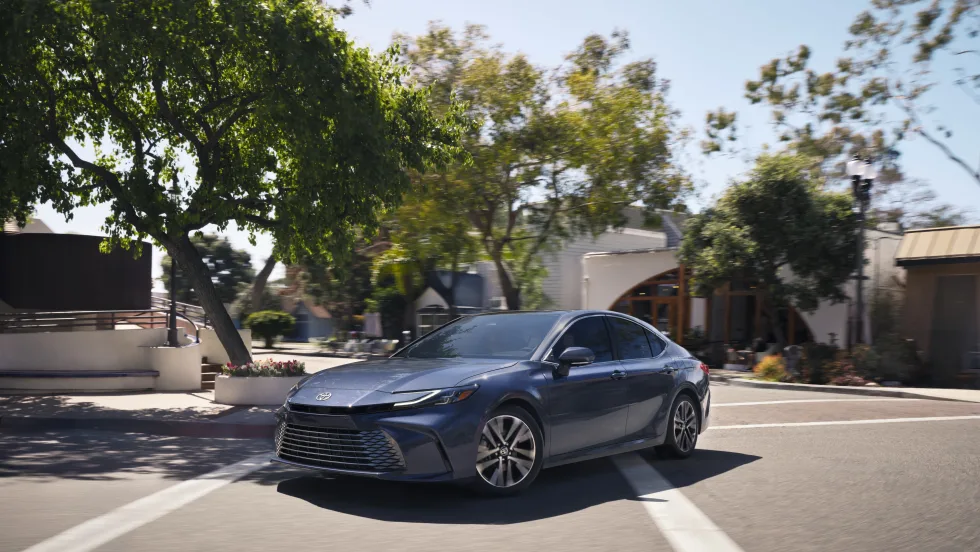
2027 Toyota Camry Offers Hybrid Powertrain Across Five Grades
The 2027 Toyota Camry is a carryover with new pricing.
Read More →
Chevrolet Updates 2027 Trax and Trailblazer with More Standard Safety Features
Chevrolet is updating two of its smallest SUVs with added driver-assistance technology, redesigned interiors, and revised trim options. The changes could add more safety equipment as standard for commercial fleets, while a new Trailblazer configuration adds another all-wheel-drive option.
Read More →
What’s Next for Fleet? Safety, AI & Industry Recognition | AF News Recap
Could your company's culture be encouraging distracted driving? This week, we're exploring how workplace expectations affect driver safety, what AI, EVs, and autonomous vehicles could mean for the future of fleet management, and how fleet professionals can strengthen their award nominations.
Read More →



A buyer's guide to fleet management software in 2027
Buying fleet management software in 2027 means looking beyond features and price. As fleet operations, technology and expectations evolve, this guide explores what today’s fleet professionals should consider when choosing a system that can deliver value now and adapt to what comes next.
Read More →
Does Your Fleet's Culture Encourage Distracted Driving?
What happens when the people responsible for enforcing safety rules are the ones setting the wrong example? The answer may reveal why some of the biggest risks to fleet drivers have little to do with what's written in the employee handbook.
Read More →
What Will Shape the Next Era of Fleet Management?
EVs, AI, and autonomous vehicles are reshaping fleet management. Discover what’s ahead—and how fleet leaders can prepare for the next era.
Read More →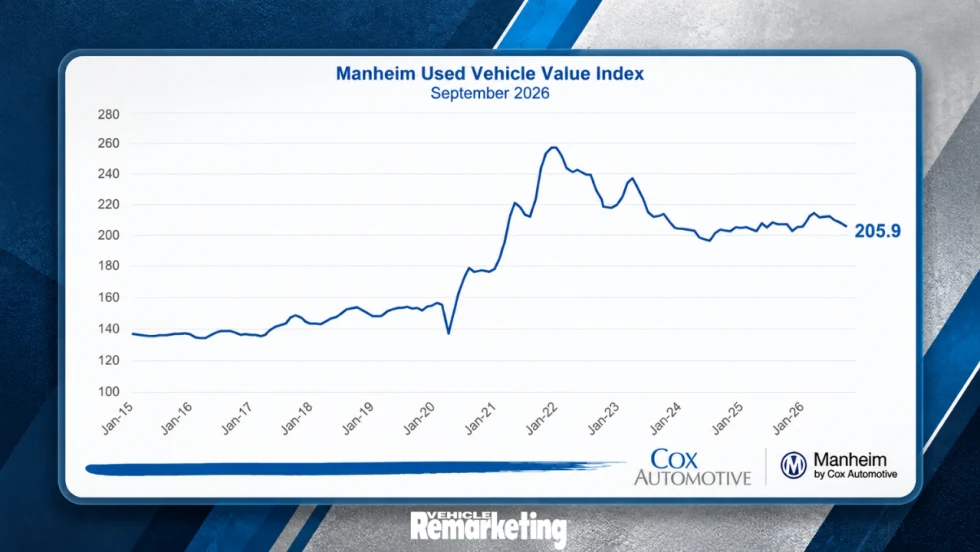
Wholesale Used-Vehicle Values Fall as Cox Automotive Cuts 2026 Forecast
Wholesale used-vehicle prices declined in September as depreciation accelerated, prompting Cox Automotive to lower its year-end forecast.
Read More →
FLD Promotes Three Executives in Leadership Changes
FLD has promoted three longtime executives, naming Gary Mott CEO, Richard Mallek president, and Ron Sanders managing partner.
Read More →
How Fleets Can Recruit and Train Veterans for Technician Roles
Here's how the technician shortage has affected uptime for fleets, and what to do about it.
Read More →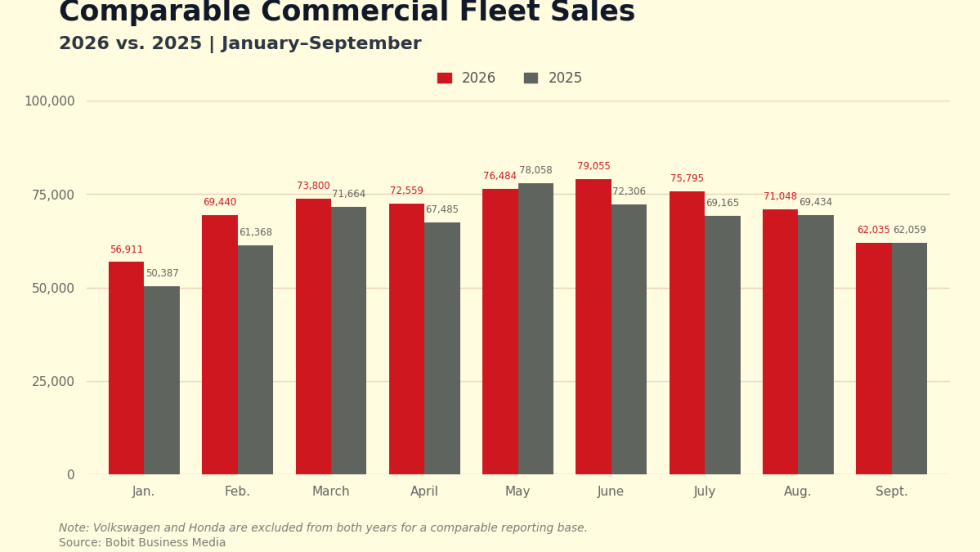
Commercial Fleet Sales Rise 5.8% Through September 2026
September commercial fleet sales were essentially unchanged from a year earlier, slowing year-to-date growth while keeping volume ahead of 2025.
Read More →