




Developing a Driverless Vehicle
Google and a growing number of automakers are making big bets that self-driving vehicle technology is the future of transportation and have been incorporating various levels of autonomous driving capabilities in their latest products.

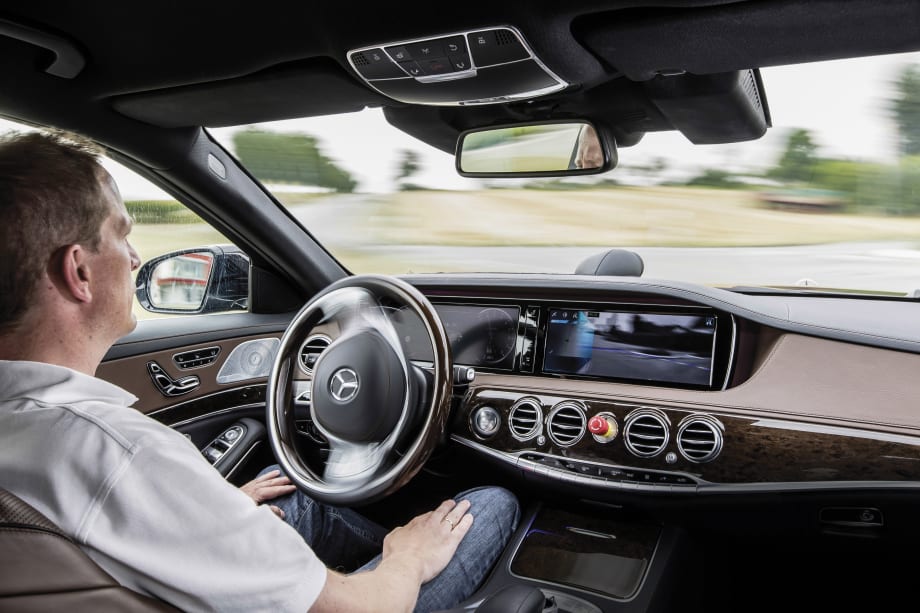
Photo courtesy of Daimler.
Photo courtesy of Daimler.
Imagine a crash-free society, where human error is taken out of the driving equation. Vehicles would function as robots, equipped with lasers, radar, camera sensors, and GPS systems. They would travel from Point A to Point B with a near-zero chance of a collision with other vehicles, pedestrians crossing the street, or deer startled by headlights.
Seem far-fetched? Technology giant Google, which has logged nearly 700,000 miles in its small fleet of autonomous Prius hybrids, and a growing number of automakers are making big bets that this technology is the future of transportation and have been incorporating various levels of autonomous driving capabilities in their latest products, with street-legal self-driving cars to be launched within the next decade or so.
Many of the building blocks for autonomous driving are already in production. These advanced driver assistance systems (ADAS) include adaptive cruise control (which automatically adjusts cruising speed based on traffic flow ahead of the vehicle), blind spot detection (which warns the driver when there are nearby vehicles that can't be seen by the sideview mirror), emergency brake assist (which detects critical traffic situations and automatically applies braking when needed), and lane departure warning (alerting the driver before the vehicle is about to leave the lane).
Mercedes-Benz and Nissan both expect to be selling fully autonomous vehicles by 2020. Tesla, the luxury electric vehicle (EV) manufacturer, said the company expects to bring to market a vehicle with 90-percent autonomous capabilities by 2016. Tesla's systems would allow drivers to turn on a form of "auto-pilot," similar to those used in commercial airlines, to handle the bulk of the driving duties on a given commute.
Audi, BMW, Ford, GM, and Volvo are also working on developing vehicles with self-driving capabilities within the next decade.
Navigant Research forecasts global annual sales of autonomous vehicles to reach more than 95 million units annually, representing 75 percent of all light-duty vehicle sales, by 2035.
"Fully autonomous vehicles are unlikely to reach the market suddenly," said David Alexander, senior research analyst with Navigant Research. "Instead, it will be a more gradual process, where more capable systems that can assume control of certain aspects of driving will be introduced over time. The first features will most likely be self-parking, traffic jam assistance, and freeway cruising — well-defined situations that lend themselves to control by upgraded versions of today's onboard systems."
Varying the Levels of Autonomy
The prediction by Navigant Research of 95 million autonomous vehicles sold annually by 2035 refers to Level 3 and Level 4 self-driving vehicles.
To provide guidance to states considering legislation that permits operation of self-driving vehicles, the National Highway Traffic Safety Administration (NHTSA) provides this framework, categorizing vehicle "autonomy" based on four levels, from vehicles equipped with minimal automation, to those that offer full self-driving capabilities:
Level 1 — Function-Specific Automation: Involves one or more specific control functions, such as electronic stability control or pre-charged brakes, where the vehicle automatically assists with braking to enable the driver to regain control of the vehicle or stop faster than possible by acting alone.
Level 2 — Combined Function Automation: Involves automation of at least two primary control functions designed to work in unison to relieve the driver of control of those tasks, such as combining adaptive cruise control and lane centering capabilities.
Level 3 — Limited Self-Driving Automation: Enables the driver to relinquish full control of all safety-critical functions under certain traffic or environmental conditions, relying heavily on the vehicle to monitor for changes in those conditions and requiring a safe transition back to driver control, when necessary.
Level 4 — Full Self-Driving Automation: The vehicle is designed to perform all safety-critical driving functions and monitor roadway conditions for an entire trip. The driver provides destination or navigation input, but is not expected to be available for control at any time during the trip. This includes both occupied and unoccupied vehicles.
Possible Impact on Fleet
If Navigant's prediction is accurate, and autonomous vehicles comprise the majority of new vehicles on the road within the next 20 years, the impact on the fleets in the future are numerous:
1. Increased Safety
According to NHTSA, 33,561 people were killed in motor vehicle crashes in the U.S. in 2012; up by 1,082 fatalities over 2011. Considering that 90 percent of all accidents in the U.S. are caused by human error, according to the Network of Employers for Traffic Safety (NETS), removing the driver from the vehicle operation equation could eliminate the possibility of accident-causing variables to make cars safer, say proponents of autonomous vehicles.
And, that could save employers a lot of money. NHTSA estimates the average on-the-job crash costs an employer about $16,500 or just under $0.16 per mile driven. Crashes involving injuries cost substantially more — $504,408 for a fatal injury and $73,750 for a nonfatal injury.
2. Potential for Fuel-Efficiency Gains
Some believe that, due to the reduced crash risk of autonomous vehicles, automakers could take more weight out of their vehicles (because fewer crash safety components would be required), and thus, make them more fuel efficient.
"Once you have self-driving vehicles that have sensors on them so they don't crash into things, you can actually make the vehicles themselves much lighter. And, when you have a much lighter vehicle, the vehicle can go a lot further on a battery (for an EV) or tank of fuel," said Alexander of Navigant.
3. Enhanced Productivity
According to the U.S. Department of Commerce, the average commute time is 25 minutes each way — just under an hour per day. If that time could be used for conference calls, answering e-mails, or crafting a proposal, without the risk of accident or injury, what an employee could accomplish in between stops or job sites would grow exponentially.
Consider how a long-haul delivery truck fleet could benefit from self-driving technologies.
"In the near term, you won't be able to load up a truck and send it on its way — on its own. But, once the truck is on the freeway, it will be able to use automated long-distance driving capability, enabling both safer and easier driving," Alexander said. "It will still need a driver on board to pilot the truck, at least for the foreseeable future. But, the idea is that as the technology becomes more sophisticated and more reliable, the driver will have less and less to do and can do other things, including sleep, while the truck takes care of the driving duties."
4. Building a Fleet on Demand
The concept of autonomous vehicles could mean fleets could reduce their ownership of vehicles to a core set of service vehicles, acquiring others "on-demand," such as delivery fleets. With a few swipes on a smartphone app, a fleet manager could schedule three vehicles to arrive the next day at 5 a.m. and, when done, the trucks would go back to base or be redeployed to other clients.
Exploring the Challenges
Despite the fact that most of the technology required for driverless vehicles to work already exists, legislative and psychological barriers still stand in the way of widespread adoption.
Sure, to err is human. But, who hasn't experienced a computer operating system "crash"? While the Google autonomous cars have logged hundreds of thousands of miles in California and Nevada without major incident, the big question mark is what will happen when millions of these robotic cars are operating in different climates and road conditions. Today, Google is focusing on mastering city street driving to take into consideration the numerous objects moving around a vehicle at any point in time.
Also, if a robot-driven car breaks the law or gets into an accident, who is responsible?
"There's going to be quite a legal shake-out in regards to liability," said Art Liggio, president of Driving Dynamics, a driver safety training and fleet risk management company. "Who's at fault when a crash occurs with a technology advanced vehicle — the operator, the vehicle manufacturer, or the collision avoidance software programmers? New legislation will need to be passed to control this 'lawsuit free-for-all' before any of this becomes a real-world model."
Alexander of Navigant agreed. "If you have an autonomous vehicle that crashes into something and kills someone, that's going to push the industry back decades potentially. And, the strange thing is that every year in the U.S. more than 30,000 people die from car accidents driven by people. But, one autonomous vehicle involved in a fatal crash — and that could push adoption back for years."
More Safety

Does Your Fleet's Culture Encourage Distracted Driving?
What happens when the people responsible for enforcing safety rules are the ones setting the wrong example? The answer may reveal why some of the biggest risks to fleet drivers have little to do with what's written in the employee handbook.
Read More →
Fleet Manager’s Ultimate Playbook: Navigating the New Standard in OEM Connectivity
Rising operating costs, driver safety concerns, and unplanned downtime are putting unprecedented pressure on modern fleets. Discover how fleet managers use embedded OEM connectivity and real-time vehicle data to cut TCO, prevent downtime, and protect drivers without aftermarket telematics hardware.
Read More →
From Driver Well-Being to EV Charging | AF News Recap
Mental health belongs in the fleet safety conversation. This week, we’re looking at five ways fleets can support employee well-being before a crisis, plus Holman’s expansion in Mexico, new one-day Fleet Forward passes, and why EV charging demand is outpacing infrastructure growth.
Read More →
Nexar-Nauto Merger Aims to Give Fleets Better Safety Intelligence Through Larger Driving Dataset
Stefan Heck tells Automotive Fleet that combining more than 10 billion miles of driving history with Nexar's AI models will give fleets deeper insights into driver risk and roadway conditions than either company could provide independently.
Read More →
Don't Wait for a Crisis: 5 Ways to Build Mental Health Into Your Fleet Safety Program
For Suicide Prevention Month, fleet and safety leaders have an opportunity to put mental health where it belongs: at the center of workplace safety.
Read More →
How Camera Data Can Strengthen a Fleet’s Insurance Renewal
Insights from a commercial insurance carrier and a broker show how fleets can turn video telematic data, driver coaching, and improved claims results into a stronger case at insurance renewal.
Read More →
The Safest Fleets Aren’t the Ones with the Most Technology
You’ve made the telematics investment. Here’s how to capture the other half of its value and build the safest fleet on the road.
Read More →
Hidden in Plain Sight: Fleet Compliance Risks
Fleet compliance isn't just about having policies — it's about consistently enforcing them. This practical guide reveals six hidden compliance risks common in public sector and shared fleet operations and outlines proven strategies to improve visibility, accountability, and audit readiness
Read More →
NETS Sets 2026 Fleet Safety Benchmark Conference for Indianapolis
The Sept. 15–17 program will feature fleet benchmarking data, case studies, emerging technologies, and implementation strategies while running alongside the NSC Safety Congress & Expo.
Read More →
Off-the-Job Crashes Account for 43% of Employers’ $61.7 Billion Crash Burden
NETS quantifies costs dispersed across fleet, risk, HR, and other departments while providing new per-crash benchmarks for employers.
Read More →