





Miss This? Auto Safety Experts Recommend Universal ADAS Terminology
C-V2X Technology Promises to Put a Dent in Collisions, Fatalities
Several tech innovators and automakers are leading the way in bringing cellular vehicle-to-everything technology to the next generation of cars, with the goal of reducing fatalities among all road users.
October 24, 2022
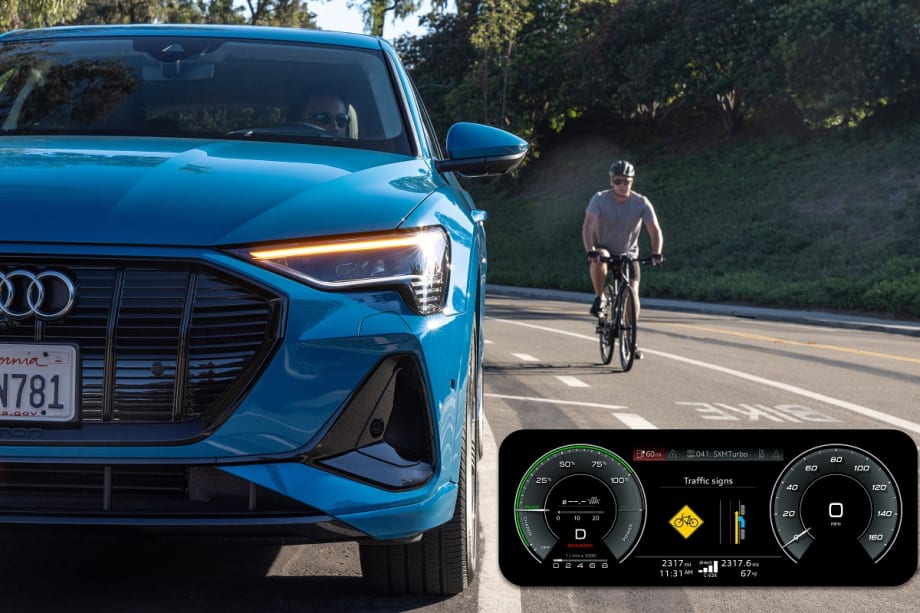
Audi vehicles equipped with C-V2X technology are being widely tested and are helping reduce cyclist injuries and fatalities. For example, the automaker’s Parallel Parking Departure Alert detects if a bicycle is approaching from behind when the driver is pulling out of its curbside spot.
Photo: Audi of America
7 min to read
Blind spots, curvy roads, poorly planned intersections. Any one of these can hide a motorist’s view of a pedestrian, bicyclist, or a hazardous roadway obstruction. Cellular vehicle-to-everything technology (C-V2X or CV2X) aims to reveal hidden perils on the highways and byways — but not only to the driver, and not in the manner you might expect.
Specifically, C-V2X is a wireless technology that allows vehicles to communicate directly with each other, with roadside infrastructure like traffic lights, and ultimately, with pedestrians, cyclists, construction workers, and more. Simply put, the technology supports information sharing to facilitate safety applications that enhance safety for virtually all road users — and in particular, vulnerable road users.
With cellular V2X technology, a car whose sensors or cameras detect a pothole will be able to notify their drivers, giving them time to maneuver and avoid that shocking bump that can make a driver lose control and cause a collision.
But the wonders of C-V2X technology don't end there. Likely later this decade, highway workers will be alerted to oncoming vehicles traveling too close, school bus drivers will be warned against letting children off if a nearby vehicle fails to stop, and bicyclists — as well as drivers — will be made aware of each other prior to possible collisions, reports The New York Times.
V2X: An Urgent Need
Fleet operators have heard the staggering statistics before. In 2020, U.S. traffic deaths reached an alarming 38,824 — the highest traffic fatality rate in two decades, according to the National Highway Traffic Safety Administration (NHTSA).
The newest projections indicate that traffic deaths may finally be declining — ever so slightly — for the first time since 2020. For the first half of 2022, NHTSA estimates 20,175 people died in motor vehicle traffic crashes, an increase of about 0.5%, compared to 20,070 fatalities NHTSA projected for the first half of 2021.
That said, NHTSA also projects that the second quarter of 2022, from April to June, had the first decline in fatalities after seven consecutive quarters of year-to-year increases in fatalities that began in the third quarter of 2020.
But while we may soon realize a tiny dip in overall fatalities, data indicates that deaths among vulnerable road users are climbing. In 2021, some 7,485 pedestrians were struck and killed by drivers in the U.S. — the most in a single year in four decades, according to a report from the Governor’s Highway Traffic Safety Administration (GHSA).
The roads are not safe for people on two wheels, either. In 2020, the most recent year for available data, some 938 bicyclists were killed in traffic crashes, according to NHTSA.
Safety experts agree, there are still far too many preventable traffic fatalities nationwide and every effort must be made to reduce collisions, injuries, and deaths.
Years ago, passive safety features like seatbelts led the way. These were followed by active safety systems such as lane departure warning, steering assist, and emergency stop. Now, automakers and technology companies are working to provide cooperative safety and C-V2X is chief among these new types of systems that offer life-saving potential.
The American Association of State Highway and Transportation Officials (AASHTO) Journal recently reported on a talk on the benefits of V2X (vehicle-to-everything technology) given by Jennifer Homendy, chair of the National Transportation Safety Board. She made it clear that V2X is vital to boosting safety for all who share the nation’s roads:
“V2X can improve safety for vulnerable road users by helping vehicles detect bicyclists, motorcyclists, and pedestrians,” Homendy said. “And in the future, even the other way around: by alerting road users to oncoming vehicles. The technology can help drivers navigate the road infrastructure more safely, such as making a left turn, merging, and crossing through an intersection. V2X technology can warn drivers to slow down in work zones, speed zones, and around dangerous curves, while dynamic speed harmonization recommends target speeds on roadways to reduce crashes.”
Who’s Developing the Technology & How C-V2X Works for the Auto Industry
Several companies are presently developing the hardware and software to support C-V2X communications for the auto industry. While some automakers are more deeply involved than others, technology companies are leading the way in research.
Major players in connected vehicle technology development and testing include Applied Information, Audi of America, Commsignia, and Qualcomm, for example.
Pilot deployments of C-V2X and V2V communications technology are being tested in the Atlanta, Georgia, suburbs, according to Future Car. The city of Alpharetta has already made its roads safer by deploying and testing C-V2X technology in pilots using school buses and the city's fire trucks.
For example, Qualcomm and partners outfitted fire trucks and school buses with C-V2X hardware that allows them to communicate with nearby roadside units (RSUs) as the vehicles approach busy intersections. The C-V2X communications technology is turning red lights at intersections to green as fire trucks or school buses approach to allow the vehicles to proceed uninterrupted, notes the report.
The C-V2X hardware installed on the bus interfaces communicates with roadside units installed at intersections that communicate with the approaching vehicles and control the operation of the traffic signals. Once the roadside units detect an approaching school bus or emergency vehicle, the traffic signal turns green and allows the vehicle to pass through unimpeded, according to Future Car.
Audi, too, has collaborated with the Virginia DOT and in Alpharetta.
The automaker’s tests feature vehicles that can communicate with school buses, highway workers, and cyclists. C-V2X test vehicles were able to detect stopped school buses, vehicles running a red light, construction workers in the roadway, and bicyclists in blind spots or attempting to turn in front of a turning vehicle, according to TheTimes report.
What’s more, those vehicles and people could, in turn, detect the C-V2X vehicle.
In a recent demonstration of the technology at Audi’s offices in California, a bicyclist equipped with a V2X sensor drove across the path of an Audi e-tron. Before the cyclist was visible to the driver, a warning sound and icon appeared on the instrument panel, giving the driver time to brake, reports The Times.
Audi believes its technology can enable drivers to recognize dangerous situations much sooner than if they were driving without these prompts. The automaker has demonstrated use cases aimed to benefit both drivers and road cyclists.
Connected vehicle and cellular vehicle to everything (C-V2X) technology is becoming increasingly important for the auto industry and safety efforts. One OEM making inroads in its tech is @Audi. Check out its Parallel Parking Departure Alert that detects approaching bicycles here.
— Automotive Fleet (@AutomotiveFleet) October 24, 2022
For example, Audi’s Parallel Parking Departure Alert detects if a bicycle is approaching from behind when the driver is pulling out of its curbside spot. The company’s Cross Traffic Alert detects if a bicycle is on a possible collision path when approaching from the left or right up ahead. And, when a vehicle and cyclist come closer to one another, Audi’s Proximity Warning delivers a notification showing where a possible collision may occur.
Other automakers that are making inroads researching and developing V2X technologies including Ford Motor Company, Jaguar Land Rover, Toyota, Hyundai, and General Motors.
Industry research and test cases indicate that V2X technology can truly put a dent in collision fatalities. In vehicles, pre-crash sensing helps drivers detect an oncoming crash sooner and cooperative collision warning through V2X systems could help avoid crashes altogether. There are also do-not-pass and wrong-way-driving warnings that will help prevent head-on collisions.
Next Steps for V2X Tech
So what is the next step in realizing C-V2X in the next generation of vehicles?
SAE International published a series of fundamental standards designed to promote interoperability and minimum performance among C-V2X devices. The standards will help smooth the way for the transportation stakeholder community to adopt C-V2X and create safety applications that can help to prevent crashes and fatalities.
Initially, the U.S. government recommended a mandate of V2X technology for new vehicles, but the recommendation was rescinded during the Trump administration. Moreover, some of the spectrum that the Federal Communications Commission (FCC) had assigned for V2X communications was reallocated for other uses, reports The Times. The FCC said that C-V2X technology was rendered unnecessary by the increasing ubiquity of in-vehicle sensors and cameras.
However, the NTSB disagrees and supports a waiver request made by automakers, state departments of transportation, and equipment manufacturers to deploy cellular C-V2X as soon as possible. The public comments on this request were overwhelmingly positive. Automakers and tech innovators now await final FCC rulemaking that will ensure the transportation wireless spectrum remains viable for direct and urgent V2X communications.
Jennifer Homendy said the NTSB is alarmed by the FCC’s decision to shrink the spectrum by 60%, reports the AASHTO Journal. “We’ve recommended the FCC protect V2X communications from harmful interference. Because, according to the National Highway Traffic Safety Administration, connected vehicle technology can help significantly reduce roadway fatalities and prevent 615,000 crashes. What are we waiting for?”
Subscribe to Our Newsletter
More Safety

Does Your Fleet's Culture Encourage Distracted Driving?
What happens when the people responsible for enforcing safety rules are the ones setting the wrong example? The answer may reveal why some of the biggest risks to fleet drivers have little to do with what's written in the employee handbook.
Read More →
Sponsored•October 1, 2026
Fleet Manager’s Ultimate Playbook: Navigating the New Standard in OEM Connectivity
Rising operating costs, driver safety concerns, and unplanned downtime are putting unprecedented pressure on modern fleets. Discover how fleet managers use embedded OEM connectivity and real-time vehicle data to cut TCO, prevent downtime, and protect drivers without aftermarket telematics hardware.
Read More →
From Driver Well-Being to EV Charging | AF News Recap
Mental health belongs in the fleet safety conversation. This week, we’re looking at five ways fleets can support employee well-being before a crisis, plus Holman’s expansion in Mexico, new one-day Fleet Forward passes, and why EV charging demand is outpacing infrastructure growth.
Read More →
Nexar-Nauto Merger Aims to Give Fleets Better Safety Intelligence Through Larger Driving Dataset
Stefan Heck tells Automotive Fleet that combining more than 10 billion miles of driving history with Nexar's AI models will give fleets deeper insights into driver risk and roadway conditions than either company could provide independently.
Read More →
Don't Wait for a Crisis: 5 Ways to Build Mental Health Into Your Fleet Safety Program
For Suicide Prevention Month, fleet and safety leaders have an opportunity to put mental health where it belongs: at the center of workplace safety.
Read More →
How Camera Data Can Strengthen a Fleet’s Insurance Renewal
Insights from a commercial insurance carrier and a broker show how fleets can turn video telematic data, driver coaching, and improved claims results into a stronger case at insurance renewal.
Read More →
The Safest Fleets Aren’t the Ones with the Most Technology
You’ve made the telematics investment. Here’s how to capture the other half of its value and build the safest fleet on the road.
Read More →
Sponsored•August 7, 2026
Hidden in Plain Sight: Fleet Compliance Risks
Fleet compliance isn't just about having policies — it's about consistently enforcing them. This practical guide reveals six hidden compliance risks common in public sector and shared fleet operations and outlines proven strategies to improve visibility, accountability, and audit readiness
Read More →
NETS Sets 2026 Fleet Safety Benchmark Conference for Indianapolis
The Sept. 15–17 program will feature fleet benchmarking data, case studies, emerging technologies, and implementation strategies while running alongside the NSC Safety Congress & Expo.
Read More →
Off-the-Job Crashes Account for 43% of Employers’ $61.7 Billion Crash Burden
NETS quantifies costs dispersed across fleet, risk, HR, and other departments while providing new per-crash benchmarks for employers.
Read More →