


More than 56,000 vehicles traveling more than 743,000,000 miles at an average cost of 7.4 cents per mile.
Sound enviable? That's the record of the United States government fleet, the largest in the world.
 MENU
MENU SEARCH
The government's very attractive (mouth-watering) discounts and volume purchases help reduce costs,
More than 56,000 vehicles traveling more than 743,000,000 miles at an average cost of 7.4 cents per mile.
Sound enviable? That's the record of the United States government fleet, the largest in the world.
The General Services Administration, watchdog of federal expenditures reported that for the fiscal year ended June 30, 1963, the government owned a total of 46,815 sedans and 10,211 station wagons. Included in the total was 20,254 sedans and 6,097 station wagons under the control of the Department of Defense.
GSA reported that total costs for the fleet amounted to $37,476,777 for sedans and $9,722,358 for station wagons. The sedans averaged 13,031 miles, for a .06873 cents per mile average. Station wagons traveled an average 13,457 miles and had a slightly higher .07754 per mile average raising the combined average to 7.4 cents.
The biggest single expense in the total cost of the government's fleet was direct costs which amounted to .02661 per mile for sedans and .02716 for station wagons. Direct maintenance and repair costs amounted to .01357 for sedans and .01584 for station wagons. Depreciation reported was figured at .01556 per mile for sedans and .01942 for station wagons. The expense of overhead and other indirect costs was figured at .01032 for sedans and .01230 station wagons. Miscellaneous or other costs totaled .00138 per mile for sedans and .00130 for station wagons. Miscellaneous costs were the only classification in which station wagons turned in a lower per mile average than sedans, possibly a reflection of the fewer number of station wagons in operation.
Accident damage amounted to .00052 per mile for sedans and .00064 for station wagons.
In addition to its owned fleet, the government utilizes rented or leased vehicles. In fiscal 1963, the General Services Administration reported that government personnel traveled 30,444,522 miles in rented or leased sedans and 3,043,588 miles in rented or leased station wagons. Direct costs for renting or leasing sedans amounted to $3,270,980 while the cost for station wagons was put at $304,334. This figures out to .10745 cents per mile for sedans and 0.9999 for station wagons. The rented or leased sedans in government use traveled an average 15,003 miles; the average for station wagons was 14,739 miles. Accident damage costs, excluding Department of Defense vehicles, amounted to $11,745 for sedans and $561 for station wagons.
Including rented and leased vehicles, the total cost per mile for sedans in fiscal 1963 amounted to .07078 cents while station wagons were operated at a total cost of .07610 cents per mile. Again, military vehicles cost more to operate than civilian vehicles. The average cost per mile for civilian sedans was .06801 cents compared with .07523 cents for military sedans. Civilian station wagons operated at .07349 per mile while military station wagons cost .07771 cents per mile.
Civilian agencies purchased 7,019 new sedans and 1,082 new station wagons during the year. A total of 708 used sedans and 253 used station wagons were also acquired.
Six Years Or 60,000 Miles
While the government fleet presently operates under a six year or 60,000 mile replacement policy, the average age of vehicles in the fleet in fiscal 1963 was 3.7 years for both sedans and station wagons. Actually, the Department of Defense cars raised the average. Civilian cars had a 3.3 year average while vehicles controlled by the military agencies had a 4.2 year average.
An analysis of the age and mileage of the sedans reported on hand by civilian agencies on June 30, 1963 gives a clear insight of the wide use variance that the government fleet undergoes.
[PAGEBREAK]
Civilian agencies reported a total of 5,822 1963 sedans on hand at the close of fiscal 1963. The majority of the cars-4,727-had between 1,000 and 9,999 miles on the speedometer yet 817 vehicles had traveled less than 1,000 miles. A total of 260 cars had racked up between 10,000 and 19,000 miles. 11 between 20,000 and 29,999 miles; five, between 30,000 and 39,999 miles and only two cars had traveled more than 50,000 miles.
Of the 6,065 1962 models on hand, 2,867 had traveled between 10,000 and 19,000 miles. One 1962 vehicle had more than 100,000 miles on the speedometer yet there were six 1962 vehicles with less than 1,000 miles.
To assist fleet administrators in their own operations, AUTOMOTIVE FLEET made a study of the government's fleet program. The result: The government runs a pretty good show but it has several things going for it that the average fleet operator doesn't have.
To begin with, the government buys its cars at mouth-watering prices. For example, as the result of a Congressional edict, it pays for $1,480 for a compact car that carries a list price of $2,400. Station wagons are purchased for $1,900. Few fleet operators can match these prices.
Despite the relatively low purchase price, all auto companies actively seek government business. The reason for the solicitation is in volume and exposure. Auto companies make their profit once they get past their basic breakeven point. Per unit earnings soar once a specific number of cars have been built. Hence, the companies are willing to sell cars to the government at rock-bottom prices. In a sense, this is true of sales to other fleet operators.
Auto companies also like the exposure their cars get in government service.
The General Services Administrations advertises for bids in lots of cars by the thousands. Bids are let twice each year and contract awards are made on the basis of the lowest bid meeting federal specifications and standards. Procurement of other than general purpose vehicles and procurement to meet emergency requirements are programmed on the basis of special invitations for bid each month.
In addition to getting its cars cheap, the government also gets a bargain on its allied accessories. Tires, for example, are purchased at half price. For the six months ended last Dec. 31 the GSA reported that service station products and services amounted to .0240 cents per mile. Tire and tube expenditures in the same period averaged out to .0028 cent mile.
All purchase and replacement of vehicles and accessories is handled through a central purchasing department in Washington. The government is able to get good prices through its volume purchases.
Currently the General Services Administration operates 82 Interagency Motor Pools throughout the United States. It has more than 600 employees.
Minor maintenance work such as oil and lubrication, electrical repairs, engine tune up and tire work is generally performed in the GSA pool shops, although in certain areas the work is farmed out to commercial shops. Heavy overhauling and major maintenance work usually is performed under contract with local repair shops. This is done deliberately to provide local communities with government work, thus helping small business rather than competing against small business.
[PAGEBREAK]
A typical GSA fleet operation is the Interagency Motor Pool in Chicago.
The Chicago headquarters is responsible for 2,800 cars operating out of distant spots such as Cleveland, Indianapolis, Louisville, Ky. and Lansing, Mich.
Of the 639 cars in the Chicago region, 95 are dispatch vehicles which are available for use by authorized personnel by the hour, day or week The remainder of the vehicles are assigned to specific personnel or agencies.
The cars which are not based in Chicago are serviced locally at regular intervals. A supervisor in the Chicago office follows up to make certain that service procedures are carried out. A personal inspection of the away-from-base vehicles is made at least twice a year.
Like most other government vehicles, those in the Chicago region are mainly garaged outside. Regular seminars are held for service personnel and the scattered pool managers. Top men in various fields are called upon to service as consultants to the GSA personnel.
Automotive Fleet's editorial board was impressed with the work being done by the GSA personnel.
Automotive Fleet's editorial board was impressed with the work being done by the GSA auto people. While the government operates its fleet without the cross of taxation, the outstanding job being done indicates that the personnel are dedicated and are not the typical government bureaucrats.
Sedans | Station Wagons | |
Number of Vehicles Owned | 46,815 | 10,211 |
Number of Miles Operated | 545,222,731 | 128,704,077 |
Average Miles Per Vehicle | 13.031 | 13,457 |
Gallons of Gasoline Consumed | 37,398,981 | 10,098,014 |
Average Miles Per Gallon | 14.6 | 12.7 |
Total Costs ($US) | 37,476,777 | 9,722,358 |
Total Costs Per Mile | 0.06873 | 0.07554 |
Direct Operating Costs | 14,513,737 | 3,495,672 |
Direct Operating Costs Per Mile | 0.02661 | 0.02716 |
Direct Maintenance & Repair | 7,402,782 | 2,039,618 |
Direct Maintenance & Repair Per Mile | 0.1357 | 0.01584 |
Depreciation Reported | 8,485,741 | 2,499,770 |
Depreciation Reported Per Mile | 0.1556 | 0.01942 |
Overhead and Indirect Costs | 5,945,475 | 1,621,574 |
Overhead and Indirect Costs Per Mile | 0.01032 | 0.01230 |
Other Costs | 1,129,042 | 65,724 |
Other Costs Per Mile | 0.00318 | 0.00130 |
Accident Damage Costs Per Mile | 0.00052 | 0.00064 |
Average Age of Government Fleet | 3.7 years | 3.7 years |
Sedans | Station Wagons | |
Number of Miles Operated | 30,441,522 | 3,043,588 |
Direct Costs ($US) | 3,270,980 | 304,334 |
Direct Costs Per Mile | 0.10745 | 0.09999 |
Average Miles Per Vehicle | 15,003 | 14,739 |
Accident Damage* ($US) | 11,745 | 561 |
*Excluding military vehicles

BBL Fleet expanded its footprint in the fleet management industry with the acquisition of Velcor Leasing Corporation of Madison through a stock purchase agreement finalized Feb. 27, 2026.
Read More →
The company introduced new AI-driven fleet safety and operations technologies during its annual user conference.
Read More →
Fleet leaders are under pressure to reduce costs, adapt to economic uncertainty, and make smarter decisions. See how peers across North America are responding with real data, proven strategies, and forward-looking insights. Download the 2026 Market Pulse Report to benchmark your strategy and uncover where you can gain an edge.
Read More →
In this AF news recap, host Faith Howell covers how Waffle House stepped up during disaster response and new AI tech on the market.
Read More →
AI is no longer a future concept for fleets—it’s already embedded in the tools, data, and decisions that operators rely on every day. In this episode of the Fleet Forward Podcast, recorded live at Fleet Forward, industry leaders take the conversation beyond hype to examine what responsible AI adoption really looks like in fleet operations.
Read More →
As fleets rethink how they capture, manage, and act on vehicle data, telematics is at a major inflection point. In this episode of the Fleet Forward Podcast, we dive deep into one of the most pressing questions facing fleet leaders today: Should you rely on OEM factory-installed connectivity, aftermarket devices, or a hybrid of both?
Read More →
Experts from telematics analytics, fleet-as-a-service operations, and national EV benchmarking share how real-time data is reshaping fleet strategy—dispelling assumptions, validating best practices, and exposing costly missteps.
Read More →
A powerhouse panel featuring experts from the American Automotive Leasing Association, CalSTART, and municipal fleet leadership dives into the realities of navigating shifting emissions rules, regulatory waivers, federal agency actions, the future of the EPA’s endangerment finding, and the push for unified standards. They also examine the impacts of tariffs, autonomous vehicle policy, battery innovation, and the accelerating global EV market.
Read More →
This episode kicks off with a deep dive into the technologies and market forces reshaping today’s fleet landscape. Host Chris Brown is joined by Laolu Adeola (Leke Services), Tyson Jomini (J.D. Power), and Richard Hall (ZappiRide) to break down real-world data, shifting incentives, and practical strategies fleet leaders can use right now.
Read More →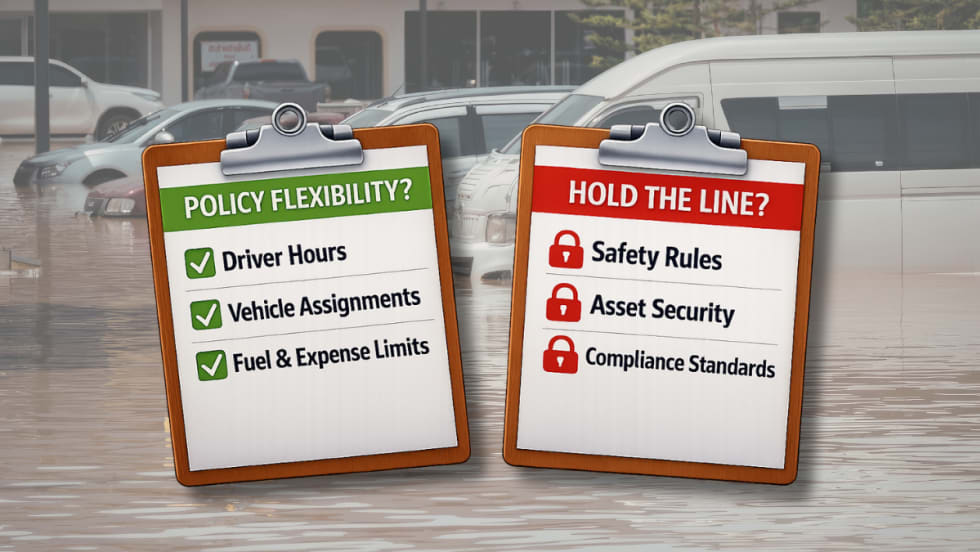
In the middle of natural disasters fleet managers must shift priorities to protect people and assets. What policy items should be loosened, and when should the line be held?
Read More →