




Roundabouts Safer for Older Drivers, IIHS Says
This alternative to traditional intersections can mitigate a major cause of crashes among older drivers: inadequate surveillance.
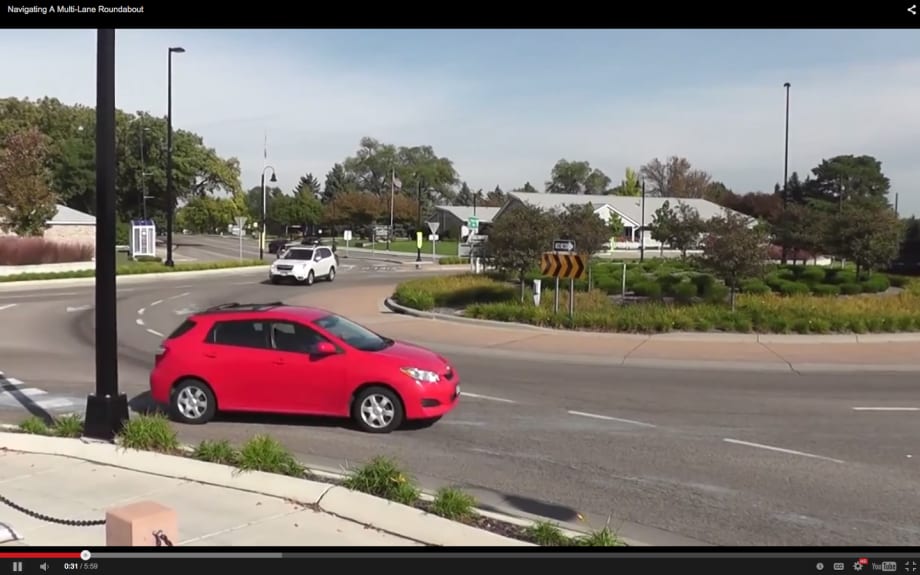
With more and more cities replacing some traditional intersections with roundabouts, one driver demographic is poised to reap more safety benefits from this trend: drivers age 70 and older.
Roundabouts eliminate some risks that older drivers struggle with.
A new study from the Insurance Institute for Highway Safety examined key factors that led to crashes among drivers age 70 and older, compared with those of drivers ages 35-54.
Researchers relied on crash data from the National Highway Traffic Safety Administration and a representative sample of more than 5,000 police-reported crashes resulting in injuries. The data underscored how driving error trends among older drivers differ sharply from those among middle-age drivers.
Among older drivers, the most common critical error was inadequate surveillance (33 percent), followed by misjudging the gap between vehicles or another vehicle’s speed, failure to obey traffic controls or other illegal maneuvers, medical events, and daydreaming (6 percent each), IIHS said. Older drivers proved to be much more likely to make mistakes linked to inadequate surveillance, along with gap or speed misjudgment, compared to middle-age drivers.
“Surveillance errors included looking but not seeing and failing to look,” IIHS noted in the organization’s latest status report. “Drivers 70 and older had the most trouble with the former. Among older drivers who made critical surveillance errors, 71 percent of their crashes were attributed to looking but not seeing another vehicle or failing to see a traffic control as opposed to failing to look, compared with 40 percent of middle-age drivers. Middle-age drivers were more likely to fail to look at all.”
These mistakes by older drivers were most prevalent while making left turns at intersections. About two-thirds of their inadequate surveillance mistakes and 77 percent of their gap or speed misjudgment errors occurred while they were turning left at an intersection.
Top Driver Factors in Crashes, by Driver Age
Ages 70+ | Ages 35-54 | |
Inadequate surveillance | 33% | 22% |
Gap/speed misjudgment | 6% | 3% |
Medical events | 6% | 4% |
Failure to obey traffic controls or other illegal maneuvers | 6% | 4% |
Daydreaming | 6% | 4% |
Source: IIHS
“Errors older drivers commonly make stem from the typical issues associated with aging,” explained Anne McCartt, a co-author of the study and IIHS senior vice president for research. “These include declines in cognitive, perceptual and physical abilities.”
For example, visual impairments among older drivers make them much more likely to have difficulty judging gaps between vehicles and gauging how fast other vehicles are traveling.
A roundabout’s tight-circle design forces drivers to slow down, and traffic flows in the same direction. The most dangerous types of crashes are eliminated, including right-angle, left-turn and head-on collisions.
Other IIHS research has concluded that when roundabouts replace traditional intersections, crashes decline about 40 percent. Collisions leading to injuries drop about 80 percent.
Unfortunately, older drivers often go out of their way to avoid roundabouts simply because they have less experience driving through roundabouts. Cities installing them need to make an effort to ease drivers’ anxiety over something new and thoroughly explain the safety benefits, especially to older drivers.
To view a video on navigating a two-lane roundabout, click on the photo above or click here.
More Safety
IIHS Crash Avoidance Tests Reveal Safety Gaps in Cargo Vans and Work Trucks
New crash-avoidance ratings from the Insurance Institute for Highway Safety reveal inconsistent performance among commercial vehicles, with several popular cargo vans and heavy-duty pickups struggling to avoid collisions with other vehicles and pedestrians.
Read More →
What’s Next for Fleet? Safety, AI & Industry Recognition | AF News Recap
Could your company's culture be encouraging distracted driving? This week, we're exploring how workplace expectations affect driver safety, what AI, EVs, and autonomous vehicles could mean for the future of fleet management, and how fleet professionals can strengthen their award nominations.
Read More →
Does Your Fleet's Culture Encourage Distracted Driving?
What happens when the people responsible for enforcing safety rules are the ones setting the wrong example? The answer may reveal why some of the biggest risks to fleet drivers have little to do with what's written in the employee handbook.
Read More →
Fleet Manager’s Ultimate Playbook: Navigating the New Standard in OEM Connectivity
Rising operating costs, driver safety concerns, and unplanned downtime are putting unprecedented pressure on modern fleets. Discover how fleet managers use embedded OEM connectivity and real-time vehicle data to cut TCO, prevent downtime, and protect drivers without aftermarket telematics hardware.
Read More →
From Driver Well-Being to EV Charging | AF News Recap
Mental health belongs in the fleet safety conversation. This week, we’re looking at five ways fleets can support employee well-being before a crisis, plus Holman’s expansion in Mexico, new one-day Fleet Forward passes, and why EV charging demand is outpacing infrastructure growth.
Read More →
Nexar-Nauto Merger Aims to Give Fleets Better Safety Intelligence Through Larger Driving Dataset
Stefan Heck tells Automotive Fleet that combining more than 10 billion miles of driving history with Nexar's AI models will give fleets deeper insights into driver risk and roadway conditions than either company could provide independently.
Read More →
Don't Wait for a Crisis: 5 Ways to Build Mental Health Into Your Fleet Safety Program
For Suicide Prevention Month, fleet and safety leaders have an opportunity to put mental health where it belongs: at the center of workplace safety.
Read More →
How Camera Data Can Strengthen a Fleet’s Insurance Renewal
Insights from a commercial insurance carrier and a broker show how fleets can turn video telematic data, driver coaching, and improved claims results into a stronger case at insurance renewal.
Read More →
The Safest Fleets Aren’t the Ones with the Most Technology
You’ve made the telematics investment. Here’s how to capture the other half of its value and build the safest fleet on the road.
Read More →
Hidden in Plain Sight: Fleet Compliance Risks
Fleet compliance isn't just about having policies — it's about consistently enforcing them. This practical guide reveals six hidden compliance risks common in public sector and shared fleet operations and outlines proven strategies to improve visibility, accountability, and audit readiness
Read More →