




VW's Strategic Shift: Balancing Tradition and Innovation in Automotive Design
A look at Volkswagen's approach to the future of fleets, featuring updates to iconic models, advancements in hybrid and EV technology, and safety innovations.

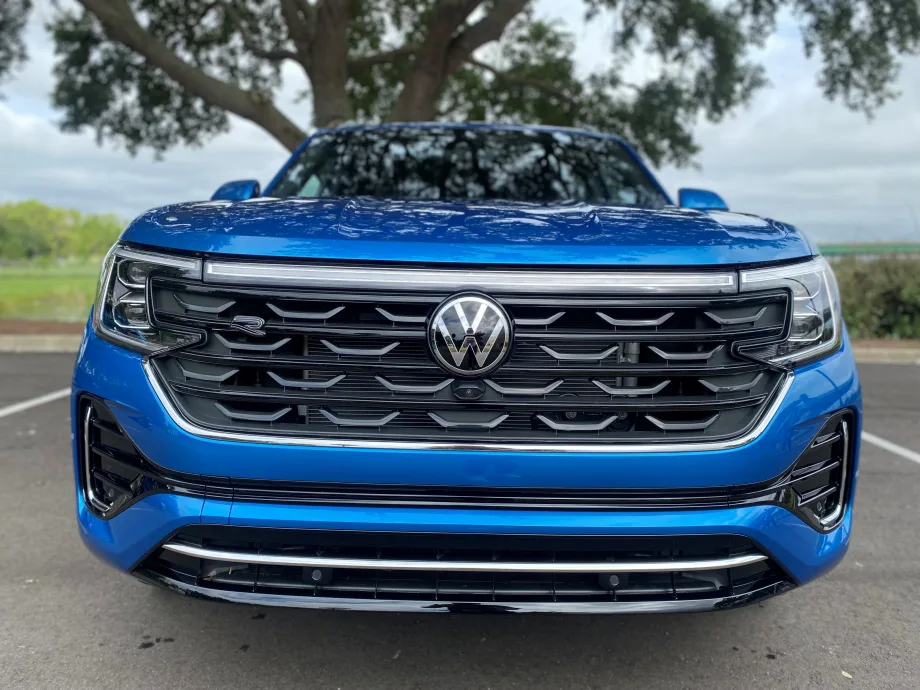
The front-end appearance is new for the 2024 model year Atlas, with adaptive front lighting flanking the four-bar grille.
Photo: Government Fleet
During Volkswagen's Fleet Preview, company reps updated attendees on Volkswagen's strategic positioning for the future, focusing on a need for flexibility around evolving regulations and changing fleet requirements.
Highlights included the facelift of the Golf R and GTI, the success of the Atlas, and the highly anticipated ID. Buzz, the latter of which is expected to significantly boost EV volume. The company is also developing hybrid and plugin powertrains for the Tiguan and Atlas.
Key focal points included safety-enhancing features such as adaptive cruise control, Travel Assist, and Emergency Assist. Volkswagen is prioritizing its fleet business, with strategic additions including new roles, advanced telematics solutions, and partnerships with industry leaders like Sortimo and Wrapmate to elevate vehicle customization and fleet management capabilities.
Staying Ahead of the Curve and Vehicle Updates
Flexibility is defining Volkswagen's approach to the road ahead according to Hein Schafer, senior vice president of product marketing and strategy for Volkswagen of America. This strategy encompasses electric vehicles (EVs), potential future hybrids, and the existing lineup of gas-powered cars.
Continuing to move the brand forward with vehicles like the Atlas, already in the market and with almost 12,000 sold in the month of August, and the ID.4, VW's lead horse in the compact SUV segment, there is anticipation for what's on the horizon.
VW is giving some of its well-known vehicles facelifts, including the Golf R, Golf GTI, and Jetta. However, VW is revving up for the all-new Tiguan, something Schafer feels will be critical to the VW brand.
Other notable VW releases include:
ID. Buzz: An electric minivan and the reincarnation of an iconic car, the Volkswagen Microbus, with a retro-futuristic style featuring large windows, an upright windshield, and a boxy shape.
VW is still looking toward an entry-level potential SUV positioned below the ID.4. With the success of the Atlas and Cross Sport, VW hopes to replicate that success with an EV down the road.
According to Schafer, VW had a successful recipe with Turbocharged Stratified Injection (TSI) and Turbocharged Direct Injection (TDI). Nevertheless, while Volkswagen remains proud of its TSI technology, the company recognizes that the time has come to step into the hybrid market.
"We are working extremely hard to get a hybrid powertrain in the Tiguan that could potentially look like a hybrid and a plugin," Schafer said. "Then, obviously, for the next generation of the Atlas and Cross Sport, we're assessing whether either a hybrid or a plugin will work."
VW's Approach to Safety Now and in the Future
From foundational features like seat belts, crumple zones, and airbags to today's advanced sensor-based driver assistance and emergency braking, VW has been looking at more ways to help enhance overall vehicle safety.
According to VW's Vehicle Safety Office, the current landscape in the U.S. can be broken down into three areas:
Basic regulations that OEMs must meet before they want to sell a vehicle in the market; not meeting these regulations means no vehicles sold.
Consumer protection organizations like the Insurance Institute for Highway Safety (IIHS) that work to push safety beyond that of the minimum regulations.
What additional safety systems are implemented beyond the regulations and consumer protection organization to compete and outperform other car manufacturers.
As technology advanced, so has vehicle safety performance, which has enabled Volkswagen to address increasingly complex driving scenarios. For instance, Automatic Emergency Braking (AEB), introduced around 2012, was initially designed to prevent or mitigate crashes with other vehicles. Over the years, however, AEB has evolved to detect and respond to pedestrians and cyclists, and it is now a standard feature across all Volkswagen models.
VW's focus on enhancing safety goes beyond these two features with IQ.Drive, a feature that comes standard starting with Model Year 2024
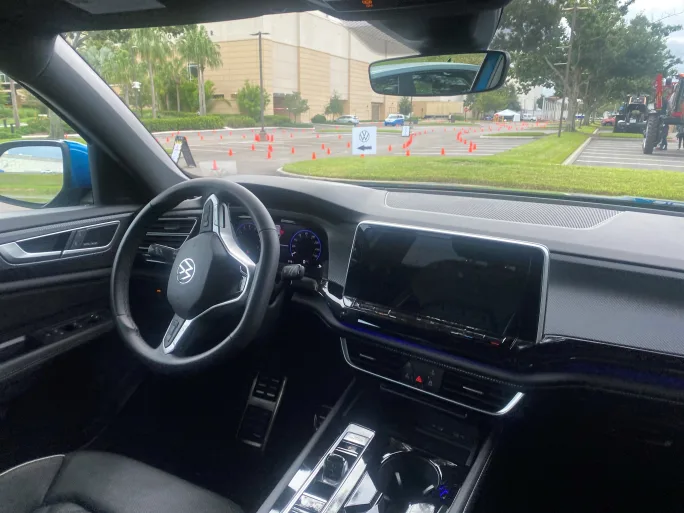
he VW Digital Cockpit Pro's full screen navigation view increases the size of the map while App-Connect21 allows apps to appear on screen by plugging in a compatible smartphone or connecting wirelessly.
Photo: Government Fleet
Highlighting IQ Drive Features
In its most basic form, IQ.Drive is a suite of safety-enhancing intelligence providing drivers with option, such as an 'Assist' button to enable or disable certain features, the use of features such as adaptive cruise control, travel assist, and rear traffic alert. But what else can drivers expect?
Breaking Down IQ Drive
Adaptive Control: Designed to maintain a set speed and/or distance that the driver sets in the vehicle, keeping space between you and the vehicle ahead. Studies show that people who use adaptive cruise control and travel assistance tend to keep more distance between them and the vehicle ahead, as opposed to individuals not using these features.
Predictive ACC: A feature being added to the adaptive cruise control that uses the posted speed limit signs as well as road geometry information (when route guidance is active) to adapt the current set speed of the ACC system. It is aimed to make it easier for drivers to stay within the speed limit.
Travel Assist: The expansion of adaptive cruise control. Not only does this perform the same tasks as ACC, but it now helps the driver stay within the center of the lane, allowing the driver to put less physical force into steering events when they are going around curves.
Automatic Emergency Braking: Allows the vehicle to react to a potential collision, such as stationary vehicles, pedestrians, and cyclists. If a driver is about to collide with the vehicle ahead, the system will give a warning. If the driver ignores the warnings, the brakes will activate to try to prevent the collision or reduce the severity of the contact.
Lane Assist: Meant to prevent drivers from accidentally leaving their lane. When a driver leaves the lane unintentionally, without the blinker, this feature activates when driving above 35 mph on roads with visible markings and can warn the driver and counter-steer if necessary.
Blind Spot Monitor: Provides information to the driver in case a vehicle is in their blind spot. And if the driver attempts to change lanes with the turn signal while a car is in the blind spot, the system provides a warning in the form of a flashing LED in or around the respective mirror.
Active Blind Spot Monitor: A combination of Blind Spot Monitor and Lane Assist. When a vehicle is in the blind spot, the lane markings are detected by the camera and the driver attempts to change lanes using the blinker, the system will alert the driver and, if needed, counter-steer to help avoid a collision with the vehicle in the blind spot.
Rear Traffic Alert: Helps drivers avoid collisions when reversing. It can detect cross-traffic behind the vehicle and alert the driver with a signal and warning indicator. If the driver doesn't respond to the warnings and a potential collision is detected, the system will engage the brakes to help avoid this.
Emergency Assist: Monitors steering wheel activity and provides alerts if the driver is not actively operating the vehicle. If the driver does not respond, the system can keep the vehicle in its lane and bring it to a controlled stop while activating the hazard lights. Emergency Assist does not require Travel Assist to be active, but Lane Assist must be enabled.
Standard on all VW Vehicles
Post Collision Braking: In the event of an accident, post collision braking activates and slows the vehicle speed so the chances of secondary crashes with other vehicles is reduced.
Intelligent Crash Response System: In the event of a collision that deploys the airbags, the ICRS can turn off the fuel pump, unlock the doors, and activate the hazard lights.
VW Updates: What's Done, Still on the Table
VW released its Model Year 25 pricing and incentives in early Quarter 2.
Improved fleet telematics offerings to help manage fleets
VW Fleet Preview wrapped up.
VW is actively looking into EV incorporation.
Working to make improvements to the invoicing process.
Enhancing the VW hub is still in the works.
Still working on a way to provide the price of graphics packages built into the invoice.
Establishing a fleet council. First foray into this with Bobit through an ID. Buzz fleet focus group. Will expand into the future.
More Operations

How Fleets Can Recruit and Train Veterans for Technician Roles
Here's how the technician shortage has affected uptime for fleets, and what to do about it.
Read More →
Avis Budget Group Deploys Neology Toll Management Technology Across Major Brands
Neology’s neoFleet platform will manage toll transactions and toll-authority operations for vehicles across Avis, Budget, Payless, Budget Truck and Zipcar.
Read More →
Fleet Personal-Use Charges Edge Higher in 2026
Nearly eight in 10 surveyed fleets allow personal use of company vehicles, while just over half of respondents report charging employees for the privilege.
Read More →
The Future of Fleet + What’s Changing Right Now | AF News Recap
Could developments overseas offer a preview of what’s coming for U.S. fleets? This week, we’re looking at the future of AI, autonomy, and electrification, plus Ford Pro’s new certified pre-owned program, smarter vehicle offboarding, and a new way for fleets to manage toll expenses.
Read More →
How to Handle Vehicle Offboarding
What do fleet managers need to do when a driver leaves?
Read More →
Fleet Manager’s Ultimate Playbook: Navigating the New Standard in OEM Connectivity
Rising operating costs, driver safety concerns, and unplanned downtime are putting unprecedented pressure on modern fleets. Discover how fleet managers use embedded OEM connectivity and real-time vehicle data to cut TCO, prevent downtime, and protect drivers without aftermarket telematics hardware.
Read More →
U.S. Bank Adds Verra Mobility Toll Management to Voyager Fleet Platform
The integration allows U.S. Bank Voyager fleet customers to manage toll payments and violations alongside fuel, EV charging and maintenance expenses.
Read More →
ADAS Prevents Crashes. But Repairs Cost More | AF News Recap
ADAS-equipped vehicles may crash less often, but they can cost more when they do. This week, we’re breaking down what that tradeoff means for fleets, plus Subaru’s first Forester Wilderness Hybrid, Nissan’s new e-POWER Rogue, and why Calstart has become Catalyst Mobility.
Read More →
Moventum Fleet Management Names Mark Iorillo Head of Sales
Iorillo brings nearly 20 years of fleet management and sales experience to the role, including previous positions at Element Fleet Management, CEI, Donlen and Ryder.
Read More →
Fleet Has a Talent Pipeline Problem. What Comes Next? | AF News Recap
Where will fleet’s next generation of leaders come from? This week, we’re looking at the industry’s talent pipeline, what certification can add to a fleet career, how to build an award-worthy track record, and the return of Automotive Fleet’s Personal Use Survey.
Read More →