




Eric Richardson Wins 2023 Fleet Safety Award
Richardson, deputy chief fleet officer for the New York City Department of Citywide Administrative Services (DCAS), has been instrumental in implementing the city’s safe fleet transition plans, safety rules for city contracts, and two citywide pilots.

Christian Lopez・Former Assistant Editor
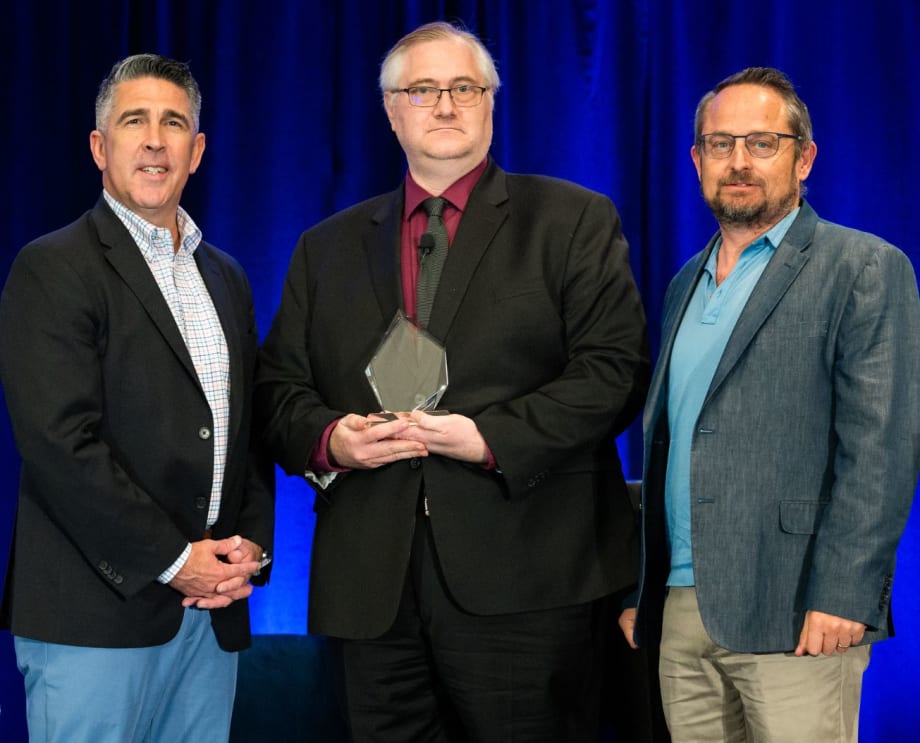
Richardson received the award at the Fleet Safety Conference from Mike Joyce of American Automotive Leasing Association (AALA) and Bobit Associate Publisher Chris Brown.
Photo: Chris Brown
4 min to read
Eric Richardson, deputy chief fleet officer for the New York City Department of Citywide Administrative Services (DCAS), won the 2023 Fleet Safety Award. Richardson accepted the award at the 2023 Fleet Safety Conference, convened in conjunction with the Fleet Forward Conference in Santa Clara, California on Nov. 10.
The award, presented by Automotive Fleet and sponsored by the American Automotive Leasing Association (AALA), is bestowed annually to a fleet or risk manager whose leadership and innovation have enhanced the safety of fleet drivers, their organizations, and the public.
The award comes with a $1,000 scholarship from AALA that the winner can retain or designate as desired. Richardson has indicated he will donate the scholarship to a road safety organization in recognition of the work that Richardson, DCAS, and NYC Fleet are doing to save lives.
Richardson continues to be actively involved in numerous safety initiatives for the city. He has helped to manage:
The release of citywide safe fleet transition plans for city vehicles.
The implementation of the Truck of the Future pilot program with the Parks Department and Department of Environmental Protection.
The launch of the first citywide pilot of intelligent speed assistance, which includes the application for a Safe Streets for All grant to expand the pilot to 7,500 vehicles in the city fleet.
Crafting the rules for the implementation of truck sideguards for city contracts.
Richardson also organized the Vision Zero Fleet Safety Forum with Peter Goldwasser from Together for Safer Roads. The event took place on Nov. 2 and brought almost 500 attendees to Queens.
Citing NYC Fleet’s Accomplishments
“Using telematics, live alerts, and reporting we have been able to focus our safety efforts on the specific vehicles that contribute to high- or medium-risk driving,” he said. “This includes a monthly safety scorecard that goes out to 55 agency commissioners and the owners of every school bus company showing the categorization of each vehicle and the specific items of risky behaviors.”
Richardson named cities like Chicago and Boston, which have followed suit with New York and have experienced similar progress in improving fleet.
Richardson cited that in the span of five years, they have seen a 30% decrease in preventable collisions in the city and a 20% reduction in high- and medium-duty risk drivers in the last six months.
Looking ahead, Richardson said that he and his team wish to expand the use of technology to include cab driver alerts, surround cameras, sensors, telematics, and external turning alerts using AI to track collisions, as well as near misses.
“We also believe that our pilot program of intelligent speed assist can move that technology similar to how we have moved on sideguards,” he said. “Of the vehicles with ISA, we have seen a 99% compliance to the speed limit we set on the vehicles and a 35% reduction in harsh braking.”
Concluding his speech, Richardson directed attention to all those in NYC who work on road safety of all kinds.
“Our NYC Vision Zero Task Force is a beacon to others on how various stakeholders in each area of the Safe System approach to road safety can collaborate, share best practices, and lean on each other when we sadly see people still dying on our roads.”
Award Runner Up & Finalists
The AALA fleet member companies initiate the nominating process by submitting candidates who they feel best meet the award qualifications. Self-nominations from individuals and companies are also accepted.
AALA’s fleet management executives review the nominees and choose the winner.
The judges cited this year's runner ups from University of Virginia: Mike Duffy, transportation operations and fleet manager at the University of Virginia Facilities Management and Brian Park, a professor in the Department of Civil and Environmental Engineering and the Department of Systems and Information Engineering at the University of Virginia – director, Traffic Operations Laboratory.
The 2023 finalists are (in no order):
Agus Rijal, Road Safety, Medco Energi, Province of Aceh, Indonesia
Jermaine Woodall, utilities and fleet services manager, Port of Long Beach
Katie Franssen & Sharon Etherington, SHE leader & fleet manager, Roche Diagnostics
Michael Wagner, director of company operations, Designscapes Colorado
Oscar Tovar, transportation administrator, Dallas County Health & Human Services,
Tatiyana Vollhardt, director of safety & compliance, Transportation Concepts Inc. Commerce
Terrance York, division manager, Fleet Management Department, City of Houston
Andres Dominguez, fleet safety coordinator, Federal Maintenance Services
Cayla Gutierrez, fleet manager, RS&H
Matt Rademacher, administrator/corp. fleet management, Southwest Gas Corp.
Jose Guzman, shop manager, Dallas County
Tyler Teter, assistant vice president fleet, Safelite
Marc Guild, EHS&S center of expertise competency leader, Corteva Agriscience
More Safety

What’s Next for Fleet? Safety, AI & Industry Recognition | AF News Recap
Could your company's culture be encouraging distracted driving? This week, we're exploring how workplace expectations affect driver safety, what AI, EVs, and autonomous vehicles could mean for the future of fleet management, and how fleet professionals can strengthen their award nominations.
Read More →
Does Your Fleet's Culture Encourage Distracted Driving?
What happens when the people responsible for enforcing safety rules are the ones setting the wrong example? The answer may reveal why some of the biggest risks to fleet drivers have little to do with what's written in the employee handbook.
Read More →
Sponsored•October 1, 2026
Fleet Manager’s Ultimate Playbook: Navigating the New Standard in OEM Connectivity
Rising operating costs, driver safety concerns, and unplanned downtime are putting unprecedented pressure on modern fleets. Discover how fleet managers use embedded OEM connectivity and real-time vehicle data to cut TCO, prevent downtime, and protect drivers without aftermarket telematics hardware.
Read More →
From Driver Well-Being to EV Charging | AF News Recap
Mental health belongs in the fleet safety conversation. This week, we’re looking at five ways fleets can support employee well-being before a crisis, plus Holman’s expansion in Mexico, new one-day Fleet Forward passes, and why EV charging demand is outpacing infrastructure growth.
Read More →
Nexar-Nauto Merger Aims to Give Fleets Better Safety Intelligence Through Larger Driving Dataset
Stefan Heck tells Automotive Fleet that combining more than 10 billion miles of driving history with Nexar's AI models will give fleets deeper insights into driver risk and roadway conditions than either company could provide independently.
Read More →
Don't Wait for a Crisis: 5 Ways to Build Mental Health Into Your Fleet Safety Program
For Suicide Prevention Month, fleet and safety leaders have an opportunity to put mental health where it belongs: at the center of workplace safety.
Read More →
How Camera Data Can Strengthen a Fleet’s Insurance Renewal
Insights from a commercial insurance carrier and a broker show how fleets can turn video telematic data, driver coaching, and improved claims results into a stronger case at insurance renewal.
Read More →
The Safest Fleets Aren’t the Ones with the Most Technology
You’ve made the telematics investment. Here’s how to capture the other half of its value and build the safest fleet on the road.
Read More →
Sponsored•August 7, 2026
Hidden in Plain Sight: Fleet Compliance Risks
Fleet compliance isn't just about having policies — it's about consistently enforcing them. This practical guide reveals six hidden compliance risks common in public sector and shared fleet operations and outlines proven strategies to improve visibility, accountability, and audit readiness
Read More →
NETS Sets 2026 Fleet Safety Benchmark Conference for Indianapolis
The Sept. 15–17 program will feature fleet benchmarking data, case studies, emerging technologies, and implementation strategies while running alongside the NSC Safety Congress & Expo.
Read More →