





Related: Donna Bibbo Retires Capping a 30-Year Career in Fleet
Where are they Now? Chrysler’s Bick Pratt
After a 43-year career with Chrysler, Pratt now focuses on his app MyTalk, which gives a voice to people who are unable to communicate through traditional means.
December 31, 2019
4 min to read

Bick Pratt's son, Michael, inspired him to create MyTalk.
Photo via Pratt.
Bick Pratt closed out a 43-year career in automotive when he retired from Fiat Chrysler Automobiles as head of government sales in 2018.
He now devotes his time to a company that was born out of his desire to help his son communicate. His son, Michael, was born with Nager syndrome which has wide ranging impact and affects his ability to hear and talk.
The company MyTalk LLC, developed an augmentative alternative communication application for mobile devices, that allows people who cannot speak the ability to communicate with a mobile device.
He started MyTalk in 2008 while still working at FCA. At that time, he split his days between the two companies. His workday at Chrysler ran from 7 a.m. to 6 p.m. and then continued at home until midnight on most nights. Saturdays and Sundays were 10- to 12-hour days most of the time.
43 Years with Chrysler
Pratt began his career at Chrysler in 1975 and moved to the company’s fleet division in 1982.
From 1975 to 1995 he worked in field sales and from 1995 to 2018 he worked at Fleet home office.
In the latter 23 years he ran many departments within Chrysler’s fleet division, such as marketing, business relations, production planning, and government sales.
Key accomplishments in his last position in government were selling more than 20,000 ProMaster Vans to the U.S. Postal Service and winning the California Highway Patrol business.
One of the biggest changes in the commercial industry happened in the ‘90s when Ford Motor Co. led the big three, requiring fleet management companies to identify the end user fleet and created what they called FIN2, Pratt noted.
FIN2 was essentially a fleet account number that would identify the end user company. Chrysler quickly followed with a similar system change requiring FMC's to include Chrysler FAN2 (Fleet Account #2) on all orders and sales reports.
It was a huge industry change because until that time manufacturers required only the FMCs’ fleet number. End users were essentially hidden from ‘the factory.’ Before FIN2/FAN2, manufacturers had to ask end user companies what they bought. It was not very accurate, Pratt noted.
When Ford made the decision to move to their new system, Pratt was given the assignment to lead a team that implemented a similar system change at Chrysler. GM also created their version.
“This was a major change for me. After 20 years as a sales rep, I now had to coordinate a team of 30 people, mostly from I.T., who had to figure out all the internal systems changes and interfaces with the FMCs,” Pratt said. “And, the FMC's were not thrilled about making the transition. It all worked out and set us up for closer and more automated relationships with end user companies. At the time, FMC's made up the major portion of our Commercial business. The entire transition was complete and fully functional within 2 years.”
Developing a Product for a Different Community
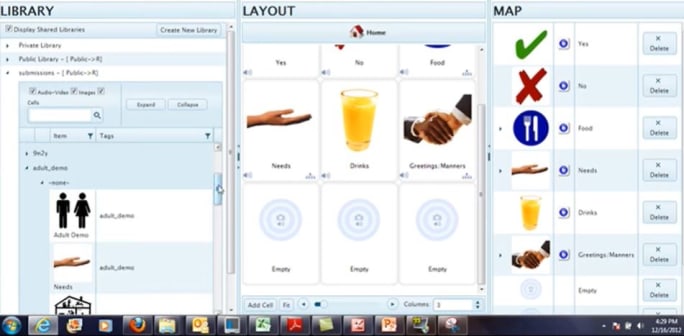
An example of what the web interface of MyTalkTools Workspace looks like.
Screenshot via MyTalk.
MyTalk was born out of a father’s desire to give his son the ability to communicate, but it wasn’t until the iPhone was released that Pratt began making that desire a reality.
“I was sitting on a couch and realized that with these new tools called iPhones, there could be a better way for people who can’t speak. I decided to create an app that would use the iPhone to speak for them,” said Pratt.
Before MyTalk, the alternative for those who could not speak was a bulky, conspicuous device that drew unwanted attention, and had marginal results in many cases. Plus, it could cost as much as $7,000.
The opportunity would be to reduce costs for end users with special needs from thousands of dollars to the cost of the Apple device plus Pratt's MyTalkTools Mobile app.
Not only was cost reduced, but now people in this community didn’t have to have to carry around cumbersome devices that brought unwanted attention. Now it would be a smartphone.
For Speech professionals, Special Ed teachers and other support professionals MyTalk is available at no cost. For families MyTalk is low cost with several options depending on need.
“We are the only ones that do ‘free for professionals’. Our commitment is to the professional community. We trust their judgement,” said Pratt. “The American Speech & Hearing Association (ASHA) speech and language pathologists are an example of the professionals that are trained, educated, and experienced, and we wanted to put our faith in them.”
Since releasing MyTalkTools Mobile in 2009 there have been over 100,000 downloads. It is used in over 100 countries and has been translated into 9 languages by end-user families whose lives were so changed that they wanted to share MyTalk in their community.
More Operations

How Fleets Can Recruit and Train Veterans for Technician Roles
Here's how the technician shortage has affected uptime for fleets, and what to do about it.
Read More →
Avis Budget Group Deploys Neology Toll Management Technology Across Major Brands
Neology’s neoFleet platform will manage toll transactions and toll-authority operations for vehicles across Avis, Budget, Payless, Budget Truck and Zipcar.
Read More →
Fleet Personal-Use Charges Edge Higher in 2026
Nearly eight in 10 surveyed fleets allow personal use of company vehicles, while just over half of respondents report charging employees for the privilege.
Read More →
The Future of Fleet + What’s Changing Right Now | AF News Recap
Could developments overseas offer a preview of what’s coming for U.S. fleets? This week, we’re looking at the future of AI, autonomy, and electrification, plus Ford Pro’s new certified pre-owned program, smarter vehicle offboarding, and a new way for fleets to manage toll expenses.
Read More →
How to Handle Vehicle Offboarding
What do fleet managers need to do when a driver leaves?
Read More →
Sponsored•October 1, 2026
Fleet Manager’s Ultimate Playbook: Navigating the New Standard in OEM Connectivity
Rising operating costs, driver safety concerns, and unplanned downtime are putting unprecedented pressure on modern fleets. Discover how fleet managers use embedded OEM connectivity and real-time vehicle data to cut TCO, prevent downtime, and protect drivers without aftermarket telematics hardware.
Read More →
U.S. Bank Adds Verra Mobility Toll Management to Voyager Fleet Platform
The integration allows U.S. Bank Voyager fleet customers to manage toll payments and violations alongside fuel, EV charging and maintenance expenses.
Read More →
ADAS Prevents Crashes. But Repairs Cost More | AF News Recap
ADAS-equipped vehicles may crash less often, but they can cost more when they do. This week, we’re breaking down what that tradeoff means for fleets, plus Subaru’s first Forester Wilderness Hybrid, Nissan’s new e-POWER Rogue, and why Calstart has become Catalyst Mobility.
Read More →
Moventum Fleet Management Names Mark Iorillo Head of Sales
Iorillo brings nearly 20 years of fleet management and sales experience to the role, including previous positions at Element Fleet Management, CEI, Donlen and Ryder.
Read More →
Fleet Has a Talent Pipeline Problem. What Comes Next? | AF News Recap
Where will fleet’s next generation of leaders come from? This week, we’re looking at the industry’s talent pipeline, what certification can add to a fleet career, how to build an award-worthy track record, and the return of Automotive Fleet’s Personal Use Survey.
Read More →