




Watch 38 Vehicle Models Draw Top IIHS Rating
The new judging criteria for IIHS Top Safety Pick+ include higher standards for headlight quality.

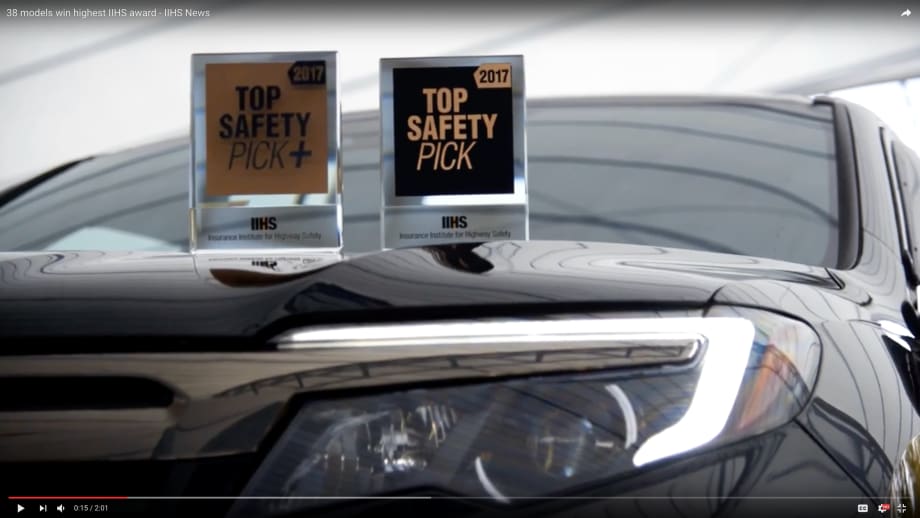
The Insurance Institute for Highway Safety has named 38 vehicle models 2017 Top Safety Pick+ award winners and 44 models Top Safety Pick winners.
IIHS toughened the criteria for Top Safety Pick+ to reflect new headlight evaluations launched in 2016. The recognition program is meant to encourage manufacturers to offer advanced protection for vehicle occupants in crashes, along with features that help drivers avoid crashes in the first place.
“The field of contenders is smaller this year because so few vehicles have headlights that do their job well, but it’s not as small as we expected when we decided to raise the bar for the awards,” said Adrian Lund, IIHS president. “Manufacturers are focusing on improving this basic safety equipment, and we’re confident that the winners’ list will grow as the year progresses.”
For both Top Safety Pick+ and Top Safety Pick awards, models must earn the highest score of “good” in the small overlap front, moderate overlap front, side, roof strength and head restraint tests, as well as an “advanced” or “superior” rating for front crash prevention with standard or optional autobrake. Headlights are factored in only for the top award.
Toyota/Lexus leads manufacturers with nine 2017 Top Safety Pick+ award winners, including the updated Toyota Corolla. Honda and its Acura division picked up five Top Safety Pick+ awards.
Among 2017 models, only seven are available with “good”-rated headlights. They are the Chevrolet Volt small car, Honda Ridgeline pickup, Hyundai Elantra small car, Hyundai Santa Fe mid-size SUV, Subaru Legacy mid-size car, Toyota Prius v mid-size car, and Volvo XC60 mid-size luxury SUV.
IIHS launched headlight ratings in the spring after lab tests revealed that government standards allow for huge variation in the amount of illumination headlights provide in on-road driving. Nighttime visibility is critical to highway safety because about half of traffic deaths occur either in the dark or at dawn or dusk, IIHS said.
In the IIHS evaluations, engineers measure how far light is projected from a vehicle’s low beams and high beams, as the vehicle travels straight and on curves. Also measured is glare from low beams for oncoming drivers. Vehicles equipped with high-beam assist, which automatically switches between high beams and low beams depending on the presence of other vehicles, can get extra credit.
IIHS noted that its evaluations demonstrate that a vehicle’s price tag doesn’t correspond to the quality of headlights. More modern lighting types, including high-intensity discharge (HID) and LED lamps along with curve-adaptive systems, also are no guarantee of top performance.
To qualify for 2017 Top Safety Pick+, a vehicle must earn “good” ratings in the five crashworthiness tests, an “advanced” or “superior” rating for front crash prevention, and a “good” or “acceptable” headlight rating. Here are the winners:
Small Cars
Chevrolet Volt
Hyundai Elantra sedan only; built after March
2016 Mazda 3 4-door sedan | 4-door hatchback
Toyota Corolla
Toyota Prius built after August 2016
Mid-size Cars
Honda Accord 4-door
Mazda 6
Nissan Altima
Nissan Maxima
Subaru Legacy
Subaru Outback
Toyota Camry
Toyota Prius v
Volkswagen Jetta
Mid-size luxury cars
Audi A4
Lexus ES 350
Volvo S60
Volvo V60
Large luxury cars
Genesis G80
Genesis G90
Lexus RC
Small SUVs
Mazda CX-3
Mitsubishi Outlander
Nissan Rogue
Subaru Forester built after October 2016
Toyota RAV4
Mid-size SUVs
Honda Pilot
Hyundai Santa Fe built after March 2016
Mid-size luxury SUVs
Acura MDX
Acura RDX
Audi Q5
Buick Envision
Lexus NX
Lexus RX
Mercedes-Benz GLE-Class
Volvo XC60
Minivan
Chrysler Pacifica built after August 2016
Large pickup
Honda Ridgeline
More Safety

Nexar-Nauto Merger Aims to Give Fleets Better Safety Intelligence Through Larger Driving Dataset
Stefan Heck tells Automotive Fleet that combining more than 10 billion miles of driving history with Nexar's AI models will give fleets deeper insights into driver risk and roadway conditions than either company could provide independently.
Read More →
Don't Wait for a Crisis: 5 Ways to Build Mental Health Into Your Fleet Safety Program
For Suicide Prevention Month, fleet and safety leaders have an opportunity to put mental health where it belongs: at the center of workplace safety.
Read More →
How Camera Data Can Strengthen a Fleet’s Insurance Renewal
Insights from a commercial insurance carrier and a broker show how fleets can turn video telematic data, driver coaching, and improved claims results into a stronger case at insurance renewal.
Read More →
The Safest Fleets Aren’t the Ones with the Most Technology
You’ve made the telematics investment. Here’s how to capture the other half of its value and build the safest fleet on the road.
Read More →
Hidden in Plain Sight: Fleet Compliance Risks
Fleet compliance isn't just about having policies — it's about consistently enforcing them. This practical guide reveals six hidden compliance risks common in public sector and shared fleet operations and outlines proven strategies to improve visibility, accountability, and audit readiness
Read More →
NETS Sets 2026 Fleet Safety Benchmark Conference for Indianapolis
The Sept. 15–17 program will feature fleet benchmarking data, case studies, emerging technologies, and implementation strategies while running alongside the NSC Safety Congress & Expo.
Read More →
Off-the-Job Crashes Account for 43% of Employers’ $61.7 Billion Crash Burden
NETS quantifies costs dispersed across fleet, risk, HR, and other departments while providing new per-crash benchmarks for employers.
Read More →
Ram Recalls More Than 1.27 Million 1500 Pickups for Seat Belt Anchor Issue
The recall affects certain 2019-2026 Ram 1500 pickups that may have improperly attached second-row seat belt buckle anchors.
Read More →
How Better Visibility Cut Speeding Violations by 48%
Fleet leaders don't need more data, they need clearer visibility into what the data is saying. This case study explores how one utility replaced speeding-event counts with a single metric — miles driven in violation — to strengthen safety and significantly reduce speeding violations.
Read More →
Operation Safe Driver Week: Why the Industry's Oldest Safety Campaign Still Matters to Fleets
A look at how a 2007 enforcement initiative became one of the most consequential weeks on the fleet safety calendar, and what it means for your drivers in 2026.
Read More →