




Further Reading: French Regulator Approves VW's Takeover Bid for Europcar
VW Group Meets EU CO2 Emissions Goal for 2021
With a strong market push in EVs and BEVs, the Volkswagen Group achieved an estimated 25% market share of the BEV segment in Europe with over 5% sales growth over the previous year in the electric segment.
by Automotive Staff
January 24, 2022
The VW Group intends to be the leading global provider of EVs and PHEVs by 2025.
[EMPTY CREDIT]
3 min to read
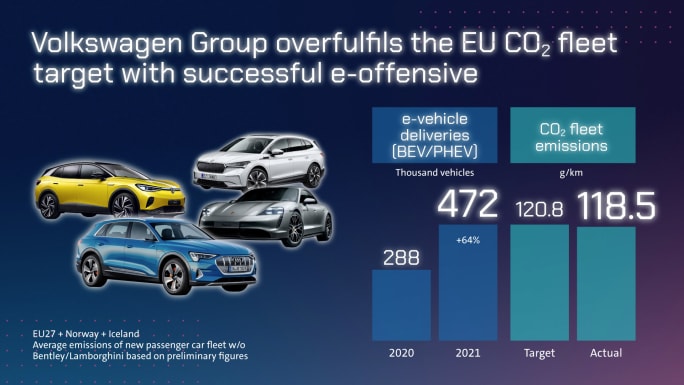
The Volkswagen Group recently reported strong numbers in its goal to decarbonize its vehicle fleet and evolve into a more ecologically responsible and sustainable group. In 2021, the Group delivered 64% more electric vehicles (EVs) in the EU—over 470,000. Battery-electric vehicles (BEVs) and plug-in hybrids (PHEVs) rose to 17.2% of deliveries, up 7% from 2020. The Group is the market leader in this segment in Europe, and preliminary figures reveal average C02 emissions of 118.5g/km for its new passenger car fleet in the EU, just 2% below the legal target (final numbers will be reported in the future).
“Our Group-wide electric offensive picked up significant speed last year with many attractive new models," said Christian Dahlheim, Head of Group Sales, "and nearly one in five vehicles delivered in Europe was electrified, and more than half of these were all-electric. This helped us to further reduce CO2 fleet emissions and fulfil the EU target. We were also able to inspire many new customers for e-mobility. As part of our NEW AUTO strategy, we will continue to consistently drive forward the electrification of our portfolio in the coming years. In 2030, we plan a share of all-electric vehicles of 60 percent in Europe.”
[EMPTY CREDIT]
According to the Group, in 2020 it had achieved average CO2 emissions of 99.9 g/km for its fleet in the EU (including the United Kingdom, Norway, and Iceland), a number that was calculated based on the New European Driving Cycle (NEDC). The legal basis since 2021 has been the Worldwide harmonized Light vehicles Test Procedure (WLTP). The underlying test cycle in the WTLP is more accurate than in the NEDC, accounting for higher top speeds being driven, for example. This generally gives higher CO2 emissions, which is why the CO2 fleet targets have also been switched over to the WLTP. The fleet values achieved for 2020 and 2021 are not comparable for this reason, and the UK isn't included in 2021 anyway due to its secession from the EU.
This year, the Volkswagen Group will offer several new all-electric vehicles as part of its push into an electric future. Based on the Modular Electric Drive Toolkit (MEB), the Volkswagen plans to launch SUV coupés the ID.501 and the ID.5 GTX02 as well as the ID.BUZZ03. Also based on the MEB, the ŠKODA brand will debut the Enyaq iV Coupé03. CUPRA will expand the range of the the Born04 with additional battery capacities and a more powerful e-Boost version. Audi will introduce the upgraded e-tron and new versions of the Porsche Taycan and the Taycan Sport Turismo will be available for the first time.
The Group intends to become the global leader and manufacturer of electric vehicles worldwide by 2025. The Group plans to invest about €52 billion by 2026 in e-mobility as well as an additional €8 billion in the hybridization of its model portfolio.
Volkswagen was the first automotive group to commit to the Paris Climate Agreement and intends to become net climate neutral by 2050, which is why the Group continues to innovate and stress decarbonization beyond its vehicles. The power plant in Wolfsburg, for example, which produces electricity for the plant and district heating for the city, was recently converted from coal to gas, saving roughly 1.5 million tons of CO2 per year (equivalent to annual emissions of 870,000 cars).
More Global Fleet
GeoFencing Adds to Your Truck Security Arsenal
Geofencing is a familiar fleet tool today, but its early adoption marked a major shift in vehicle tracking, route monitoring, and the debate over employee privacy.
Read More →
Holman Takes Full Ownership of ARIZA in Mexico
Holman is bringing its Mexican fleet management operation fully under its own brand after more than 30 years as a joint venture. The change gives multinational fleet customers a single Holman operation across the U.S., Canada, and Mexico.
Read More →
5 Tire Maintenance Tips to Help Prevent Work Truck Downtime
Regular tire checks can do more than extend tread life. These five maintenance practices can help work truck fleets catch problems early, reduce costs, and prevent downtime.
Read More →

Proven Ways to Reduce Work Truck Downtime
The age-old problem of downtime will always be a reality, but with new strategies at hand, fleets have more ways to keep trucks on the road longer.
Read More →

Cameras, Safety and Insurance: From Reactive Claims to Real-Time Prevention (Part 2 of 2)
Part Two: Commercial auto remains one of the most challenging and costly lines of coverage for fleet operators and insurers alike. Continue learning more about how to effectively address these issues from Onur Aksan, Enterprise Business Development Executive, Geotab
Read More →
Cameras, Safety and Insurance: From Reactive Claims to Real-time Prevention
Commercial auto remains one of the most challenging and costly lines of coverage for fleet operators and insurers alike. Learn more about how to effectively address these issues from Onur Aksan, Enterprise Business Development Executive, Geotab.
Read More →
Fleet Costs Are Rising: Here’s How Leaders Are Responding
Fleet leaders are under pressure to reduce costs, adapt to economic uncertainty, and make smarter decisions. See how peers across North America are responding with real data, proven strategies, and forward-looking insights. Download the 2026 Market Pulse Report to benchmark your strategy and uncover where you can gain an edge.
Read More →
Enterprise Fleet Management Surpasses 900,000 Vehicles in U.S. & Canada
Enterprise Mobility connects with mobility solutions around the globe
Read More →