




Volvo to Participate in Creation of Body Panel Batteries
Volvo Cars is one of nine European companies and institutes working to develop a composite blend of carbon fibers and polymer resin that can store and charge more energy faster than conventional batteries can.
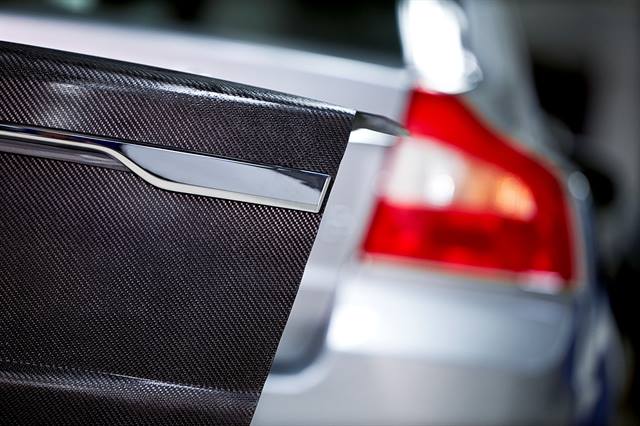
Different sections of the vehicle, including the trunk lid, could be used to charge up and power electric vehicles down the road. Photo courtesy Volvo Cars
Volvo Cars is one of nine European companies and institutes working to develop a composite blend of carbon fibers and polymer resin that can store and charge more energy faster than conventional batteries can.
The materials development project was launched earlier this year by Imperial College in London, with Volvo Cars being the only car manufacturer participating in the project. With the help of approximately $5.5 million in financial support from the European Union, the group hopes to create a material that is not only able to store and charge energy, but is extremely strong and pliant, which means it can be shaped for use in building the car's body panels. According to the group's calculations, the car's weight could be cut by as much as 15 percent if steel body panels were replaced with the new material.
"Our role is to contribute expertise on how this technology can be integrated in the future and to input ideas about the advantages and disadvantages in terms of cost and user-friendliness," says Per-Ivar Sellergren, development engineer at the Volvo Cars Materials Centre.
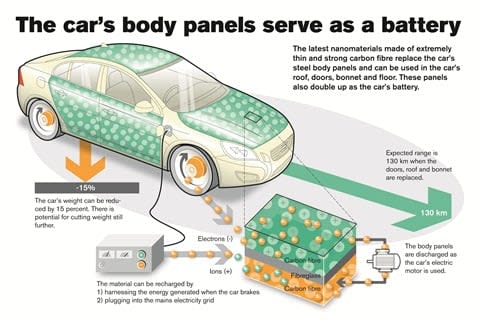
A composite blend of carbon fibers and polymer resin is being developed that can store and charge more energy faster than conventional batteries can. Photo courtesy Volvo Cars
Initially, the car's spare wheel recess will be converted into a composite battery.
"This is a relatively large structure that is easy to replace. Not sufficiently large to power the entire car, but enough to switch the engine off and on when the car is at a standstill, for instance at traffic lights," says Per-Ivar Sellergren.
A video on the Imperial College YouTube page features Dr. Emile Greenhalgh, from the Department of Aeronautics, explaining how the composite material works and the possible benefits of using this material in vehicle manufacturing.
More Green Fleet

EV Charging Use Is Outpacing Infrastructure Growth
ChargePoint’s 2026 Charging Forward Report points to rising charger use, higher-powered charging, commercial vehicle electrification, and energy-management technology. Here’s what fleets should know.
Read More →
Merchants Fleet Reports 290M EV Miles as Fleets Navigate Changing Electrification Market
From millions in operating savings to hundreds of millions of EV miles, Merchants Fleet’s latest report reveals what’s working and what’s changing in fleet electrification.
Read More →
The EV Breakdown Nobody's Talking About: Why Most Electric Vehicle Roadside Calls Aren't Mechanical Failures
Here's why EV breakdowns are widely misunderstood.
Read More →
ChargePoint Now Available in Energy Pass
ChargePoint and additional planned charging network integrations were added to GM's Energy Pass.
Read More →

First Look: Slate Auto's Electric Fleet Pickup
Could an affordable, modular EV pickup make electrification more practical for fleets?
Read More →
Slate Debuts Colorful, Unique EV Models
A recent media and client event, studded with electric vehicles dressed up on platforms, planted a new position for the manufacturer in the wider EV market. Fleets will find cost-saving advantages.
Read More →
Slate Electric SUV, Pickup Switchable Model Aims For Light-Duty Fleets
Everything about this EV is counterintuitive and understated, making it stand out from the crowd.
Read More →
Inspiration Mobility Acquires Key Electrada Assets
Inspiration Mobility Group has acquired select assets of Electrada, adding the fleet electrification provider's team, technology, and charging infrastructure development capabilities to its energy management business.
Read More →
Turning Connected Vehicle Data Into Decisions That Matter
Fleet leaders have more data than ever, but turning that data into clear, actionable decisions remains a challenge. This white paper shows how leading organizations are using connected vehicle data to improve safety, reduce costs, and optimize fleet performance. Learn how to turn insight into action across your fleet.
Read More →