




Video: 2015 Hyundai Genesis Earns Top IIHS Safety Award
The redesigned luxury car performs well in crash tests and also draws a 'superior' rating for front crash prevention.

Photo of 2015 Hyundai Genesis courtesy of Hyundai.
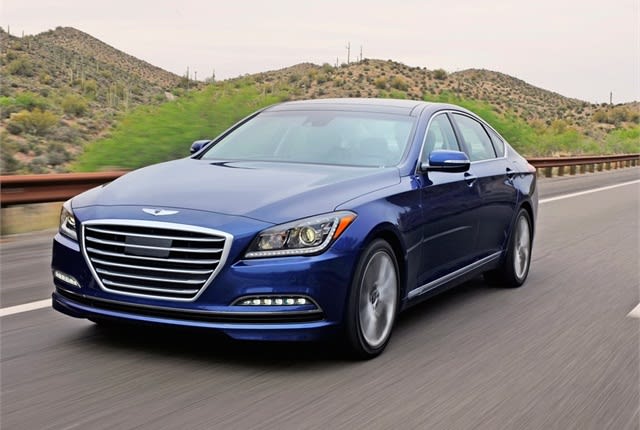
Photo of 2015 Hyundai Genesis courtesy of Hyundai.
The redesigned Hyundai Genesis, a large luxury car, has earned the 2014 Top Safety Pick+ award from the Insurance Institute for Highway Safety (IIHS) -- thanks to a “good” rating in the challenging small overlap front crash test and a “superior” rating for front crash prevention.
The 2015 Genesis also drew “good” ratings in the moderate overlap front, side, roof strength and head restraint evaluations.
In the small overlap test, the driver's space was maintained well, and injury measures recorded on the driver dummy indicated low risk of any significant injuries in a crash of this severity, IIHS said. The dummy's head made good contact with the front airbag, which stayed in position during the crash, and the side curtain airbag deployed to protect the head from contact with side structures.
IIHS added the small overlap evaluation to its testing lineup in 2012. In the crash, 25 percent of a vehicle's front end on the driver side strikes a 5-foot-tall rigid barrier at 40 mph. It replicates what happens when the front corner of a vehicle strikes another vehicle or an object like a tree or a utility pole.
The Genesis’ optional front crash prevention system, which is being offered for the first time on the 2015 model, earned a “superior” rating because of its automatic braking capabilities. In track tests, the car stopped completely before hitting the target in tests at 12 mph and 25 mph, IIHS said.
The Genesis is one of only three large luxury cars to have earned the institute’s highest award for 2014. To qualify for Top Safety Pick+, a vehicle must earn a “good” or “acceptable” rating for small overlap protection, a “good” rating in the other four IIHS tests, and a “basic,” “advanced” or “superior” rating for front crash prevention.
“The Top Safety Pick+ designation recognizes state-of-the-art safety,” said Adrian Lund, IIHS president. “The new Genesis is not only engineered to protect people when crashes happen, but with its optional automatic emergency braking system rated superior in our tests, this car can help drivers avoid some of the most common kinds of collisions altogether.”
The 2015 Genesis uses new Sensory Surround Safety technology including a Hyundai first -- Automatic Emergency Braking (AEB) -- utilizing sensor fusion technology to help avoid a potential collision or reduce its impact. With this system, Genesis employs automatic braking whenever it detects another vehicle at an unsafe closing rate of speed. This system uses the front radar from the Smart Cruise Control system and the forward camera from the Lane Departure Warning (LDW) to provide this extra margin of safety.
In addition, Genesis combines available LDW with all-new Lane Keep Assist (LKA) to provide a driver-adjustable level of steering assist. This helps prevent inadvertent lane departure when a vehicle approaches the edge of a lane and also provides steering wheel haptic vibration feedback.
Genesis is equipped with a number of new, advanced technologies, many of them Hyundai firsts. A new driver-selectable Intelligent Drive Mode allows drivers to select from four drive modes, depending on conditions and driving preferences. A new Blind-Spot Detection system (BSD) helps monitor traffic around the car. For Genesis vehicles equipped with the Heads-Up Display (HUD), the BSD system indicators also project onto the windshield, nearer the driver’s view of the road.
Lane Change Assist (LCA) helps detect vehicles approaching toward its rear side at high speeds, especially during higher-speed driving, while Rear Cross-traffic Alert (RCTA) scans areas to each side of the car when drivers are backing out of parking spaces.
Genesis also benefits from technology in its CO2 sensor control system. Hyundai engineers discovered that occupants start to get drowsy when CO2 levels reached more than 2,000 parts per million, so the new ventilation system helps ensure the cabin maintains a CO2 concentration well below that level at all times using freshly-ventilated ambient air.
More Safety

Nexar-Nauto Merger Aims to Give Fleets Better Safety Intelligence Through Larger Driving Dataset
Stefan Heck tells Automotive Fleet that combining more than 10 billion miles of driving history with Nexar's AI models will give fleets deeper insights into driver risk and roadway conditions than either company could provide independently.
Read More →
Don't Wait for a Crisis: 5 Ways to Build Mental Health Into Your Fleet Safety Program
For Suicide Prevention Month, fleet and safety leaders have an opportunity to put mental health where it belongs: at the center of workplace safety.
Read More →
How Camera Data Can Strengthen a Fleet’s Insurance Renewal
Insights from a commercial insurance carrier and a broker show how fleets can turn video telematic data, driver coaching, and improved claims results into a stronger case at insurance renewal.
Read More →
The Safest Fleets Aren’t the Ones with the Most Technology
You’ve made the telematics investment. Here’s how to capture the other half of its value and build the safest fleet on the road.
Read More →
Hidden in Plain Sight: Fleet Compliance Risks
Fleet compliance isn't just about having policies — it's about consistently enforcing them. This practical guide reveals six hidden compliance risks common in public sector and shared fleet operations and outlines proven strategies to improve visibility, accountability, and audit readiness
Read More →
NETS Sets 2026 Fleet Safety Benchmark Conference for Indianapolis
The Sept. 15–17 program will feature fleet benchmarking data, case studies, emerging technologies, and implementation strategies while running alongside the NSC Safety Congress & Expo.
Read More →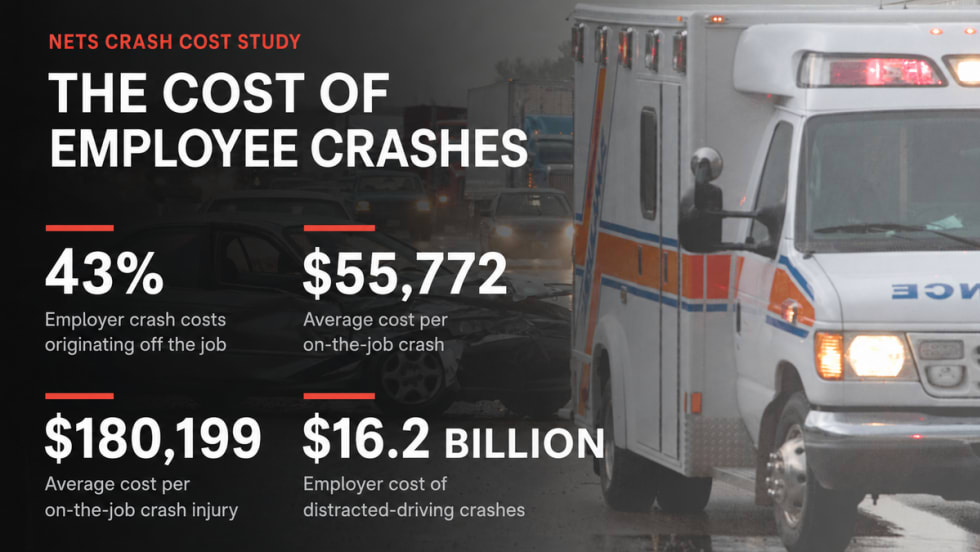
Off-the-Job Crashes Account for 43% of Employers’ $61.7 Billion Crash Burden
NETS quantifies costs dispersed across fleet, risk, HR, and other departments while providing new per-crash benchmarks for employers.
Read More →
Ram Recalls More Than 1.27 Million 1500 Pickups for Seat Belt Anchor Issue
The recall affects certain 2019-2026 Ram 1500 pickups that may have improperly attached second-row seat belt buckle anchors.
Read More →
How Better Visibility Cut Speeding Violations by 48%
Fleet leaders don't need more data, they need clearer visibility into what the data is saying. This case study explores how one utility replaced speeding-event counts with a single metric — miles driven in violation — to strengthen safety and significantly reduce speeding violations.
Read More →
Operation Safe Driver Week: Why the Industry's Oldest Safety Campaign Still Matters to Fleets
A look at how a 2007 enforcement initiative became one of the most consequential weeks on the fleet safety calendar, and what it means for your drivers in 2026.
Read More →