




Toyota Tacoma Top Performer in New Small Pickup Crash Tests
ARLINGTON, VA --- The Toyota Tacoma was the only one of five small pickup trucks, all 2008 models, to earn the highest rating of "good" for occupant protection in recent side crash tests conducted by the Insurance Institute for Highway Safety.
ARLINGTON, VA --- The Toyota Tacoma was the only one of five small pickup trucks, all 2008 models, to earn the highest rating of "good" for occupant protection in recent side crash tests conducted by the Insurance Institute for Highway Safety.
The Dodge Dakota, Ford Ranger and Nissan Frontier were rated "marginal." The Chevrolet Colorado was rated "poor" in the side test, which simulates a side impact from an SUV or another pickup.
"More people may be looking at small pickups because of rising gas prices," said Institute President Adrian Lund. "Unfortunately, they won't find many that afford state-of-the-art crash protection. Most earn dismal ratings for protecting people in side crashes, and all but the Tacoma and Frontier lack electronic stability control, which is a key feature in preventing crashes."
The institute said that performance in side tests is important because side impacts are the second most common type of fatal crash, killing nearly 9,000 occupants in 2006. The Tacoma's side airbags did a good job of reducing forces on the driver dummy and the passenger dummy in the back seat in the institute's test. The curtain-style airbag that deployed from the roof above the side windows protected the dummies' heads from being struck by any hard structures. The risk of significant injury to the head/neck and chest was low. Measures recorded on the driver dummy indicated a fracture of the pelvis would be possible in a real-world crash of this severity. The Tacoma's structure held up reasonably well, preventing major intrusion into the occupant compartment, the institute said.
The Tacoma also was rated "good" for frontal crash protection, but its seat/head restraints earned the second lowest rating of "marginal" for protection against whiplash in rear-end crashes.
The institute said that if Toyota improves the Tacoma's rear crash rating, this manufacturer would have the only two pickup models to earn the institute's Top Safety Pick award so far. The other is Toyota's Tundra, a large pickup truck.
The Tacoma is the only pickup in the group of small models that was tested with side airbags, which are optional in 2008 models. When side airbags are optional, the institute's policy is to test a vehicle without the option. An auto manufacturer may request a second test with the airbags if the automaker reimburses the institute for the cost of the vehicle. Manufacturers of the Dakota, Frontier and Colorado didn't request second tests (side airbags aren't offered in the Ranger, even as options).
The Tacoma was tested only with its optional side airbags, an exception to normal policy because such airbags will be standard in 2009 Tacoma pickups being shipped to dealers this month.
In 2008, side airbags are standard in more than 65 percent of new vehicle models. Manufacturers have pledged to make such airbags standard across their fleets by the 2010 model year. A federal side impact standard that essentially will require side airbags goes into effect in the 2015 model year.
Small pickup trucks have the highest driver death rates of any vehicles on the road, including minicars. In 2006, small pickups experienced 116 driver deaths per million registered vehicles one to three years old. This compares with 106 for minicars, 99 for small cars, and 42 for small SUVs. Part of the reason is that small pickup trucks are more likely than other passenger vehicles to be involved in single-vehicle crashes, especially rollovers.
Electronic stability control is a feature that can help prevent crashes, but it's not available on many pickups. It's standard on 12 percent of 2008 pickups, and it's not available at all on 67 percent. In contrast, it's standard on 64 percent of cars and 95 percent of SUVs. The only pickups in this group of small models with available electronic stability control are the Tacoma and Frontier. Toyota has made this feature standard on the Tacoma starting with 2009 models. It's also standard on the 2009 Colorado and GMC Canyon.
"We would expect electronic stability control to significantly reduce the single-vehicle crash risk in small pickups," Lund said. "It's a lifesaving feature that should be standard on all of these vehicles."
The Chevrolet Colorado, also sold as the GMC Canyon, was the only one to earn the lowest rating of "poor" in the institute's side test. The driver dummy's head was hit by the top of the institute's moving barrier during the impact. Moreover, the side structure of the Colorado allowed a lot more intrusion into the occupant compartment than the other pickups, the institute said.
In addition to the side tests, new frontal offset crash tests were conducted for the Colorado and Dakota. While the Dakota earned a "good" rating, the Colorado was rated "acceptable" overall for occupant protection in frontal crashes. In the frontal test of the Colorado, intrusion by the tire and wheel into the driver footwell area combined with separation of the footwell from the doorsill trapped the driver dummy's left foot underneath the brake pedal. The pedal had to be cut off to free the foot. This entrapment resulted in a structural rating downgrade for the Colorado. Still, injury measures for the dummy's head, neck, and chest were low.
All of the small pickup trucks the institute recently tested, except the Ford Ranger, are crew cabs with bench seats in back. Instead of this, the Ranger is equipped with two side-facing jump seats too small for anyone but very small adults or children. This pickup's side rating of "marginal" applies only to front-seat occupants.
The institute said it doesn't recommend riding in jump seats. Aside from lack of space, jump seats just have lap belts. A study conducted by the Children's Hospital of Philadelphia found that children riding in the small back seats of pickup trucks like the Ranger are about four times as likely to be injured in crashes as those in the back seats of other vehicles.
The institute's frontal crashworthiness evaluations are based on results of 40 mph frontal offset crash tests. Each vehicle's overall evaluation is based on measurements of intrusion into the occupant compartment, injury measures recorded on a Hybrid III dummy in the driver seat, and analysis of slow-motion film to assess how well the restraint system controlled dummy movement during the test.
Side evaluations are based on performance in a crash test in which the side of a vehicle is struck by a barrier moving at 31 mph. The barrier represents the front end of a pickup or SUV. Ratings reflect injury measures recorded on two instrumented SID-IIs dummies, assessment of head protection countermeasures, and the vehicle's structural performance during the impact.
Rear crash protection is rated according to a two-step procedure. Starting points for the ratings are measurements of head restraint geometry --- the height of a restraint and its horizontal distance behind the back of the head of an average-size man. Seat/head restraints with good or acceptable geometry are tested dynamically using a dummy that measures forces on the neck.
More Safety
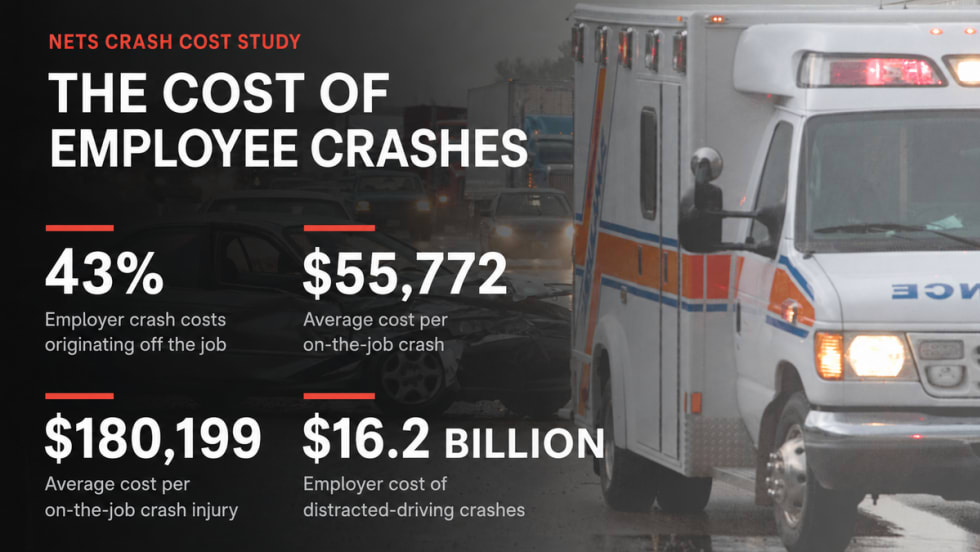
Off-the-Job Crashes Account for 43% of Employers’ $61.7 Billion Crash Burden
NETS quantifies costs dispersed across fleet, risk, HR, and other departments while providing new per-crash benchmarks for employers.
Read More →
Ram Recalls More Than 1.27 Million 1500 Pickups for Seat Belt Anchor Issue
The recall affects certain 2019-2026 Ram 1500 pickups that may have improperly attached second-row seat belt buckle anchors.
Read More →
Top 50 Executive Fleets
It is that time of year again! Time for the 2026 list of the Top 50 Executive Fleets, presented by Automotive Fleet and Volvo as part of its annual Fleet 500. Download now to see this year's list of companies!
Read More →
How Better Visibility Cut Speeding Violations by 48%
Fleet leaders don't need more data, they need clearer visibility into what the data is saying. This case study explores how one utility replaced speeding-event counts with a single metric — miles driven in violation — to strengthen safety and significantly reduce speeding violations.
Read More →
Operation Safe Driver Week: Why the Industry's Oldest Safety Campaign Still Matters to Fleets
A look at how a 2007 enforcement initiative became one of the most consequential weeks on the fleet safety calendar, and what it means for your drivers in 2026.
Read More →
Nexar-Nauto Merger Aims to Give Fleets Better Safety Intelligence Through Larger Driving Dataset
Stefan Heck tells Automotive Fleet that combining more than 10 billion miles of driving history with Nexar's AI models will give fleets deeper insights into driver risk and roadway conditions than either company could provide independently.
Read More →
From Silos to Solutions: Relationship Management for Safer Fleets
From telematics adoption and driver accountability to policy consistency and risk mitigation, this episode breaks down what it really takes to build a safer fleet culture without slowing business down.
Read More →
IIHS Launches First Commercial Vehicle Safety Evaluations
The Insurance Institute for Highway Safety has begun evaluating heavy-duty pickups and cargo vans for driver protection. Which models earned top marks?
Read More →
Reducing Risk by Eliminating Phone Use Behind the Wheel
Hosted with the cofounder of Lifesaver Mobile, this episode addresses phone use behind the wheel and how to design a driving environment that actually helps prevents accidents.
Read More →
Cameras, Safety and Insurance: From Reactive Claims to Real-Time Prevention (Part 2 of 2)
Part Two: Commercial auto remains one of the most challenging and costly lines of coverage for fleet operators and insurers alike. Continue learning more about how to effectively address these issues from Onur Aksan, Enterprise Business Development Executive, Geotab
Read More →