




Related: Toyota to Provide EVs, Autonomous Vehicles for 2020 Tokyo Games
Toyota Plans to Build Prototype 'City of the Future'
Toyota plans to populate Woven City with Toyota Motor Corporation employees and their families, retired couples, retailers, visiting scientists, and industry partners.
by Staff
January 7, 2020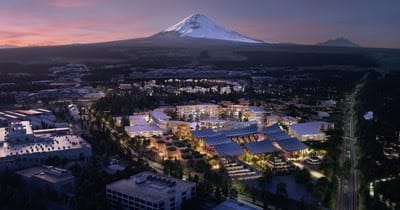
The groundbreaking for the site is planned for early 2021.
Photo courtesy of Toyota.
3 min to read
Yesterday at CES, Toyota revealed plans to build a prototype "city" of the future on a 175-acre site at the base of Mt. Fuji in Japan.
Called the Woven City, it will be a fully connected ecosystem powered by hydrogen fuel cells. Toyota plans to populate Woven City with Toyota Motor Corporation employees and their families, retired couples, retailers, visiting scientists, and industry partners. The plan is for 2,000 people to start, adding more as the project evolves.
Envisioned as a "living laboratory," the Woven City will serve as a home to full- time residents and researchers who will be able to test and develop technologies such as autonomy, robotics, personal mobility, smart homes and artificial intelligence in a real-world environment.
Toyota will extend an open invitation to collaborate with other commercial and academic partners and invite interested scientists and researchers from around the world to come work on their own projects in this one-of-a-kind, real-world incubator.
For the design of Woven City, Toyota has commissioned Danish architect, Bjarke Ingels, CEO, Bjarke Ingels Group (BIG). His team at BIG have designed many high-profile projects: from 2 World Trade Center in New York and Lego House in Denmark, to Google's Mountain View and London headquarters.
The masterplan of the city includes the designations for street usage into three types: for faster vehicles only, for a mix of lower speed, personal mobility and pedestrians, and for a park-like promenade for pedestrians only. These three street types weave together to form an organic grid pattern to help accelerate the testing of autonomy.
The city is planned to be fully sustainable, with buildings made mostly of wood to minimize the carbon footprint, using traditional Japanese wood joinery, combined with robotic production methods. The rooftops will be covered in photo-voltaic panels to generate solar power in addition to power generated by hydrogen fuel cells. Toyota plans to weave in the outdoors throughout the city, with native vegetation and hydroponics.
Residences will be equipped with the latest in human support technologies, such as in-home robotics to assist with daily living. The homes will use sensor-based AI to check occupants' health, take care of basic needs and enhance daily life, creating an opportunity to deploy connected technology with integrity and trust, securely and positively.
To move residents through the city, only fully-autonomous, zero-emission vehicles will be allowed on the main thoroughfares. In and throughout Woven City, autonomous Toyota e-Palettes will be used for transportation and deliveries, as well as for changeable mobile retail.
Both neighborhood parks and a large central park for recreation, as well as a central plaza for social gatherings, are designed to bring the community together. Toyota believes that encouraging human connection will be an equally important aspect of this experience.
The groundbreaking for the site is planned for early 2021.
More Fleet Forward
What Fleets Want: FFC Panel to Examine the Future of the Fleet-OEM Relationship
Fleet and OEM leaders will tackle how connected vehicles, embedded telematics, and data are changing the relationship between commercial fleets and automakers.
Read More →
2026 Fleet Manager of the Year Finalists Announced
Who are the 2026 Fleet Manager of the Year finalists?
Read More →
John Rossant to Deliver Opening Keynote at 2026 Fleet Forward Conference
The CoMotion founder will draw on developments across Europe, China, the Middle East, and other international markets to identify trends that could influence how U.S. fleets plan for the coming decade.
Read More →
How to Build Custom Fleet Tools With AI and Vibe Coding [Webinar]
A new Automotive Fleet webinar explores how fleet managers are using AI and vibe coding to automate routine work and create simple operational tools without traditional programming skills.
Read More →
Is Fleet Ready for Its New Disruptors?
Three emerging leaders from a corporate fleet, public fleet, and the automotive supply chain will bring new ideas and a willingness to challenge industry norms to the Fleet Forward Conference stage.
Read More →
NAFA Announces 2026 Fleet Safety Symposium Education Program
Register for NAFA’s Fleet Safety Symposium and save $200 on your Fleet Forward Conference registration.
Read More →
Fleet Managers Take the Lead in Hands-On AI Workshop at FFC
The fleet manager-led session will show how to use “vibe coding” to build practical fleet tools without a traditional programming background.
Read More →
NETS Crash-Cost Data and CoolSys’ 80% Loss Reduction Take Center Stage at FFC
NETS will present findings from its latest Cost of Crashes research, then CoolSys safety leader and author Shawn Martinez will explain how the company built a safer driving culture across 3,500 employees.
Read More →
Is Your Grey Fleet Creating an Unmanaged Safety Risk?
NCR Atleos Fleet Manager Jose Rocha will join Cardata and SambaSafety experts at Fleet Forward Conference to examine how fleets can extend safety oversight to every employee who drives for business.
Read More →
Agentic AI Session at FFC Will Help Fleets Turn Data Into TCO Action
Mike Albert Fleet Solutions and Motorq will show how agentic AI can uncover maintenance, fuel, and utilization savings buried across disconnected fleet data.
Read More →