




Toyota Disputes Account of San Diego Prius Driver
SAN DIEGO, CA - Toyota said Monday, March 15, that its preliminary test results on a 2008 Prius, which was allegedly involved in an unintended-acceleration episode last week near San Diego, were inconsistent with the driver's account.
SAN DIEGO, CA - Toyota said Monday, March 15, that its preliminary test results on a 2008 Prius, which was allegedly involved in an unintended-acceleration episode last week near San Diego, were inconsistent with the driver's account.
Toyota engineers on March 10 and 11 performed a technical field examination and testing on the car. "While a final report is not yet complete, there are strong indications that the driver's account of the event is inconsistent with the findings of the preliminary analysis," the company said.
Toyota said tests indicated that the driver repeatedly pressed the brake pedal and accelerator -- a conclusion that's at odds with the driver's account that he applied heavy pressure on the brakes while the car accelerated out of control on its own.
"We believe the vehicle was being driven with the front brakes lightly applied," Bob Waltz, Toyota's U.S. vice president for product quality and service support, said on Monday, according to a Wall Street Journal account of the press conference in San Diego.
James Sikes called 911 on March 8 while driving on a California freeway to report his Prius had sped up to more than 90 mph on its own and couldn't be stopped. Eventually, a California Highway Patrol officer pulled alongside Sikes' car and advised him to apply both the brakes and the emergency brake and to turn off the engine. Eventually, the car came to a stop. Sikes was uninjured.
[PAGEBREAK]
Toyota said company engineers employed data download/analysis, static and dynamic testing as well as thorough inspections of all relative components. In addition, Toyota said, company engineers retraced the reported driving route, taking into account driving time and statements from the 911 recording.
Toyota said the accelerator pedal was found to be working normally with no mechanical binding or friction. The front brakes showed severe wear and damage from overheating, but the rear brakes and parking brake were in good condition and functional.
In addition, the automaker said, a carpeted floor mat of the correct type was installed but not secured to the retention hooks. It was not found to be interfering or even touching the accelerator pedal, Toyota said. Also working normally were the push-button power switch and the shift lever. The 911 operator had advised Sikes to shift the car into Neutral and depress the power button for three seconds to turn the car off.
"There were no diagnostic trouble codes found in the power management computer, nor was the dashboard malfunction indicator light activated," Toyota said. "The hybrid self-diagnostic system did show evidence of numerous, rapidly repeated on-and-off applications of both the accelerator and the brake pedals."
[PAGEBREAK]
The Prius braking system is designed to use both conventional hydraulic friction brakes and a regenerative braking system that switches the electric drive motors into brakes to generate electricity. The system has a self-protection function that cuts engine power if moderate brake pedal pressure is applied and the accelerator pedal is depressed more than approximately 50 percent. "This function, which is intended to protect the system from overload and possible damage, was found to be functioning normally during the preliminary field examination," Toyota said.
Toyota engineers concluded "it would be extremely difficult for the Prius to be driven at a continuous high speed with more than light brake-pedal pressure, and that the assertion that the vehicle could not be stopped with the brakes is fundamentally inconsistent with basic vehicle design and the investigation observations."
Toyota suggested that Sikes' account of the incident draw further examination.
NHTSA investigators, who were present during Toyota's testing, are conducting their own examination. The NHTSA said on Monday that it couldn't yet "find anything to explain" Sikes' account of the incident. Sikes' attorney, John Gomez, said he would offer no further comment until the NHTSA had completed its investigation.
Meanwhile, California Highway Patrol spokesman Brian Pennings told the Wall Street Journal that its officer's observations about the incident aren't consistent with all of Toyota's conclusions. The CHP will release its own report.
More Safety

Nexar-Nauto Merger Aims to Give Fleets Better Safety Intelligence Through Larger Driving Dataset
Stefan Heck tells Automotive Fleet that combining more than 10 billion miles of driving history with Nexar's AI models will give fleets deeper insights into driver risk and roadway conditions than either company could provide independently.
Read More →
Don't Wait for a Crisis: 5 Ways to Build Mental Health Into Your Fleet Safety Program
For Suicide Prevention Month, fleet and safety leaders have an opportunity to put mental health where it belongs: at the center of workplace safety.
Read More →
How Camera Data Can Strengthen a Fleet’s Insurance Renewal
Insights from a commercial insurance carrier and a broker show how fleets can turn video telematic data, driver coaching, and improved claims results into a stronger case at insurance renewal.
Read More →
The Safest Fleets Aren’t the Ones with the Most Technology
You’ve made the telematics investment. Here’s how to capture the other half of its value and build the safest fleet on the road.
Read More →
Hidden in Plain Sight: Fleet Compliance Risks
Fleet compliance isn't just about having policies — it's about consistently enforcing them. This practical guide reveals six hidden compliance risks common in public sector and shared fleet operations and outlines proven strategies to improve visibility, accountability, and audit readiness
Read More →
NETS Sets 2026 Fleet Safety Benchmark Conference for Indianapolis
The Sept. 15–17 program will feature fleet benchmarking data, case studies, emerging technologies, and implementation strategies while running alongside the NSC Safety Congress & Expo.
Read More →
Off-the-Job Crashes Account for 43% of Employers’ $61.7 Billion Crash Burden
NETS quantifies costs dispersed across fleet, risk, HR, and other departments while providing new per-crash benchmarks for employers.
Read More →
Ram Recalls More Than 1.27 Million 1500 Pickups for Seat Belt Anchor Issue
The recall affects certain 2019-2026 Ram 1500 pickups that may have improperly attached second-row seat belt buckle anchors.
Read More →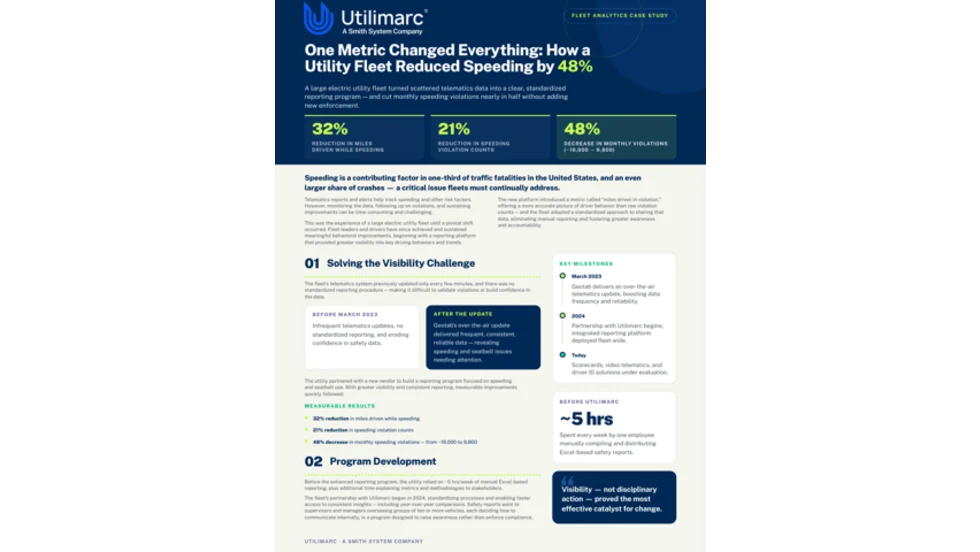
How Better Visibility Cut Speeding Violations by 48%
Fleet leaders don't need more data, they need clearer visibility into what the data is saying. This case study explores how one utility replaced speeding-event counts with a single metric — miles driven in violation — to strengthen safety and significantly reduce speeding violations.
Read More →
Operation Safe Driver Week: Why the Industry's Oldest Safety Campaign Still Matters to Fleets
A look at how a 2007 enforcement initiative became one of the most consequential weeks on the fleet safety calendar, and what it means for your drivers in 2026.
Read More →