




Toyota Celebrates 60 Years in the U.S.
Since its humble beginnings in a 3,000-square-foot, one-time Rambler dealership, Toyota has woven itself into the cultural fabric of America. Sixty years in, it encompasses a presence in every state, including 10 manufacturing facilities and nearly 1,500 Toyota and Lexus dealerships.
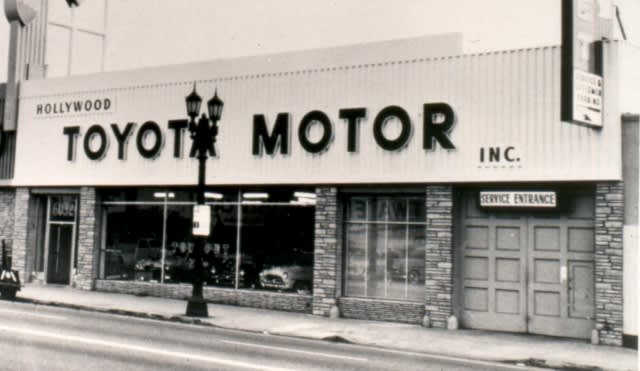
Photo of Toyota's first U.S. headquarters in Hollywood, Calif., courtesy of Toyota.
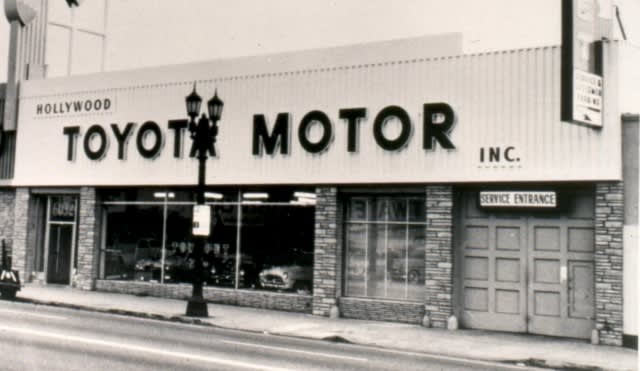
Photo of Toyota's first U.S. headquarters in Hollywood, Calif., courtesy of Toyota.
When Toyota launched its North American headquarters in a Hollywood, Calif., dealership on October 31, 1957, it was, no doubt, a frightening affair. Halloween notwithstanding, a Japanese car company making a foray into the U.S. market was a bold move 60 years ago. And, according to the automaker, its first vehicle the Toyopet Crown didn’t turn out to be a screaming success either.
But, since those humble beginnings in a 3,000-square-foot, one-time Rambler dealership, Toyota has woven itself into the cultural fabric of America. Sixty years in, it encompasses a presence in every state, including 10 manufacturing facilities (14 in North America), nearly 1,500 Toyota and Lexus dealerships, and 136,000 direct, dealer and supplier U.S. employees.
And, the company recently unified operations by bringing together its quality engineering, sales, marketing, financial services and corporate functions in one location at a new North America headquarters campus in Plano, Texas.
“Celebrating our anniversary isn’t just about the products we’ve sold the past 60 years,” said Toyota Motor North America CEO Jim Lentz. “It’s also about celebrating Toyota’s thousands of employees who will help the company embark on the next leg of its American journey and continuing to improve our products and services for our customers.”
To commemorate its 60th anniversary, Toyota rededicated a 50th anniversary time capsule originally dedicated at its former Torrance, Calif., headquarters in 2007. The capsule, which includes items like a 2000GT die cast matchbox edition model car, an original key for a 1977 Toyota Hilux truck and a Toyota Formula One racer scale model—will be re-opened on the 100th anniversary in 2057.
Plano Mayor Harry LaRosiliere, who attended the ceremony, said the capsule marks a new chapter for Toyota.
“As Toyota moved their North American corporate offices to Plano over the last three years, the entire region has experienced the positive impact of their team members unique character and culture. The entire organization exhibits a sense of purpose, innovation, and family. We are proud they call Plano home, and we are honored to be part of today’s anniversary celebration,” LaRosiliere said. “We look forward to the next 60 years with Toyota in the City of Plano.”
Toyota’s American journey has been fueled by the cars it makes.
In the 1950s that meant the Toyopet Crown and the now-legendary Land Cruiser. Introduced in the 1960s, the Corolla would go on to become the bestselling nameplate in the world.
The 1970s got sporty with the Celica and the beloved Supra.
The 1980s introduced the American public to Camry and 4Runner, among others.
In 1989, Toyota launched its luxury vehicle division, Lexus, in the U.S. with two models, the LS 400 and ES 250.
In the 1990s, Toyota filled out its lineup with models like the Tacoma, RAV4, Avalon, and Sienna, and from Lexus, the GS, LX, and RX.
In 2003, Toyota launched Scion to bring in younger customers and to test out revolutionary processes and products.
The 1970s were critical to operations. Toyota marked its first U.S. production, signing Atlas Fabricators of Long Beach (later changed to TABC) to make truck beds. Toyota Technical Center, which just celebrated its 40th anniversary in May, opened its first U.S. R&D facility and Calty Design Research opened its doors in Southern California.
Growth continued into the 1980s with the launch of manufacturing facilities in California and Kentucky. In addition, Toyota Motor Credit Corporation (now known as Toyota Financial Services), began operations in the U.S. in October 1982. In the 1990s and 2000s, Toyota added vehicle and parts plants in Indiana, West Virginia, Alabama, Tennessee, Texas, Missouri, and Mississippi. To support the rapid growth, Toyota consolidated its R&D and manufacturing operations under a single company in 2006.
Over the years, Toyota Motor North America has transformed from just a sales company into a mobility company. In 2016, the Toyota Research Institute launched, leading the way to autonomous vehicles, robotics, vehicle safety and materials science.
In the same year, Toyota Connected was created to use data to personalize the customer driving experience. What started as a single store in Southern California has evolved into an American institution that continues to bring jobs, mobility, and technology to its communities.
More Operations

Here's When You Should Make an Exception to Fleet Policy
Fleet policies are designed to create consistency, but not every driver or situation fits neatly within standard rules.
Read More →
AI-Native or AI-Acquired: What Should Fleet Managers Look for in an AI Platform?
Six questions can help fleet managers look beyond AI marketing claims to evaluate integration, data access, and real-world operational performance.
Read More →
A buyer's guide to fleet management software in 2027
Buying fleet management software in 2027 means looking beyond features and price. As fleet operations, technology and expectations evolve, this guide explores what today’s fleet professionals should consider when choosing a system that can deliver value now and adapt to what comes next.
Read More →

What Will Shape the Next Era of Fleet Management?
EVs, AI, and autonomous vehicles are reshaping fleet management. Discover what’s ahead—and how fleet leaders can prepare for the next era.
Read More →
How Fleets Can Recruit and Train Veterans for Technician Roles
Here's how the technician shortage has affected uptime for fleets, and what to do about it.
Read More →
Avis Budget Group Deploys Neology Toll Management Technology Across Major Brands
Neology’s neoFleet platform will manage toll transactions and toll-authority operations for vehicles across Avis, Budget, Payless, Budget Truck and Zipcar.
Read More →
Fleet Personal-Use Charges Edge Higher in 2026
Nearly eight in 10 surveyed fleets allow personal use of company vehicles, while just over half of respondents report charging employees for the privilege.
Read More →
The Future of Fleet + What’s Changing Right Now | AF News Recap
Could developments overseas offer a preview of what’s coming for U.S. fleets? This week, we’re looking at the future of AI, autonomy, and electrification, plus Ford Pro’s new certified pre-owned program, smarter vehicle offboarding, and a new way for fleets to manage toll expenses.
Read More →
How to Handle Vehicle Offboarding
What do fleet managers need to do when a driver leaves?
Read More →
Fleet Manager’s Ultimate Playbook: Navigating the New Standard in OEM Connectivity
Rising operating costs, driver safety concerns, and unplanned downtime are putting unprecedented pressure on modern fleets. Discover how fleet managers use embedded OEM connectivity and real-time vehicle data to cut TCO, prevent downtime, and protect drivers without aftermarket telematics hardware.
Read More →