




Study: Americans Favor Alcohol Detection Devices
ARLINGTON, VA --- A new survey indicates that people are ready to prevent any driver from starting a vehicle after drinking too much alcohol, even though the technology to do it isn't available yet.
ARLINGTON, VA --- A new survey indicates that people are ready to prevent any driver from starting a vehicle after drinking too much alcohol, even though the technology to do it isn't available yet.
Responding to a new Insurance Institute for Highway Safety survey, people across the nation said they like the idea of using advanced technology to stop drunk drivers from operating their vehicles. About two of three respondents deem this a good or very good idea, assuming the technology is reliable. More than 40 percent would want such devices in their own cars if offered as an option. Drinkers and nondrinkers alike favor the concept.
The results are the institute's first take on what people think about equipping all vehicles with alcohol detection devices that would be more sophisticated than the ignition interlocks in some vehicles today. A total of 1,004 people were surveyed July 15-19. Results are weighted for the U.S. population.
"The results are clear-cut and a bit surprising," said Anne McCartt, the institute's senior vice president for research. "We didn't expect to find support across the board for the idea of detecting alcohol in everybody, but this survey tells us people are ready to crack down on all impaired drivers, not just those who've had DWI convictions."
Nearly three of four respondents said they'd heard about interlocks being required in cars of people with DWI convictions. Wired to ignitions, the devices keep vehicles from starting if convicted offenders register blood alcohol readings above a predetermined level, usually well below the legal blood alcohol concentration (BAC) threshold of 0.08 percent.
About 180,000 interlocks are in use nationwide. They're successfully reducing the risk that prior offenders will commit repeat violations. However, most fatal-crash-involved drivers with illegal BACs haven't had a DWI conviction in the past three years. If interlocks had been in all vehicles, not just those of prior offenders, to prevent driving above the legal limit, more than 8,000 lives could have been saved last year, the institute estimated.
An impediment is the device itself. Interlocks mandated for DWI offenders are "unwieldy and obtrusive," McCartt pointed out. "This is okay for convicted offenders but not for every driver on every trip. An alcohol detector that's suitable for all drivers would have to be all but invisible and require virtually no upkeep. It would have to be quick and easy to use and provide accurate readings. No such device exists yet, but it's being worked on."
The Driver Alcohol Detection System for Safety program, a partnership between the National Highway Traffic Safety Administration and Automotive Coalition for Traffic Safety, is exploring new detection technologies that one day could be developed for widespread use.
"The idea is to stop anyone from operating a vehicle if the BAC registers 0.08 percent or higher, not to prevent drivers from having any drinks at all before getting in their cars," McCartt explained. Sixty-four percent of survey respondents said the devices would be a good idea in all cars if the technology proves reliable. Only 30 percent said it's a bad idea.
Not surprisingly, support is stronger for use by convicted drunk drivers. Eighty-four percent of people surveyed said this is a good idea, compared with 15 percent who said it's not a good idea or a bad idea.
Among the 33 percent of respondents who volunteered that they never drink, approval of the devices in all cars is 74 percent. It's still high, at 66 percent, among people who said they drink once a week. Even among people who said they drink four or more times a week, support for the devices is about 50 percent.
Twenty-six percent of survey respondents who regularly drive and also said they drink admitted to driving within two hours of consuming alcohol. Seventy percent of these people volunteered they might have gotten behind the wheel when over the legal alcohol limit. Presumably these are the drivers who would be most affected by detection devices, but 55 percent said they consider the devices a good idea for everyone. This isn't much different from the 60 percent of drivers who drink but say they never drive within two hours of drinking.
Asked why they're a good idea, 67 percent of survey participants said interlocks prevent drunk driving. Saving lives and preventing crashes are the next most often cited reasons.
About a third of respondents who felt the technology is a bad or very bad idea cited concerns about privacy or government interference, while 20 percent said not all drivers need to be screened. Others mentioned concerns about the device's accuracy and cost.
Forty-two percent of the people who regularly drive said they would want an alcohol detection device in their next vehicle if it were available as an option and the price were reasonable. Most people felt a price under $500 would be reasonable. Of the 54 percent who said they wouldn't want a device, 44 percent volunteered they don't drink alcohol so it wouldn't be useful. Forty-four percent of drivers who drink said they would want an alcohol detection device in their next vehicle.
Alcohol-impaired driving is a big contributor to fatal crashes, and most impaired drivers are never arrested. A total of 11,773 people died in crashes involving drivers with BACs at or above 0.08 percent in 2008. This represents 32 percent of all traffic-related deaths.
More Safety

Nexar-Nauto Merger Aims to Give Fleets Better Safety Intelligence Through Larger Driving Dataset
Stefan Heck tells Automotive Fleet that combining more than 10 billion miles of driving history with Nexar's AI models will give fleets deeper insights into driver risk and roadway conditions than either company could provide independently.
Read More →
Don't Wait for a Crisis: 5 Ways to Build Mental Health Into Your Fleet Safety Program
For Suicide Prevention Month, fleet and safety leaders have an opportunity to put mental health where it belongs: at the center of workplace safety.
Read More →
How Camera Data Can Strengthen a Fleet’s Insurance Renewal
Insights from a commercial insurance carrier and a broker show how fleets can turn video telematic data, driver coaching, and improved claims results into a stronger case at insurance renewal.
Read More →
The Safest Fleets Aren’t the Ones with the Most Technology
You’ve made the telematics investment. Here’s how to capture the other half of its value and build the safest fleet on the road.
Read More →
Hidden in Plain Sight: Fleet Compliance Risks
Fleet compliance isn't just about having policies — it's about consistently enforcing them. This practical guide reveals six hidden compliance risks common in public sector and shared fleet operations and outlines proven strategies to improve visibility, accountability, and audit readiness
Read More →
NETS Sets 2026 Fleet Safety Benchmark Conference for Indianapolis
The Sept. 15–17 program will feature fleet benchmarking data, case studies, emerging technologies, and implementation strategies while running alongside the NSC Safety Congress & Expo.
Read More →
Off-the-Job Crashes Account for 43% of Employers’ $61.7 Billion Crash Burden
NETS quantifies costs dispersed across fleet, risk, HR, and other departments while providing new per-crash benchmarks for employers.
Read More →
Ram Recalls More Than 1.27 Million 1500 Pickups for Seat Belt Anchor Issue
The recall affects certain 2019-2026 Ram 1500 pickups that may have improperly attached second-row seat belt buckle anchors.
Read More →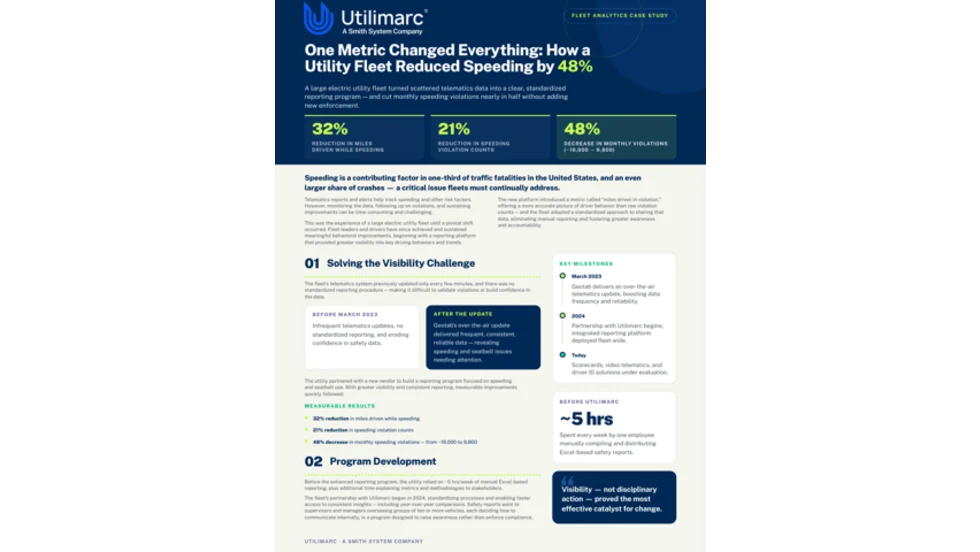
How Better Visibility Cut Speeding Violations by 48%
Fleet leaders don't need more data, they need clearer visibility into what the data is saying. This case study explores how one utility replaced speeding-event counts with a single metric — miles driven in violation — to strengthen safety and significantly reduce speeding violations.
Read More →
Operation Safe Driver Week: Why the Industry's Oldest Safety Campaign Still Matters to Fleets
A look at how a 2007 enforcement initiative became one of the most consequential weeks on the fleet safety calendar, and what it means for your drivers in 2026.
Read More →