




Speeding Declines After Boston Reduces Limit
Speeding declined significantly in Boston, after the city lowered the limit to 25 miles per hour from 30 mph, according to new analysis from the Insurance Institute for Highway Safety released today.

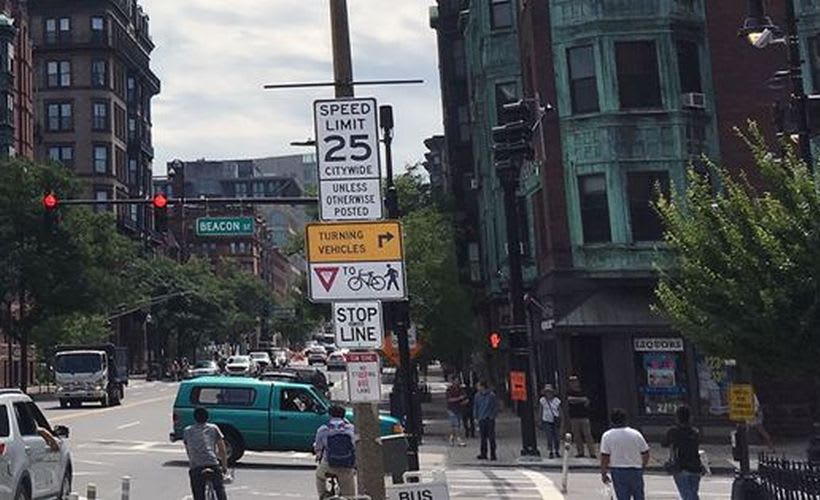
Excessive speeding has declined significantly in Boston after the city lowered the speed limit to 25 mph from 30 mph.
Photo courtesy of IIHS.
Speeding declined significantly in Boston, after the city lowered the limit to 25 miles per hour from 30 mph, according to new analysis from the Insurance Institute for Highway Safety released today.
Vehicles exceeding 35 mph after the change fell by 29.3%, while vehicles exceeding 30 mph fell by 8.5%, and vehicles exceeding 25 mph fell by 2.9%, according to the institute. Boston lowered the limit on Jan. 17, 2017. The findings were presented at the Governors Highway Safety Association meeting in Atlanta on Aug. 28.
"Speeding occurs on roads of all types, not just highways and freeways," said David Harkey, the institute's president. "Even on lower speed roads, speeding can have deadly consequences, especially for pedestrians and bicyclists. Some cities are lowering speed limits to reduce the risks for these vulnerable road users, who are increasingly dying in crashes."
With the study, the institute is hoping to support Vision Zero initiatives in cities, including Boston, New York, and Seattle, that seek to eliminate all traffic fatalities and severe injuries. The initiative began in Sweden.
Cities have faced high-dollar civil settlements and judgments as a result of city fleet vehicles, including public works vehicles, striking and killing pedestrians. Pedestrian deaths in the U.S. have increased 46% since reaching a low point in 2009 with higher rates of increases in urban areas. The faster a vehicle is moving, the less time the driver has to see a pedestrian and slow down or stop.
A pedestrian struck by a vehicle at 25 mph has a 25% risk of sustaining a serious or fatal injury. The risk increases to 50% at 33 mph and 75% at 41 mph, according to research from the AAA Foundation for Traffic Safety.
The National Safety Council applauded the study as a public awareness tool.
"This study serves as a reminder that raising speed limits is counterproductive and higher speeds bring greater risks, particularly to our pedestrians and bicyclists who are our most vulnerable roadway users. The study also reinforces the power of high visibility enforcement campaigns. When drivers are well-informed about changes to existing laws and the consequences of breaking them, they are more inclined to change their own behaviors and drive safer," according to a statement from the council.
More Safety

Fleet Manager’s Ultimate Playbook: Navigating the New Standard in OEM Connectivity
Rising operating costs, driver safety concerns, and unplanned downtime are putting unprecedented pressure on modern fleets. Discover how fleet managers use embedded OEM connectivity and real-time vehicle data to cut TCO, prevent downtime, and protect drivers without aftermarket telematics hardware.
Read More →
From Driver Well-Being to EV Charging | AF News Recap
Mental health belongs in the fleet safety conversation. This week, we’re looking at five ways fleets can support employee well-being before a crisis, plus Holman’s expansion in Mexico, new one-day Fleet Forward passes, and why EV charging demand is outpacing infrastructure growth.
Read More →
Nexar-Nauto Merger Aims to Give Fleets Better Safety Intelligence Through Larger Driving Dataset
Stefan Heck tells Automotive Fleet that combining more than 10 billion miles of driving history with Nexar's AI models will give fleets deeper insights into driver risk and roadway conditions than either company could provide independently.
Read More →
Don't Wait for a Crisis: 5 Ways to Build Mental Health Into Your Fleet Safety Program
For Suicide Prevention Month, fleet and safety leaders have an opportunity to put mental health where it belongs: at the center of workplace safety.
Read More →
How Camera Data Can Strengthen a Fleet’s Insurance Renewal
Insights from a commercial insurance carrier and a broker show how fleets can turn video telematic data, driver coaching, and improved claims results into a stronger case at insurance renewal.
Read More →
The Safest Fleets Aren’t the Ones with the Most Technology
You’ve made the telematics investment. Here’s how to capture the other half of its value and build the safest fleet on the road.
Read More →
Hidden in Plain Sight: Fleet Compliance Risks
Fleet compliance isn't just about having policies — it's about consistently enforcing them. This practical guide reveals six hidden compliance risks common in public sector and shared fleet operations and outlines proven strategies to improve visibility, accountability, and audit readiness
Read More →
NETS Sets 2026 Fleet Safety Benchmark Conference for Indianapolis
The Sept. 15–17 program will feature fleet benchmarking data, case studies, emerging technologies, and implementation strategies while running alongside the NSC Safety Congress & Expo.
Read More →
Off-the-Job Crashes Account for 43% of Employers’ $61.7 Billion Crash Burden
NETS quantifies costs dispersed across fleet, risk, HR, and other departments while providing new per-crash benchmarks for employers.
Read More →
Ram Recalls More Than 1.27 Million 1500 Pickups for Seat Belt Anchor Issue
The recall affects certain 2019-2026 Ram 1500 pickups that may have improperly attached second-row seat belt buckle anchors.
Read More →