




Report: U.S. Pedestrian Fatalities Remain High
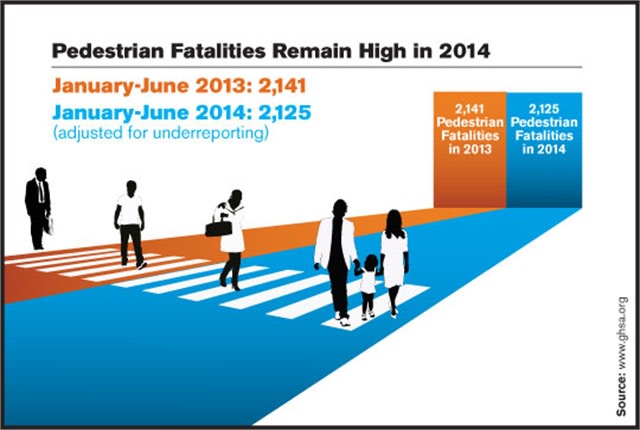
A report from the Governors Highway Safety Association finds that 2,125 pedestrians were killed in the first half of 2014 – essentially unchanged when compared with the 2,141 pedestrian fatalities during the same period in 2013.
Graphic courtesy of GHSA.
Graphic courtesy of GHSA.
A new report concludes that the number of pedestrians killed on American roadways last year likely remained about the same as in 2013, but 24 states and Washington D.C. did see pedestrian fatality decreases in the year’s first half.
Released by the Governors Highway Safety Association, the report analyzes preliminary data provided by the 50 state highway safety offices and the District of Columbia. Dr. Allan Williams, former chief scientist at the Insurance Institute for Highway Safety, compared the number of pedestrian fatalities from the first six months of 2013 and 2014.
Early data indicate a slight (2.8 percent) decrease in deaths. But after factoring in expected undercounting, Williams estimates that 2,125 pedestrians were killed in the first half of 2014 – essentially unchanged when compared with the 2,141 pedestrian fatalities during the same period in 2013.
“This is clearly a good news, bad news scenario,” said Jonathan Adkins, GHSA executive director. “While we're encouraged that pedestrian fatalities haven’t increased over the past two years, progress has been slow. Protecting pedestrians is a priority for GHSA and our members; we're determined to drive the number down to zero.”
Making sustained strides in pedestrian safety has been challenging, Williams agreed.
“Pedestrian deaths declined steeply from 7,516 in 1975 to 4,735 in 2013,” Williams pointed out. “But when you consider the percentage of pedestrians killed in all motor vehicle crashes, the gains are less pronounced. The rate was 17 percent in the late 1970s and early 1980s. It fell to a low of 11 percent in the past decade, but climbed back to 14 percent in 2013.”
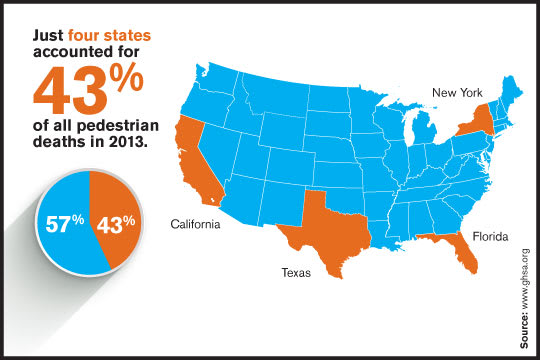
Williams noted that states with the most fatalities are primarily large-population states with large urban centers. Four states – California, Florida, Texas, and New York – accounted for 43 percent of all pedestrian deaths in 2013. Delaware and Florida had the highest rates of pedestrian deaths per 100,000 residents at 2.70 and 2.56, respectively. In the District of Columbia, pedestrians accounted for the highest percentage of all motor vehicle deaths (45 percent), followed by New York (28 percent), Nevada (25 percent) and Delaware (25 percent).
The findings, however, do offer some promise. Twenty-four states and the District of Columbia had decreases in pedestrian fatalities in the first half of 2014, compared with the same period in 2013, while five remained the same. Sixteen states had nine or fewer pedestrian fatalities, with Wyoming and Nebraska each reporting just one.
Also encouraging is the substantial reduction in pedestrian fatalities involving the elderly and children. While pedestrians 70 and older have always had the highest per-capita crash rate of any age group, that number dropped from 9.3 in 1975 to 2.2 in 2013. Meanwhile, in 1975 nearly one in four pedestrian deaths (21 percent) involved infants and children up to 12 years of age; that rate fell to 4 percent in 2013.
What’s troubling is the 28-percentage-point surge in deaths involving pedestrians ages 20 to 69 over this same period. Additionally, about 70 percent of pedestrians killed in motor vehicle crashes were males, many of whom were struck at night and in the fall and winter months.
Alcohol is also a factor in many of these fatal crashes. In 2013, more than a third (36 percent) of pedestrians 16 and older involved in fatal crashes had blood alcohol concentrations of .08 or higher.
Distraction may play a role as well, since there is some evidence from Fatality Analysis Reporting System (FARS) and emergency room data that both distracted driving and walking are contributing increasingly to pedestrian injuries and fatalities.
To combat the problem, states are using a combination of engineering, education and enforcement solutions. For example, California is distributing a “how to” guide to help communities address pedestrian safety. At high-risk intersections in Pennsylvania, specially identified crossing guards are educating pedestrians of all ages about safe crossing practices. Police officers in Delaware are participating in education patrols, during which violators are stopped, educated and, in some cases, given items to increase their visibility.
Graphic courtesy of GHSA.
New York City, recognizing the impact speed has on a pedestrian's survival rate, opted to lower the city speed limit – from 30 mph to 25 mph – last November. The change is just one component of the city's “Vision Zero” plan, which also includes public outreach about safe walking and driving practices, enforcement of pedestrian safety laws and infrastructure improvements.
Engineering countermeasures such as pedestrian refuge islands, longer pedestrian signal timing and more visible crosswalks – combined with education and enforcement – are also being used in many states, including Washington and Maryland.
To read the full report, titled “Spotlight on Highway Safety: Pedestrian Traffic Fatalities by State,” click here.
More Safety

Nexar-Nauto Merger Aims to Give Fleets Better Safety Intelligence Through Larger Driving Dataset
Stefan Heck tells Automotive Fleet that combining more than 10 billion miles of driving history with Nexar's AI models will give fleets deeper insights into driver risk and roadway conditions than either company could provide independently.
Read More →
Don't Wait for a Crisis: 5 Ways to Build Mental Health Into Your Fleet Safety Program
For Suicide Prevention Month, fleet and safety leaders have an opportunity to put mental health where it belongs: at the center of workplace safety.
Read More →
How Camera Data Can Strengthen a Fleet’s Insurance Renewal
Insights from a commercial insurance carrier and a broker show how fleets can turn video telematic data, driver coaching, and improved claims results into a stronger case at insurance renewal.
Read More →
The Safest Fleets Aren’t the Ones with the Most Technology
You’ve made the telematics investment. Here’s how to capture the other half of its value and build the safest fleet on the road.
Read More →
Hidden in Plain Sight: Fleet Compliance Risks
Fleet compliance isn't just about having policies — it's about consistently enforcing them. This practical guide reveals six hidden compliance risks common in public sector and shared fleet operations and outlines proven strategies to improve visibility, accountability, and audit readiness
Read More →
NETS Sets 2026 Fleet Safety Benchmark Conference for Indianapolis
The Sept. 15–17 program will feature fleet benchmarking data, case studies, emerging technologies, and implementation strategies while running alongside the NSC Safety Congress & Expo.
Read More →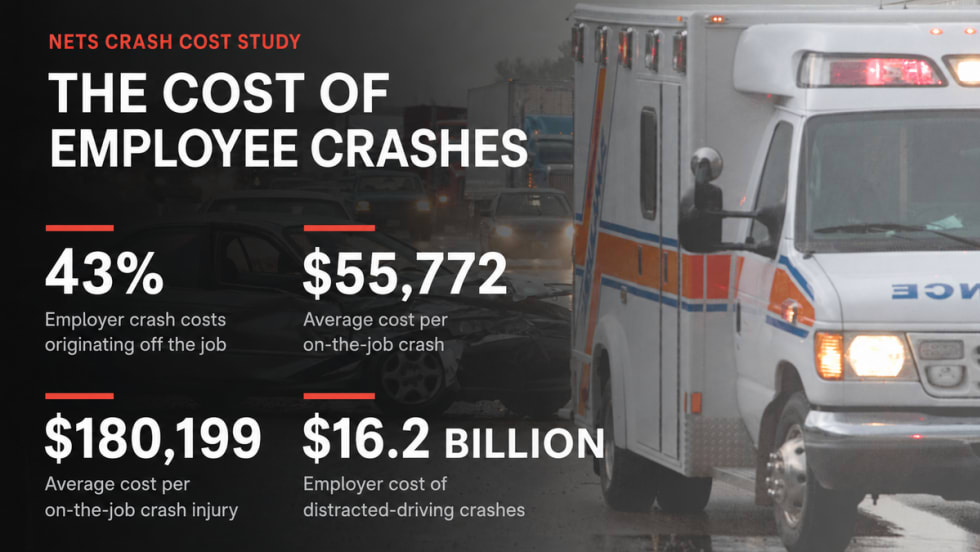
Off-the-Job Crashes Account for 43% of Employers’ $61.7 Billion Crash Burden
NETS quantifies costs dispersed across fleet, risk, HR, and other departments while providing new per-crash benchmarks for employers.
Read More →
Ram Recalls More Than 1.27 Million 1500 Pickups for Seat Belt Anchor Issue
The recall affects certain 2019-2026 Ram 1500 pickups that may have improperly attached second-row seat belt buckle anchors.
Read More →
How Better Visibility Cut Speeding Violations by 48%
Fleet leaders don't need more data, they need clearer visibility into what the data is saying. This case study explores how one utility replaced speeding-event counts with a single metric — miles driven in violation — to strengthen safety and significantly reduce speeding violations.
Read More →
Operation Safe Driver Week: Why the Industry's Oldest Safety Campaign Still Matters to Fleets
A look at how a 2007 enforcement initiative became one of the most consequential weeks on the fleet safety calendar, and what it means for your drivers in 2026.
Read More →