





Learn More: A Roadmap for U.S. Postal Service Electrification
Propane Autogas Truck Delivered to USPS Contractor
Hi Pro will soon add five Class 6 medium-duty straight box propane autogas delivery trucks to its fleet.
April 16, 2021
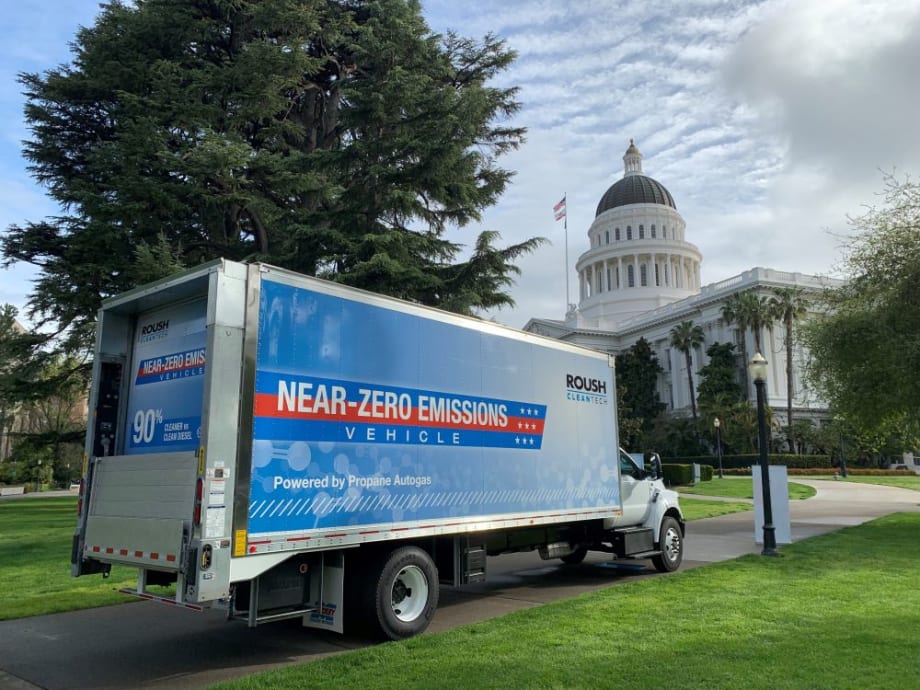
The Ford gasoline trucks, will be upfitted with a propane system developed by ROUSH CleanTech.
Photo: ROUSH CleanTech
3 min to read
Hi Pro Inc., a nationwide mail logistics contractor, will soon add five Class 6 medium-duty straight box propane autogas delivery trucks to its fleet. HPro has more 40 years of service history with the USPS and currently includes service in the Denver area.
The Colorado-bound vehicles are part of a $1 million research pilot project funded through the U.S. Department of Energy’s Office of Energy Efficiency & Renewable Energy.
“Our goal coming out of this project is to demonstrate real-world applications of propane autogas as an alternative to diesel-fueled trucks,” said Bonnie Trowbridge, executive director of the Denver Metro Clean Cities Coalition. “As a state that prioritizes sustainability, we’re especially excited to conduct this research in Colorado. This is an opportunity to study the air quality benefits of the ultra-low NOx propane engines and show that propane autogas is a viable clean energy source for fleets.”
The project, entitled “Delivering Clean Air in Denver: Propane Trucks and Infrastructure in Mail Delivery Application” will fund the purchase and deployment of the propane-powered logistics trucks and infrastructure. DMCC, in partnership with DOE’s National Renewable Energy Laboratory, will track data and performance measurements of the propane autogas trucks. DMCC will work with the Propane Education & Research Council to provide educational materials using the collected data.
“We are honored to be selected for this important research project and to reduce emissions in our community,” said Joshua Stoneback, CEO at Hi Pro. “Through this project, we will create a playbook for fleets to also go green with propane autogas. In fact, we would like to implement similar low-NOx emission fuel choices across the nation with the assistance of USPS and our partners in this Denver Metro project.”
The Ford gasoline trucks, will be upfitted with a propane system developed by Roush CleanTech. The conversion will employ ultra-low NOx engines, which in real-world testing reduced harmful emissions by 96% compared to diesel. The engine is certified to the optional ultra-low NOx CARB .02 standard, operating 90% cleaner than the EPA’s strictest heavy-duty standard. Each truck will also produce 281 metric tons of CO2 less per year than the same electric vehicle charging and operating using Colorado’s electric grid.
“Not only is propane autogas a near-zero-emissions solution that’s readily available today, it’s also the most cost-effective solution to reduce emissions,” said Stephen Whaley, director of autogas business development at PERC. “Propane autogas has the lowest total cost-of-ownership, providing a win-win for fleets and the environment.”
The vehicles and infrastructure will be delivered and installed later this year. The new propane station will be provided by AmeriGas.
“We are excited to get this project off the ground and to start supplying Hi Pro Inc. with domestic, clean propane autogas,” said Chris Ransom, national account manager - autogas for AmeriGas. “We’re ready to show that propane autogas can provide fleets with the performance and range they need while still achieving near-zero emissions.”
Originally posted on Work Truck Online
More Global Fleet

GeoFencing Adds to Your Truck Security Arsenal
Geofencing is a familiar fleet tool today, but its early adoption marked a major shift in vehicle tracking, route monitoring, and the debate over employee privacy.
Read More →
Holman Takes Full Ownership of ARIZA in Mexico
Holman is bringing its Mexican fleet management operation fully under its own brand after more than 30 years as a joint venture. The change gives multinational fleet customers a single Holman operation across the U.S., Canada, and Mexico.
Read More →
5 Tire Maintenance Tips to Help Prevent Work Truck Downtime
Regular tire checks can do more than extend tread life. These five maintenance practices can help work truck fleets catch problems early, reduce costs, and prevent downtime.
Read More →

Proven Ways to Reduce Work Truck Downtime
The age-old problem of downtime will always be a reality, but with new strategies at hand, fleets have more ways to keep trucks on the road longer.
Read More →


Cameras, Safety and Insurance: From Reactive Claims to Real-Time Prevention (Part 2 of 2)
Part Two: Commercial auto remains one of the most challenging and costly lines of coverage for fleet operators and insurers alike. Continue learning more about how to effectively address these issues from Onur Aksan, Enterprise Business Development Executive, Geotab
Read More →
Cameras, Safety and Insurance: From Reactive Claims to Real-time Prevention
Commercial auto remains one of the most challenging and costly lines of coverage for fleet operators and insurers alike. Learn more about how to effectively address these issues from Onur Aksan, Enterprise Business Development Executive, Geotab.
Read More →
Fleet Costs Are Rising: Here’s How Leaders Are Responding
Fleet leaders are under pressure to reduce costs, adapt to economic uncertainty, and make smarter decisions. See how peers across North America are responding with real data, proven strategies, and forward-looking insights. Download the 2026 Market Pulse Report to benchmark your strategy and uncover where you can gain an edge.
Read More →
Enterprise Fleet Management Surpasses 900,000 Vehicles in U.S. & Canada
Enterprise Mobility connects with mobility solutions around the globe
Read More →