




Pedestrian Deaths Climb a Projected 10%
Preliminary crash data for 2015 reveal a disturbing trend that’s detailed in a new report from the Governors Highway Safety Association.
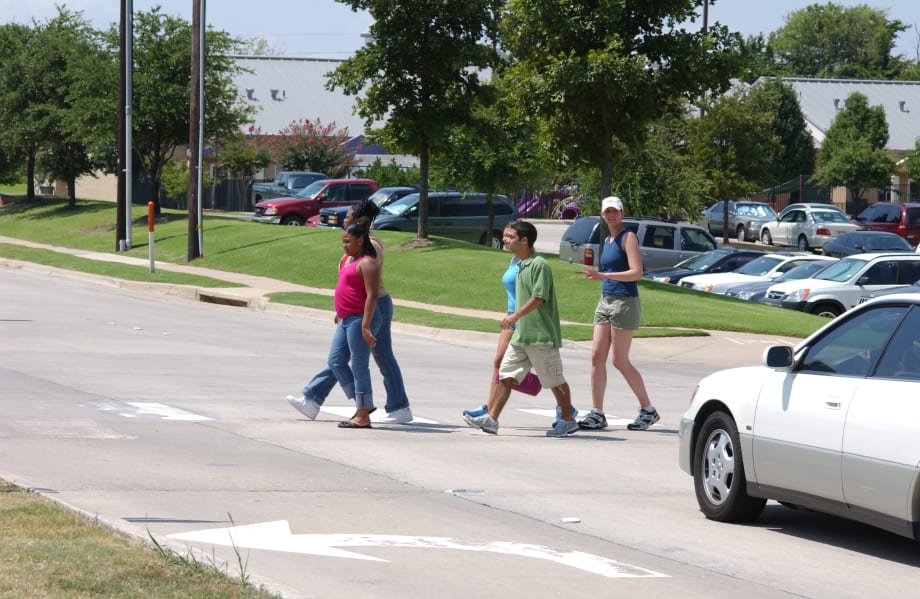
GHSA has asked its state members to share examples of strategies underway to reduce pedestrian and motor vehicle collisions. Photo courtesy of NHTSA.
GHSA has asked its state members to share examples of strategies underway to reduce pedestrian and motor vehicle collisions. Photo courtesy of NHTSA.
Pedestrian deaths resulting from traffic crashes rose a projected 10% in 2015 compared to the previous year, according to a new report based on preliminary crash data.
The Governors Highway Safety Association (GHSA) released its annual Spotlight on Highway Safety Report, which provides the first look at 2015 pedestrian fatality trends. The report is based on early figures reported by all 50 state highway safety agencies and the District of Columbia. Richard Retting and Dr. Heather Rothenberg of Sam Schwartz Consulting authored the report.
“We are projecting the largest year-to-year increase in pedestrian fatalities since national records have been kept, and therefore we are quite alarmed,” Retting said.
Since the federal Fatality Analysis Reporting System was established in 1975, the year-to-year change in the number of pedestrian fatalities has varied from a 10.5% decrease to an 8.1% increase.
“Pedestrian safety is clearly a growing problem across the country,” Retting noted. “It is important to understand the data underlying these crashes so states and localities can apply the right mix of engineering, education and enforcement to counteract this troubling trend.”
Researchers compared the number of pedestrian fatalities for the first six months of 2015 (2,368) with the same time period the previous year (2,232). They adjusted for anticipated underreporting associated with the early data, and expect the final 2015 pedestrian fatality total will be approximately 10% higher than in 2014.
Along with the increase in pedestrian fatalities, pedestrians now account for a larger share— about 15% — of all motor vehicle crash-related deaths compared with 11% a decade ago.
Many factors could be contributing to this spike. An increase in motor vehicle travel, fueled in part by improved economic conditions and lower gas prices, is one factor. Also, the growing use of cell phones among walkers and drivers may be partially to blame.
Additionally, vehicles are becoming more and more crashworthy, so the likelihood of drivers and passengers surviving a crash is improving all the time. By contrast, pedestrians remain just as susceptible to injuries when hit by a motor vehicle.
Another important factor is the increase in the number of Americans walking for health, economic or environmental reasons. This underscores the need to create safe, walkable pathways and to ensure that people who drive and people who walk both understand and follow the rules of the road, GHSA said.
States reported a wide range of increases and decreases in the number of pedestrian fatalities over the first six months of 2015. Twenty-one states had decreases, 26 states and the District of Columbia reported increases, and three states had no change.
Not surprisingly, more pedestrian fatalities tend to occur in large states with large urban centers. California, Florida, Texas and New York accounted for 42% of all pedestrian deaths in the first six months of 2015. However, when population is taken into account, the states with the highest fatality rate per 100,000 residents were all over the map. In 2014, the seven states with the highest rates were New Mexico, Florida, Delaware, Nevada, Louisiana, South Carolina and Arizona.
“GHSA and our member states will continue to make pedestrian safety a priority,” said Jonathan Adkins, GHSA executive director. “The recently passed federal surface transportation bill, the FAST Act, will give states more resources and flexibility to address their most pressing pedestrian safety problems. We look forward to working with NHTSA and our other partners to drive down these numbers and move toward zero deaths.”
GHSA has asked its state members to share examples of strategies underway to reduce pedestrian and motor vehicle collisions. Some of the most promising approaches include targeted traffic enforcement coupled with public information campaigns, data analysis and mapping to identify high-risk zones, community-based pedestrian safety assessments and road safety audits, and strategic partnerships with universities or other organizations. The report provides examples of these efforts in 28 states.
You can access the full report at www.ghsa.org.
More Safety
IIHS Crash Avoidance Tests Reveal Safety Gaps in Cargo Vans and Work Trucks
New crash-avoidance ratings from the Insurance Institute for Highway Safety reveal inconsistent performance among commercial vehicles, with several popular cargo vans and heavy-duty pickups struggling to avoid collisions with other vehicles and pedestrians.
Read More →
What’s Next for Fleet? Safety, AI & Industry Recognition | AF News Recap
Could your company's culture be encouraging distracted driving? This week, we're exploring how workplace expectations affect driver safety, what AI, EVs, and autonomous vehicles could mean for the future of fleet management, and how fleet professionals can strengthen their award nominations.
Read More →
Does Your Fleet's Culture Encourage Distracted Driving?
What happens when the people responsible for enforcing safety rules are the ones setting the wrong example? The answer may reveal why some of the biggest risks to fleet drivers have little to do with what's written in the employee handbook.
Read More →
Fleet Manager’s Ultimate Playbook: Navigating the New Standard in OEM Connectivity
Rising operating costs, driver safety concerns, and unplanned downtime are putting unprecedented pressure on modern fleets. Discover how fleet managers use embedded OEM connectivity and real-time vehicle data to cut TCO, prevent downtime, and protect drivers without aftermarket telematics hardware.
Read More →
From Driver Well-Being to EV Charging | AF News Recap
Mental health belongs in the fleet safety conversation. This week, we’re looking at five ways fleets can support employee well-being before a crisis, plus Holman’s expansion in Mexico, new one-day Fleet Forward passes, and why EV charging demand is outpacing infrastructure growth.
Read More →
Nexar-Nauto Merger Aims to Give Fleets Better Safety Intelligence Through Larger Driving Dataset
Stefan Heck tells Automotive Fleet that combining more than 10 billion miles of driving history with Nexar's AI models will give fleets deeper insights into driver risk and roadway conditions than either company could provide independently.
Read More →
Don't Wait for a Crisis: 5 Ways to Build Mental Health Into Your Fleet Safety Program
For Suicide Prevention Month, fleet and safety leaders have an opportunity to put mental health where it belongs: at the center of workplace safety.
Read More →
How Camera Data Can Strengthen a Fleet’s Insurance Renewal
Insights from a commercial insurance carrier and a broker show how fleets can turn video telematic data, driver coaching, and improved claims results into a stronger case at insurance renewal.
Read More →
The Safest Fleets Aren’t the Ones with the Most Technology
You’ve made the telematics investment. Here’s how to capture the other half of its value and build the safest fleet on the road.
Read More →
Hidden in Plain Sight: Fleet Compliance Risks
Fleet compliance isn't just about having policies — it's about consistently enforcing them. This practical guide reveals six hidden compliance risks common in public sector and shared fleet operations and outlines proven strategies to improve visibility, accountability, and audit readiness
Read More →