




New Tech Helps Turning Left, Changing Lanes
German automotive supplier Continental highlights new advanced features including left-turn assist, smart street lights and a lane-change assistant.
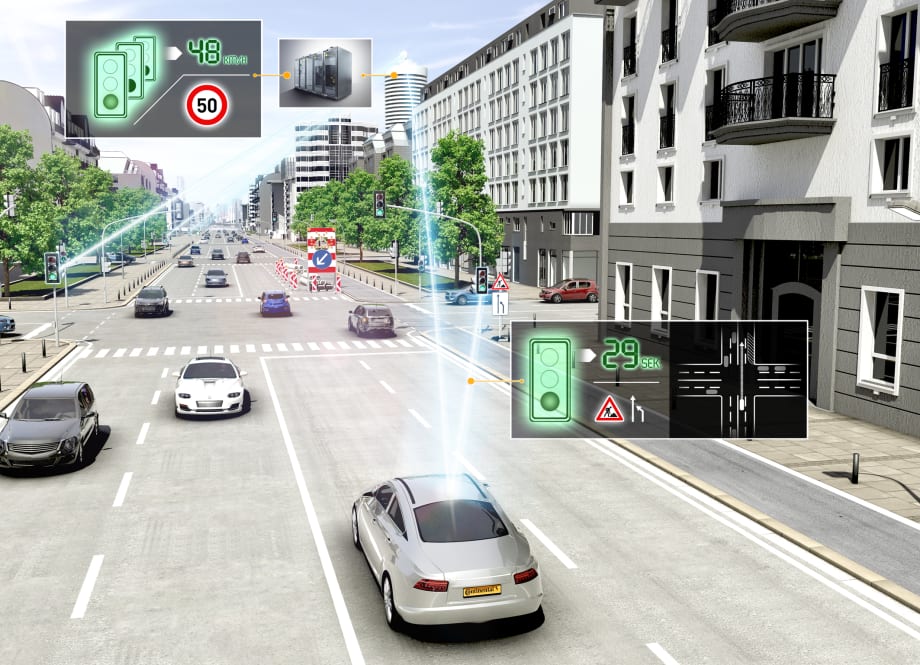
This image, courtesy of Continental, illustrates how vehicle-to-X communications can help make urban driving safer and more efficient.
This image, courtesy of Continental, illustrates how vehicle-to-X communications can help make urban driving safer and more efficient.
At recent auto industry events in Europe, Continental AG has showcased a range of new advanced safety features including left-turn assist, electronic brake lights, a lane change assistant and even smart street lights.
The German automotive supplier’s newly unveiled safety features provide a glimpse into future applications of vehicle-to-vehicle and vehicle-to-infrastructure – collectively known as “vehicle-to-X” – communications.
The Left Turn Assist feature is designed to help drivers execute one of the most dangerous driving maneuvers – making a left turn at an intersection when the driver’s full view of oncoming traffic is obstructed. Continental highlighted this feature at the Frankfurt Motor Show last month.
Left Turn Assist issues audible and visual warnings to alert the driver of an impending collision arising from an approaching vehicle that’s hidden from view. Automatic intervention is only triggered if the driver fails to observe the warning despite the increasing probability of an accident, according to Continental.
Also presented was the Electronic Brake Light, which informs the driver when a vehicle further ahead in traffic is braking, even if it cannot be seen yet. This information can be very valuable, particularly on winding country roads, Continental said. Additionally, the company highlighted its Roadworks Assistant, which provides information about work zones ahead and recommends the lane the driver should choose to ensure optimal safety.
“Our aim is to reduce the number of accidents significantly or to eliminate them altogether,” said Bernhard Klumpp, head of the passive safety and sensorics division at Continental. “With V2X, it is possible not just to see around the corner, so to speak, but also to detect hazards early on, before they are visually perceived. By issuing appropriate warnings, through cooperative assistance, and right up to an intervention by the vehicle, we want to eliminate these hazards, before the driver notices them or the sensors detect them.”
Continental’s so-called V2X OneBox contains all the components required for V2X communication, the company said. This solution implements ad-hoc communication – real-time direct communication between vehicles without a fixed network infrastructure.
The OneBox can easily be integrated into the existing vehicle architecture and is based on a modular system that’s already compatible with next-generation applications, such as the initiation of emergency braking maneuvers instead of warnings, Continental said.
The direct communication between road users via an ad-hoc network makes V2X communication very different from interaction via a backend. V2X communication requires neither a mobile phone network nor a mobile network operator. Communication is independent of network availability – an essential prerequisite for safety-related technologies, Continental said.
Earlier this month, Continental demonstrated its “smart street light of the future” during the ITS World Congress event in Bordeaux, France. A shift toward using LED lights on streets has created the potential for smart functionality in street lights.
“The use of LEDs means that the electronics required for control, diagnostics and communication are already present in the street lights,” said Alfred Waldhaeusl, who is coordinating the intelligent street light project at Continental.
The diagnostic function, which reports light failure to operators, provides the information channel required to forward sensor data as well. And that sensor data can address a range of driver concerns – from the presence of pedestrians to the availability of parking spaces.
“Sensors enable us to identify whether parking spaces in the vicinity of the light are occupied,” Waldhaeusl explained. “We can then provide this information either directly or via a cloud to drivers who are looking for a parking space nearby. This way we improve parking management, revenues and the CO2 footprint of municipalities.”
Sensors, of course, can also detect moving objects and people. Brightness could be adjusted to match requirements, depending on whether a pedestrian, cyclist or car is approaching. Or the light could even be switched off entirely.
“We could also identify accidents and not just ensure rapid assistance but also warn following vehicles,” Waldhaeusl added.
Intelligent street light control could also play a key role in automated driving. Additional key elements include recording environmental factors such as brightness, temperature, rain, snow and the formation of ice.
At the UR:BAN project event in Düsseldorf, Germany, also held this month, Continental demonstrated how driver assistance and vehicle networking technologies can make city driving safer. The demonstrated systems provided driver assistance with narrow passages, oncoming traffic and lane changes.
The Lane Change Assistant has 360-degree vision, reducing the burden on drivers in inner-city traffic scenarios with multiple lanes, according to Continental. The system determines the position of the host vehicle in the lane and uses environment sensors to monitor the space around the vehicle – including behind it. This information permits the assistant to detect whether a safe lane change is possible and to help execute the lane change if that’s what the driver wants.
The aim of this function is to guide the vehicle safely and smoothly into the neighboring lane. Drivers can, however, override these steering and longitudinal vehicle control systems at any time by steering or braking, the company said.
Congested city streets represent one of the most demanding scenarios for driver assistance systems. But vehicle-to-X technology has the potential to dramatically improve both safety and congestion on urban roads.
“That is precisely why we took on this challenge,” said Hongjun Pu, project manager for Continental. “To allow drivers to traverse intersections more smoothly and thereby free up the traffic flow, we use vehicle-to-X networking via WLAN or, if required, the mobile phone network and Internet.”
More Safety

Nexar-Nauto Merger Aims to Give Fleets Better Safety Intelligence Through Larger Driving Dataset
Stefan Heck tells Automotive Fleet that combining more than 10 billion miles of driving history with Nexar's AI models will give fleets deeper insights into driver risk and roadway conditions than either company could provide independently.
Read More →
Don't Wait for a Crisis: 5 Ways to Build Mental Health Into Your Fleet Safety Program
For Suicide Prevention Month, fleet and safety leaders have an opportunity to put mental health where it belongs: at the center of workplace safety.
Read More →
How Camera Data Can Strengthen a Fleet’s Insurance Renewal
Insights from a commercial insurance carrier and a broker show how fleets can turn video telematic data, driver coaching, and improved claims results into a stronger case at insurance renewal.
Read More →
The Safest Fleets Aren’t the Ones with the Most Technology
You’ve made the telematics investment. Here’s how to capture the other half of its value and build the safest fleet on the road.
Read More →
Hidden in Plain Sight: Fleet Compliance Risks
Fleet compliance isn't just about having policies — it's about consistently enforcing them. This practical guide reveals six hidden compliance risks common in public sector and shared fleet operations and outlines proven strategies to improve visibility, accountability, and audit readiness
Read More →
NETS Sets 2026 Fleet Safety Benchmark Conference for Indianapolis
The Sept. 15–17 program will feature fleet benchmarking data, case studies, emerging technologies, and implementation strategies while running alongside the NSC Safety Congress & Expo.
Read More →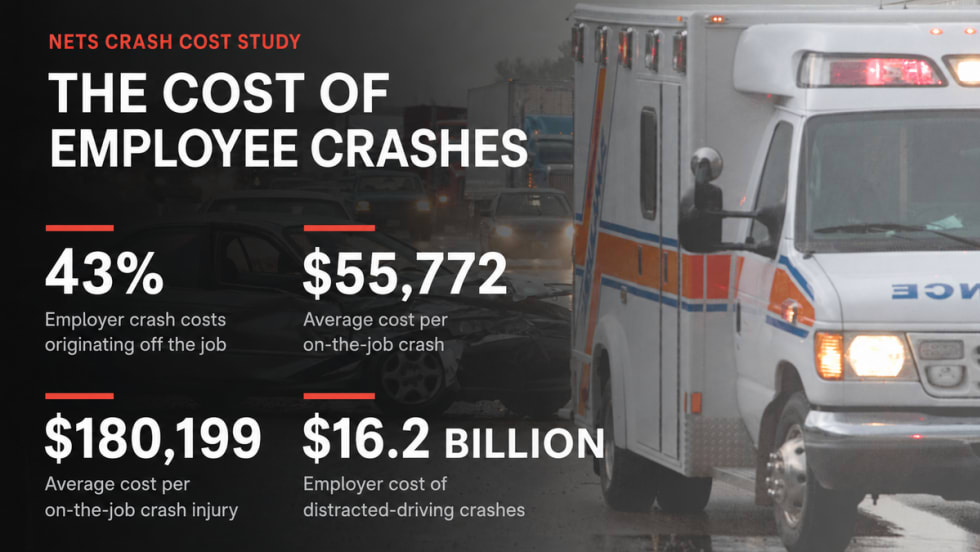
Off-the-Job Crashes Account for 43% of Employers’ $61.7 Billion Crash Burden
NETS quantifies costs dispersed across fleet, risk, HR, and other departments while providing new per-crash benchmarks for employers.
Read More →
Ram Recalls More Than 1.27 Million 1500 Pickups for Seat Belt Anchor Issue
The recall affects certain 2019-2026 Ram 1500 pickups that may have improperly attached second-row seat belt buckle anchors.
Read More →
How Better Visibility Cut Speeding Violations by 48%
Fleet leaders don't need more data, they need clearer visibility into what the data is saying. This case study explores how one utility replaced speeding-event counts with a single metric — miles driven in violation — to strengthen safety and significantly reduce speeding violations.
Read More →
Operation Safe Driver Week: Why the Industry's Oldest Safety Campaign Still Matters to Fleets
A look at how a 2007 enforcement initiative became one of the most consequential weeks on the fleet safety calendar, and what it means for your drivers in 2026.
Read More →