




New Samsara Report Reveals Holiday Driving Trends
Samsara's latest report examines driving behaviors during the holidays and provides tips on how to stay safe.

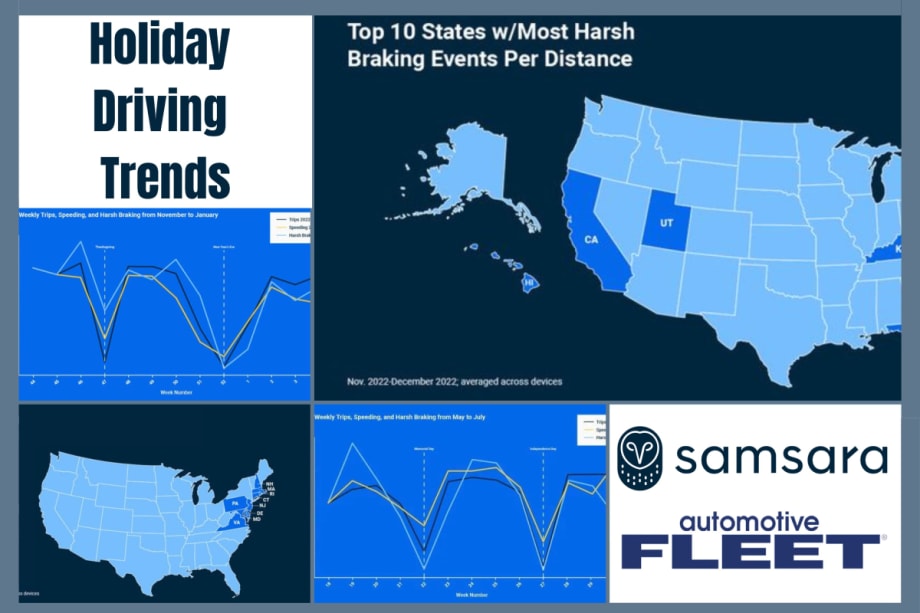
The roads will be busier than usual during the holidays and professional drivers will be working to do their jobs safely and efficiently.
Photo: Automotive Fleet/Samsara
For the professional drivers who work through the busy end-of-year holiday season, more vehicles on the road—combined with obvious hazards like snow, rain, and ice—could lead to more dangerous trips. To identify the trends and common risks of driving during the holidays, Samsara's Data Science and Analytics team released a new report taking a closer look at the driving behaviors of organizations in 2022 and 2023.
Samsara found that risky driving behaviors often don't peak during holiday weeks themselves. Rather, these issues are more common in the weeks leading up to and following holidays.
Harsh Braking Common Around Thanksgiving
One study found that harsh braking is one of the most likely predictors of future crashes.
For this reason, any rise in harsh braking is cause for concern, and our data showed higher levels of this behavior surrounding the Thanksgiving holiday, according to Samsara.
Harsh braking was 22% higher the week before Thanksgiving, compared to the week of the holiday. Furthermore, harsh braking was 13% higher in the week after Thanksgiving, compared to Thanksgiving week. The company also identified the top 10 states where drivers experience the most harsh braking during November and December 2022.
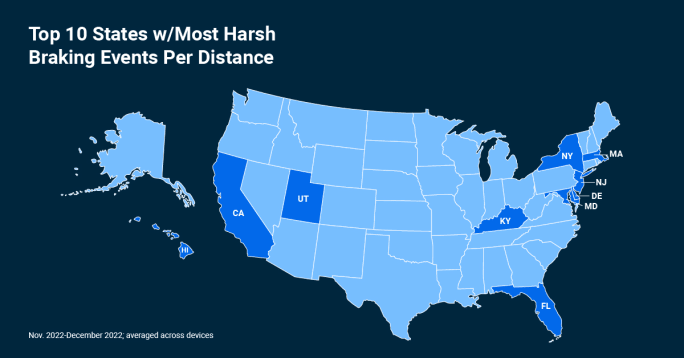
Sudden, hard braking—also called harsh braking—is highly associated with on-the-road crashes for commercial drivers.
Photo: Samsara
When Samsara looked at incidents of speeding, as compared to Thanksgiving week, it found that incidents were 21% higher the week before and incidents were 22% higher the week after. However, speeding was not uniform across the country, as is the case with harsh braking, where incident rates are more consistent.
Many of the states with the highest level of speeding per trip were clustered in the Northeast, including Connecticut, New Hampshire, Delaware, and Maryland.
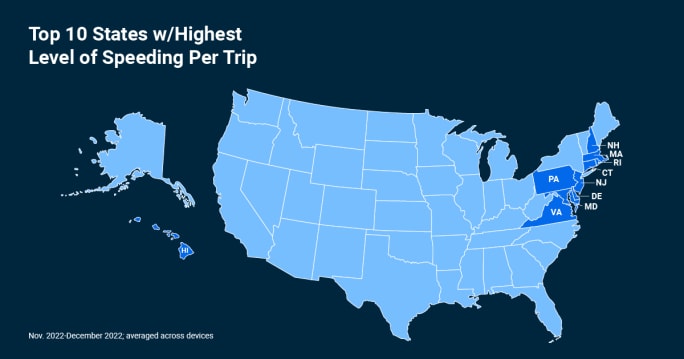
Traffic, harsh braking, and speeding have been highly correlated in Samsara's data.
Photo: Samsara
Samsara also noticed trends in what time of day drivers speed the most. Trips where speeding occurs are more likely to start mid-morning, 9:00 am to 11:00 am, while they are least likely to start late at night, 10:00 pm to 1:00 am.
These results suggest that professional drivers aren’t speeding when there is a relatively open road in front of them late at night, but rather at times when there are likely more drivers on the road. Samsara's data reflects conclusions from the NHTSA that show traffic congestion is a top contributing factor to aggressive driving behaviors, including speeding.
Moreover, traffic volume is typically higher around the holidays. In 2022, we found that trip volume was 37% higher the week before Thanksgiving compared to Thanksgiving week. Data from organizations like the National Safety Council point to increased traffic volume as a major risk factor for road accidents around major holidays.
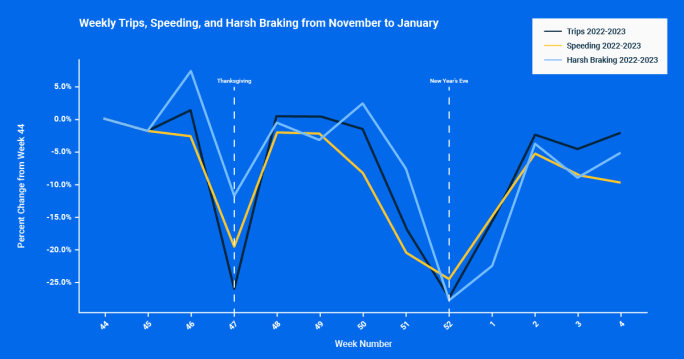
The graph illustrates the weekly percentage change relative to the baseline value from the first week of November (week 44). It shows the normalized number of trips, average time spent speeding, and harsh braking between November and early January.
Photo: Samsara
Risks Increase Around Many Major Holidays
Unsafe driving behaviors like speeding and harsh braking fluctuate across weeks of the year, especially around holidays. In fact, according to the National Highway Traffic Safety Administration, there are generally more motor vehicle traffic crash fatalities during holiday periods than during non-holiday periods.
For every holiday, there are busier and less busy times. For example, Samsara's data showed that speeding incidents were 9% higher the week before Independence Day and incidents were 10% higher the week after in 2022. A similar trend occurred in 2023 when we saw that speeding incidents, compared to the week of Independence Day, were 15% higher the week before and incidents were 14% higher the week after.
These swings suggest that in some instances commercial drivers might be shifting activity away from holiday weeks to those before and after holidays. As they do, however, they might end up with more trips during weeks that have relatively higher speeding and harsh braking rates. Overall, higher levels of speeding and harsh braking incidents are consistent from year to year around holiday time periods, according to the report.
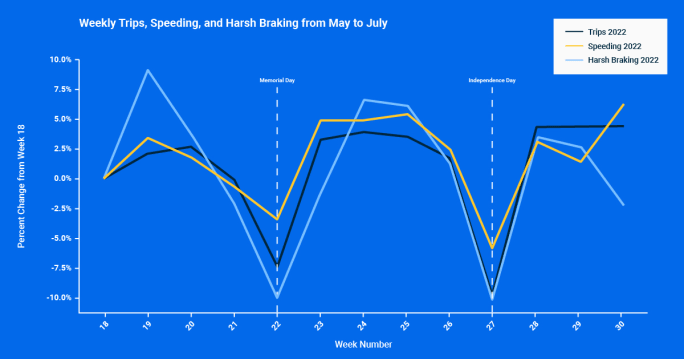
The graph illustrates the weekly percentage change relative to the baseline value from the first week of May (week 18). Shows the normalized number of trips, average time spent speeding, and harsh braking between May and July in 2022.
Photo: Samsara
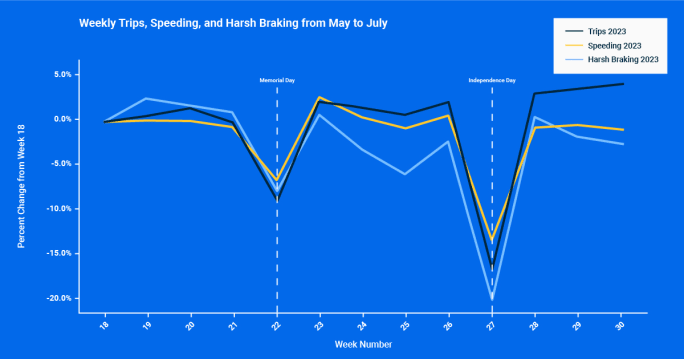
The graph shows the normalized number of trips, average time spent speeding, and harsh braking between May and July in 2023.
Photo: Samsara
Tips for Safer Driving During the Holidays
Here are three tips Samsara rounded up from professional drivers with decades of experience and exceptional safety records to help everyone drive more safely:
Watch out for distracted driving: Ina Daly, a driver with XPO who has 40 years of experience, said: “You can tell a distracted driver by their fluctuating speed... They're drifting in their lane. Their head is looking down instead of focusing on the road. You want to give those people a wide berth.”
Add extra time to your driving itinerary: Daly also points out the importance of not adding to the holiday rush by giving yourself more time to get where you’re going. She said: “You don't want that stressful drive. You’re hurrying. That lends to bad driving behaviors like tailgating and speeding, which leads to accidents. Don’t put yourself in that situation.”
Remember to respect trucks and other non-passenger vehicles: Robert Chidester, a driver for RelaDyne with 45 years of experience and a Samsara Top Driver award winner, noted that not all vehicles behave the same way. He said: "Some people think driving a truck is exactly like driving a car, but it’s not. It doesn’t stop like a car, it doesn’t go around corners like a car, and it can’t go uphill like a car. Some people on the road get really frustrated with trucks, but I think they just don’t understand how a truck needs to operate and drive on the road. Just give us some patience and remember that we’re driving the way a truck needs to be driven safely."
The statistics shown are based on a review of anonymized historical data of Samsara customers in the United States.
More Safety

Fleet Manager’s Ultimate Playbook: Navigating the New Standard in OEM Connectivity
Rising operating costs, driver safety concerns, and unplanned downtime are putting unprecedented pressure on modern fleets. Discover how fleet managers use embedded OEM connectivity and real-time vehicle data to cut TCO, prevent downtime, and protect drivers without aftermarket telematics hardware.
Read More →
From Driver Well-Being to EV Charging | AF News Recap
Mental health belongs in the fleet safety conversation. This week, we’re looking at five ways fleets can support employee well-being before a crisis, plus Holman’s expansion in Mexico, new one-day Fleet Forward passes, and why EV charging demand is outpacing infrastructure growth.
Read More →
Nexar-Nauto Merger Aims to Give Fleets Better Safety Intelligence Through Larger Driving Dataset
Stefan Heck tells Automotive Fleet that combining more than 10 billion miles of driving history with Nexar's AI models will give fleets deeper insights into driver risk and roadway conditions than either company could provide independently.
Read More →
Don't Wait for a Crisis: 5 Ways to Build Mental Health Into Your Fleet Safety Program
For Suicide Prevention Month, fleet and safety leaders have an opportunity to put mental health where it belongs: at the center of workplace safety.
Read More →
How Camera Data Can Strengthen a Fleet’s Insurance Renewal
Insights from a commercial insurance carrier and a broker show how fleets can turn video telematic data, driver coaching, and improved claims results into a stronger case at insurance renewal.
Read More →
The Safest Fleets Aren’t the Ones with the Most Technology
You’ve made the telematics investment. Here’s how to capture the other half of its value and build the safest fleet on the road.
Read More →
Hidden in Plain Sight: Fleet Compliance Risks
Fleet compliance isn't just about having policies — it's about consistently enforcing them. This practical guide reveals six hidden compliance risks common in public sector and shared fleet operations and outlines proven strategies to improve visibility, accountability, and audit readiness
Read More →
NETS Sets 2026 Fleet Safety Benchmark Conference for Indianapolis
The Sept. 15–17 program will feature fleet benchmarking data, case studies, emerging technologies, and implementation strategies while running alongside the NSC Safety Congress & Expo.
Read More →
Off-the-Job Crashes Account for 43% of Employers’ $61.7 Billion Crash Burden
NETS quantifies costs dispersed across fleet, risk, HR, and other departments while providing new per-crash benchmarks for employers.
Read More →
Ram Recalls More Than 1.27 Million 1500 Pickups for Seat Belt Anchor Issue
The recall affects certain 2019-2026 Ram 1500 pickups that may have improperly attached second-row seat belt buckle anchors.
Read More →