




Midsize Cars Show Improved Side-Impact Protection
ARLINGTON, Va. --- Occupant protection in side impacts of midsize cars is improving as automakers introduce safer designs and add side airbags as standard equipment.
ARLINGTON, Va. --- Occupant protection in side impacts of midsize cars is improving as automakers introduce safer designs and add side airbags as standard equipment.
The Insurance Institute for Highway Safety recently completed front, side, and rear tests of seven 2008 model midsize cars, both moderately priced and luxury: Chevrolet Malibu, Dodge Avenger, Infiniti G35, Kia Optima, Mitsubishi Galant, Nissan Altima and Saturn Aura. All earned the highest rating of good for occupant protection in frontal crashes. All but the Kia Optima earned the top rating of good for side crash protection (Malibu's rating applies to cars built after February 2008). Rear crash protection results varied more widely. Among the seats/head restraints evaluated, only those in the Optima earned a good rating.
"The side impact results represent a huge change from just four years ago," said David Zuby, institute senior vice president . "In 2004, we tested 10 midsize moderately priced cars, and all 10 were rated poor in their standard configurations without side airbags."
In the 2004 tests, only the previous generations of the Honda Accord, Toyota Camry and Chevrolet Malibu earned good ratings when tested with side airbags, which then were optional equipment.
"Side airbags were mostly optional in our first round of side impact tests of midsize cars," Zuby said. "A major change is that side airbags are standard in every one of the seven midsize cars we tested this time around. Auto manufacturers have been moving quickly to make side airbags standard, even on lower priced models."
When the institute tested the Avenger's predecessor, the Dodge Stratus, without its optional side airbags it drew a poor rating for protecting people in side crashes. The safety cage didn't hold up well, resulting in a lot of intrusion into the occupant compartment, the institute said. The driver dummy's head was struck by the intruding barrier, and injury measures recorded on the dummy indicated that broken ribs and a fractured pelvis would be likely to occur in a real-world crash of similar severity.
Chrysler redesigned this car as an early 2008 model, renaming it the Avenger, which also is sold as the Chrysler Sebring. Front and rear head curtain airbags and front seat-mounted torso airbags now are standard.
The Avenger's performance in the side test is "dramatically improved compared with the Stratus," Zuby says. The new model kept intrusion into the occupant compartment to a minimum. The side curtain airbag protected the driver dummy's head from being struck by the barrier. Injury measures indicated the possibility of rib fractures, but other injury measures were low. The Avenger was rated good for side impact protection, and it would win a Top Safety Pick award if its seat/head restraints earned a good rating instead of acceptable, the institute said.
The 2004 Optima (vehicle tested was the Optima's twin, Hyundai Sonata) was rated poor for occupant protection in side impacts, even with its standard combination side airbags designed to protect front-seat occupants' heads and chests. Measures recorded on the driver dummy indicated that rib fractures and internal organ injuries would be likely to occur in a real-world crash of similar severity, the institute said. Plus, the rear passenger dummy's head was struck by the window-sill and the pillar behind the rear door.
The Optima was redesigned during the 2006 model year. The performance of the new model greatly improved. Driver injury measures indicated the possibility of a fractured pelvis, but all other measures were low, the institute said. Kia also changed the side airbag configuration to curtain style that protects the heads of people in both front and rear seats. The new test results apply to Optimas built after June 2006.
The seat/head restraints in the Optima were the only ones the institute tested this time around that earned the top rating of good for occupant protection in rear crashes. Five of the seat/head restraint combinations drew marginal or poor ratings, the institute said.
When a vehicle is struck in the rear and driven forward, its seats accelerate occupants' torsos forward. Unsupported, an occupant's head will lag behind the forward torso movement, and the differential motion causes the neck to bend and stretch. The higher the torso acceleration, the more sudden the motion, the higher the forces on the neck, and the more likely a neck injury is to occur.
The key to reducing whiplash injury risk is to keep the head and torso moving together. To accomplish this, the geometry of a head restraint has to be adequate — high enough to be near the back of the head. Then the seat structure and stiffness characteristics must be designed to work in concert with the head restraint to support an occupant's neck and head, accelerating them with the torso as the vehicle is pushed forward.
"In stop-and-go commuter traffic, you're more likely to get in a rear-end collision than any other kind of crash," Zuby said. "It's not a major feat of engineering to design seats and head restraints that afford good protection in these common crashes."
Rear-end collisions are frequent, and neck injuries are the most common injuries reported in auto crashes. They account for 2 million insurance claims each year, costing at least $8.5 billion. Such injuries aren't life-threatening, but they can be painful and debilitating.
The institute's frontal crashworthiness evaluations are based on results of 40 mph frontal offset crash tests. Each vehicle's overall evaluation is based on measurements of intrusion into the occupant compartment, injury measures recorded on a Hybrid III dummy in the driver seat, and analysis of slow-motion film to assess how well the restraint system controlled dummy movement during the test.
Side evaluations are based on performance in a crash test in which the side of a vehicle is struck by a barrier moving at 31 mph. The barrier represents the front end of a pickup or SUV. Ratings reflect injury measures recorded on two instrumented SID-IIs dummies, assessment of head protection countermeasures, and the vehicle's structural performance during the impact.
njury measures obtained from the two dummies, one in the driver seat and the other in the back seat behind the driver, are used to determine the likelihood that a driver and/or passenger in a similar real-world crash would sustain serious injury to various parts of the body. The movements and contacts of the dummies' heads during the test also are evaluated. Structural performance is based on measurements indicating the amount of B-pillar intrusion into the occupant compartment.
Rear crash protection is rated according to a two-step procedure. Starting points for the ratings are measurements of head restraint geometry — the height of a restraint and its horizontal distance behind the back of the head of an average-size man. Seats with good or acceptable restraint geometry are tested dynamically using a dummy that measures forces on the neck. This test simulates a collision in which a stationary vehicle is struck in the rear at 20 mph. Seats without good or acceptable geometry are rated poor overall because they can't be positioned to protect many people.
More Safety
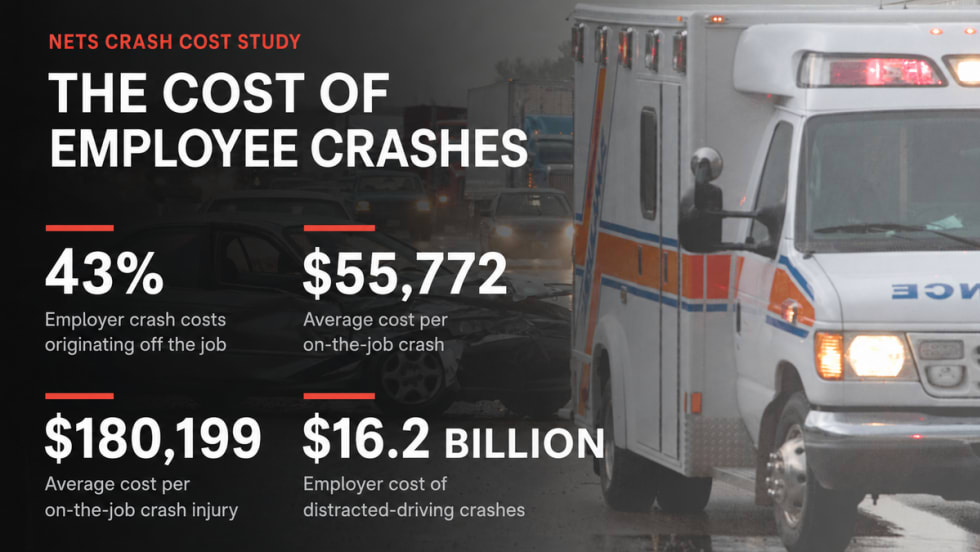
Off-the-Job Crashes Account for 43% of Employers’ $61.7 Billion Crash Burden
NETS quantifies costs dispersed across fleet, risk, HR, and other departments while providing new per-crash benchmarks for employers.
Read More →
Ram Recalls More Than 1.27 Million 1500 Pickups for Seat Belt Anchor Issue
The recall affects certain 2019-2026 Ram 1500 pickups that may have improperly attached second-row seat belt buckle anchors.
Read More →
Top 50 Executive Fleets
It is that time of year again! Time for the 2026 list of the Top 50 Executive Fleets, presented by Automotive Fleet and Volvo as part of its annual Fleet 500. Download now to see this year's list of companies!
Read More →
How Better Visibility Cut Speeding Violations by 48%
Fleet leaders don't need more data, they need clearer visibility into what the data is saying. This case study explores how one utility replaced speeding-event counts with a single metric — miles driven in violation — to strengthen safety and significantly reduce speeding violations.
Read More →
Operation Safe Driver Week: Why the Industry's Oldest Safety Campaign Still Matters to Fleets
A look at how a 2007 enforcement initiative became one of the most consequential weeks on the fleet safety calendar, and what it means for your drivers in 2026.
Read More →
Nexar-Nauto Merger Aims to Give Fleets Better Safety Intelligence Through Larger Driving Dataset
Stefan Heck tells Automotive Fleet that combining more than 10 billion miles of driving history with Nexar's AI models will give fleets deeper insights into driver risk and roadway conditions than either company could provide independently.
Read More →
From Silos to Solutions: Relationship Management for Safer Fleets
From telematics adoption and driver accountability to policy consistency and risk mitigation, this episode breaks down what it really takes to build a safer fleet culture without slowing business down.
Read More →
IIHS Launches First Commercial Vehicle Safety Evaluations
The Insurance Institute for Highway Safety has begun evaluating heavy-duty pickups and cargo vans for driver protection. Which models earned top marks?
Read More →
Reducing Risk by Eliminating Phone Use Behind the Wheel
Hosted with the cofounder of Lifesaver Mobile, this episode addresses phone use behind the wheel and how to design a driving environment that actually helps prevents accidents.
Read More →
Cameras, Safety and Insurance: From Reactive Claims to Real-Time Prevention (Part 2 of 2)
Part Two: Commercial auto remains one of the most challenging and costly lines of coverage for fleet operators and insurers alike. Continue learning more about how to effectively address these issues from Onur Aksan, Enterprise Business Development Executive, Geotab
Read More →