




Michigan Adopts Autonomous Vehicle Laws
Gov. Rick Snyder approves a four-bill package that includes permitting authorized autonomous cars to operate on public roads without a driver or steering wheel.
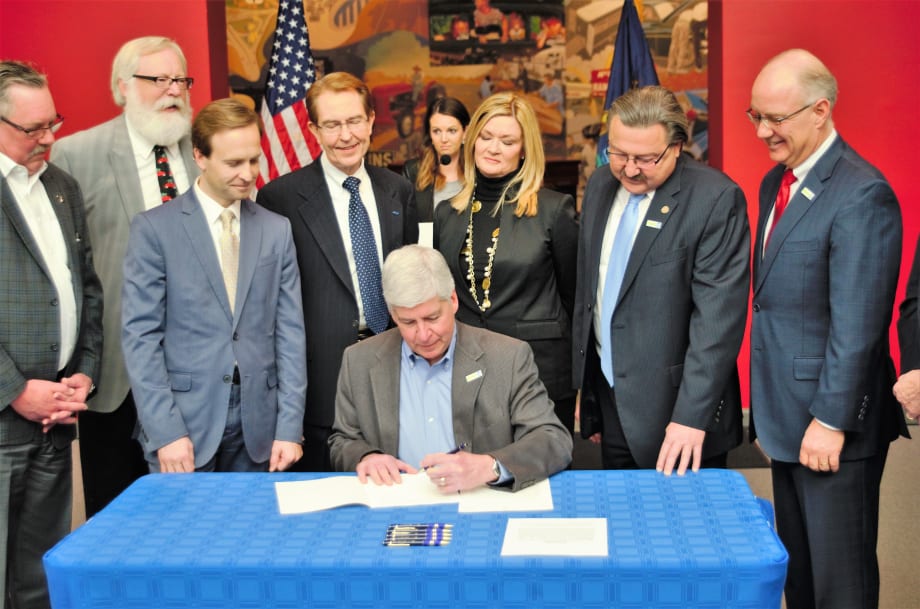
Michigan Gov. Rick Snyder on Dec. 9 signs autonomous vehicle legislation during a special ceremony at the Automotive Hall of Fame Museum, surrounded by state legislators and auto industry leaders. Photo courtesy of the governor’s office.
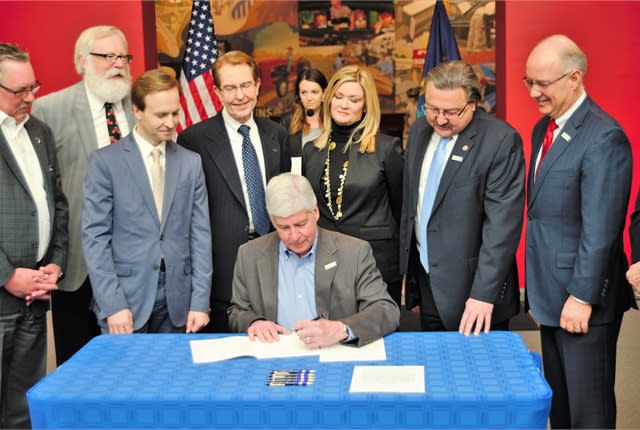
Michigan Gov. Rick Snyder on Dec. 9 signs autonomous vehicle legislation during a special ceremony at the Automotive Hall of Fame Museum, surrounded by state legislators and auto industry leaders. Photo courtesy of the governor’s office.
Michigan became the first state to pass comprehensive self-driving legislation on Dec. 9, when Gov. Rick Snyder signed into law a package of bills permitting authorized cars to operate on public roads without a driver or steering wheel, the governor has announced.
“Michigan put the world on wheels and now we are leading the way in transforming the auto industry,” Snyder said. “We are becoming the mobility industry, shaped around technology that makes us more aware and safer as we’re driving. By recognizing that and aligning our state’s policies as new technology is developed, we will continue as the leader the rest of the world sees as its biggest competition.”
The legislative package comprised four separate bills. Senate Bill 995, sponsored by Sen. Mike Kowall, allows operation of self-driving vehicles on Michigan roads. Previously, only manufacturer testing — with tighter restrictions — was permitted. The bill also permits automated vehicle platoons, in which vehicles travel together at electronically coordinated speeds, and authorizes on-demand self-driving vehicle networks.
Additionally, SB 995 creates the Michigan Council on Future Mobility, which as part of the state Department of Transportation will make recommendations on statewide policy. The goal is to ensure that regulation of autonomous vehicles keeps pace with technology advancements and doesn’t impede progress.
Senate Bill 996, also sponsored by Kowall, establishes guidelines for the operation of ride-hailing/on-demand vehicle services that use autonomous cars. Senate Bill 997, sponsored by Sen. Rebekah Warren, helps formally establish the American Center for Mobility. Last month, construction of the center began at Willow Run in Ypsilanti Township. The center will specialize in connected and autonomous vehicle testing, education, and product development.
Senate Bill 998, sponsored by Sen. Ken Horn, exempts mechanics and repair facilities from product liability lawsuits when autonomous vehicle repairs are performed according to manufacturer specifications.
All four bills drew bipartisan support in the state Senate and House of Representatives.
More Safety

Fleet Manager’s Ultimate Playbook: Navigating the New Standard in OEM Connectivity
Rising operating costs, driver safety concerns, and unplanned downtime are putting unprecedented pressure on modern fleets. Discover how fleet managers use embedded OEM connectivity and real-time vehicle data to cut TCO, prevent downtime, and protect drivers without aftermarket telematics hardware.
Read More →
From Driver Well-Being to EV Charging | AF News Recap
Mental health belongs in the fleet safety conversation. This week, we’re looking at five ways fleets can support employee well-being before a crisis, plus Holman’s expansion in Mexico, new one-day Fleet Forward passes, and why EV charging demand is outpacing infrastructure growth.
Read More →
Nexar-Nauto Merger Aims to Give Fleets Better Safety Intelligence Through Larger Driving Dataset
Stefan Heck tells Automotive Fleet that combining more than 10 billion miles of driving history with Nexar's AI models will give fleets deeper insights into driver risk and roadway conditions than either company could provide independently.
Read More →
Don't Wait for a Crisis: 5 Ways to Build Mental Health Into Your Fleet Safety Program
For Suicide Prevention Month, fleet and safety leaders have an opportunity to put mental health where it belongs: at the center of workplace safety.
Read More →
How Camera Data Can Strengthen a Fleet’s Insurance Renewal
Insights from a commercial insurance carrier and a broker show how fleets can turn video telematic data, driver coaching, and improved claims results into a stronger case at insurance renewal.
Read More →
The Safest Fleets Aren’t the Ones with the Most Technology
You’ve made the telematics investment. Here’s how to capture the other half of its value and build the safest fleet on the road.
Read More →
Hidden in Plain Sight: Fleet Compliance Risks
Fleet compliance isn't just about having policies — it's about consistently enforcing them. This practical guide reveals six hidden compliance risks common in public sector and shared fleet operations and outlines proven strategies to improve visibility, accountability, and audit readiness
Read More →
NETS Sets 2026 Fleet Safety Benchmark Conference for Indianapolis
The Sept. 15–17 program will feature fleet benchmarking data, case studies, emerging technologies, and implementation strategies while running alongside the NSC Safety Congress & Expo.
Read More →
Off-the-Job Crashes Account for 43% of Employers’ $61.7 Billion Crash Burden
NETS quantifies costs dispersed across fleet, risk, HR, and other departments while providing new per-crash benchmarks for employers.
Read More →
Ram Recalls More Than 1.27 Million 1500 Pickups for Seat Belt Anchor Issue
The recall affects certain 2019-2026 Ram 1500 pickups that may have improperly attached second-row seat belt buckle anchors.
Read More →