





Editorial Advisory Board: Interstate Challenges and the ‘Messy Middle’
Mercedes-Benz Special Trucks Tests Hydrogen Unimog
The Unimog is a test vehicle used to research the conditions under which hydrogen combustion can be implemented as a supplement to battery-electric and fuel-cell-based drives.
January 3, 2024
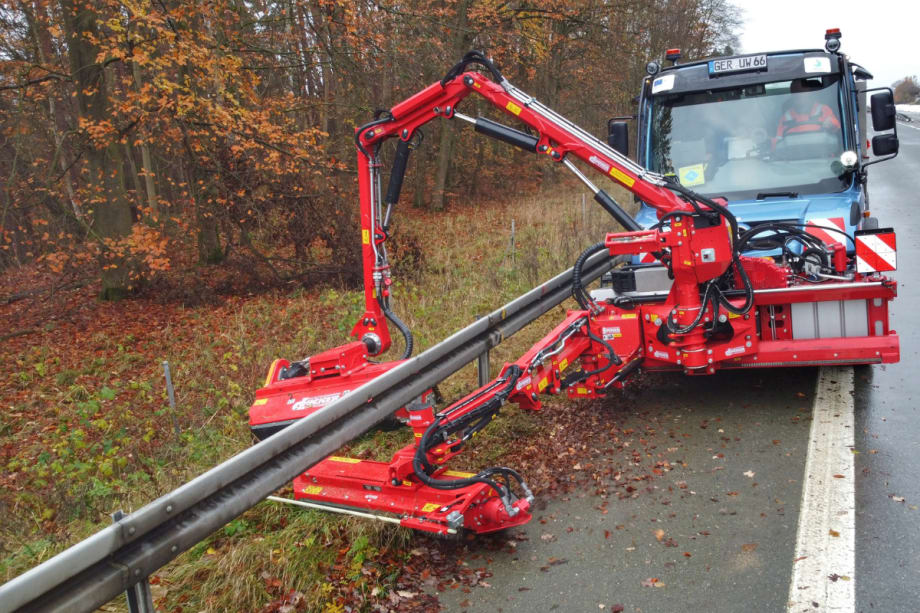
Engineers aspire to expand the volume in the upcoming development stage to cover a standard working day.
Photo: Mercedes-Benz Special Trucks
3 min to read
Mercedes-Benz Special Trucks has tested a Unimog implement carrier prototype with a hydrogen combustion engine in real operation.
The Unimog is a test vehicle that is used to research the conditions under which hydrogen combustion can be implemented as a supplement to battery-electric and fuel-cell-based drives.
Engineers collected measurement data when mowing the verge, accelerating, and refueling at a public gas station on a decommissioned section of the highway between Bayreuth and Bamberg.
The data will be used for further vehicle development. Employees from Autobahn GmbH accompanied the tests.
Practical testing at low temperatures and in varied topography is an important step in the ongoing “WaVe” development project, in which 18 partners are working together on the hydrogen combustion engine drive concept.
Enhanced Performance and Quieter Operation
The test vehicle for Mercedes-Benz Unimog is derived from the Unimog U 430 implement carrier.
It incorporates a specially converted natural gas engine, equipped with a tank, safety and monitoring systems, and measurement technology to accommodate an alternative hydrogen technology drive.
Hydrogen combustion within the engine compartment generates water, which is expelled as steam through the exhaust system.
The wheelbase and platform length are configured to allow installation of hydrogen tanks behind the cab. Four TÜV-certified high-pressure tanks, operating at 700 bars, collectively hold approximately 14 kilograms of gaseous hydrogen. These tanks are grouped into two double tanks, each independently managed by a tank control unit.
Engineers aspire to expand the volume in the upcoming development stage to cover a standard working day.
The engine produces around 290 hp/1000 Nm and is notably quieter than its diesel counterpart. For further insights into its operational mode, the prototype has a front mower featuring two mowing heads.
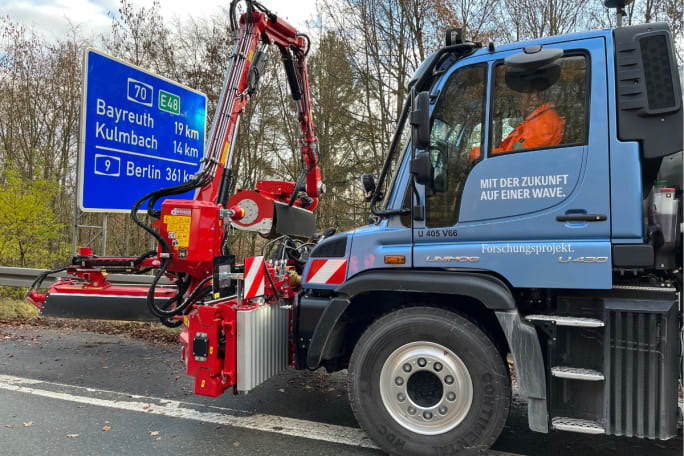
The test vehicle for Mercedes-Benz Unimog is derived from the Unimog U 430 implement carrier.
Photo: Mercedes-Benz Special Trucks
Advances Unimog's Future with Hydrogen Combustion Engine
Hydrogen Combustion Engine in "WaVe" Project" Daimler Truck is actively contributing to the "WaVe" project, a publicly funded initiative by Germany's Federal Ministry for Economic Affairs and Climate Protection, involving 18 partners from industry and science.
Launched in July 2021, the project aims to assess the potential substitution of a conventional diesel engine with a hydrogen-powered combustion engine, focusing on its applicability for traction drive and all power take-offs.
While Daimler Truck primarily concentrates on battery-electric drives and hydrogen-powered fuel cells, the "WaVe" project indicates that hydrogen combustion engines could be a sensible and complementary solution for specific applications in the decarbonization of Daimler Truck's drivetrain portfolio.
For the Unimog, especially, the hydrogen combustion engine emerges as a promising propulsion option due to limited installation space and the high-performance demands of this versatile vehicle.
Following a successful initial application, the development team anticipates six more months of adjustments and refinements to optimize this innovative mode of propulsion for the future.
Dr. Günter Pitz, Head of Powertrain Development at Mercedes-Benz Special Trucks: “The hydrogen combustion drive concept can serve as a blueprint for power-intensive applications in the specialty vehicle sector. Hydrogen combustion can make it possible to drive and work with very low emissions on construction sites, in municipal or agricultural sectors. To reach series maturity for such vehicles, reliable funding is and will be required.”
Originally posted on Work Truck Online
More Global Fleet

GeoFencing Adds to Your Truck Security Arsenal
Geofencing is a familiar fleet tool today, but its early adoption marked a major shift in vehicle tracking, route monitoring, and the debate over employee privacy.
Read More →
Holman Takes Full Ownership of ARIZA in Mexico
Holman is bringing its Mexican fleet management operation fully under its own brand after more than 30 years as a joint venture. The change gives multinational fleet customers a single Holman operation across the U.S., Canada, and Mexico.
Read More →
5 Tire Maintenance Tips to Help Prevent Work Truck Downtime
Regular tire checks can do more than extend tread life. These five maintenance practices can help work truck fleets catch problems early, reduce costs, and prevent downtime.
Read More →

Proven Ways to Reduce Work Truck Downtime
The age-old problem of downtime will always be a reality, but with new strategies at hand, fleets have more ways to keep trucks on the road longer.
Read More →


Cameras, Safety and Insurance: From Reactive Claims to Real-Time Prevention (Part 2 of 2)
Part Two: Commercial auto remains one of the most challenging and costly lines of coverage for fleet operators and insurers alike. Continue learning more about how to effectively address these issues from Onur Aksan, Enterprise Business Development Executive, Geotab
Read More →
Cameras, Safety and Insurance: From Reactive Claims to Real-time Prevention
Commercial auto remains one of the most challenging and costly lines of coverage for fleet operators and insurers alike. Learn more about how to effectively address these issues from Onur Aksan, Enterprise Business Development Executive, Geotab.
Read More →
Fleet Costs Are Rising: Here’s How Leaders Are Responding
Fleet leaders are under pressure to reduce costs, adapt to economic uncertainty, and make smarter decisions. See how peers across North America are responding with real data, proven strategies, and forward-looking insights. Download the 2026 Market Pulse Report to benchmark your strategy and uncover where you can gain an edge.
Read More →
Enterprise Fleet Management Surpasses 900,000 Vehicles in U.S. & Canada
Enterprise Mobility connects with mobility solutions around the globe
Read More →