




Mercedes-Benz Debuts New Vito Van in Germany
Mercedes-Benz has launched its new new version of the Vito mid-size van in Germany. The vehicle has a gross vehicle weight of between 2.8 and 3.2 tons.
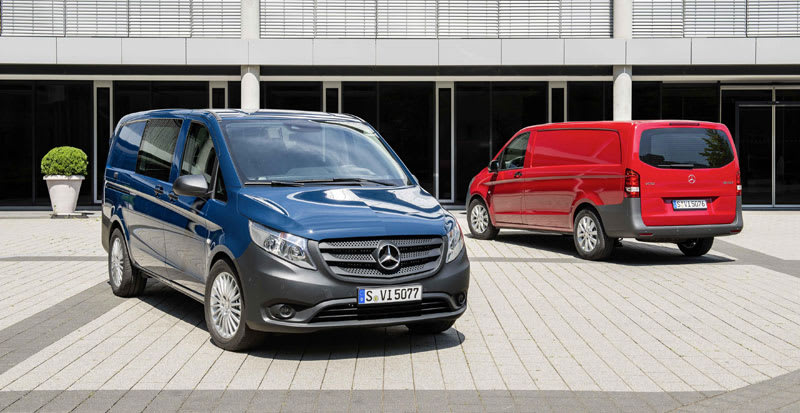
Photo: Mercedes-Benz

Photo: Mercedes-Benz
Mercedes-Benz has debuted its new version of the Vito mid-size van in Germany. The vehicle has a gross vehicle weight of between 2.8 and 3.2 tons.
Mercedes-Benz said that the professional vehicle will be useful for a number of business uses from skilled crafts and trades to retail, service providers, shuttle services and taxis. The Vito will have up to 1,369 kg of cargo capacity. Meanwhile the Vito Crew featuring a crewcab combines the advantages of a panel van with those of a crewbus, according to the automaker.
The new Vito Tourer are available in two versions: the versatile Vito Tourer PRO and the premium Vito Tourer SELECT. By virtue of this complete model family, the Tourer can be tailored to accommodate all types of passenger transport.
Now completely redesigned, the new Vito’s cockpit is exemplary in terms of its functionality and ergonomics. Symmetrical in its fundamental form, the structure is clear and uncluttered for maximum operational safety. During development the stowage concept received plenty of attention, since, for many drivers, the new Vito is their office and a living space too, according to the automaker.
“One for all” is something that applies to the new Vito’s drive system in particular. It features a choice of rear-wheel and now front-wheel drive. The correlation is clear: the new front-wheel drive system in the range is very light. When unladen or carrying only a light load, front-wheel drive offers better traction. Proven rear-wheel drive is the right solution for all applications, involving heavy weights and high towing capacities, according to the automaker.
The new Vito with front-wheel drive is made for the following profile: predominantly solo operation with maximum payload at low to medium gross vehicle weights. Keeping costs as low as possible is also a priority, according to the automaker.
It has a transverse-mounted, compact four-cylinder engine with a displacement of 1.6L and which is available in two power ratings: the Vito 109 CDI with 88 hp and the Vito 111 CDI with 114 hp.
In cases where demands on performance are high, use will be intensive, gross vehicle weights are high or trailer towing will be demanding, Mercedes-Benz said the best option could be the new Vito with rear-wheel drive and four-cylinder engine with a 2.15L displacement. It is available at three power output levels Vito 114 CDI, 136 hp; Vito 116 CDI, 163 hp, and Vito 119 BlueTEC, 190 hp.
Six-speed manual transmissions handle power transmission as standard. The 7G-TRONIC PLUS automatic transmission with torque converter is optional for the Vito 114 CDI and Vito 116 CDI and standard equipment on the Vito 119 BlueTEC.
From the transmission and low-friction rear axle to the electromechanical steering and auxiliary units – the engineers designed the new Vito for maximum fuel efficiency. On average, consumption of diesel in the NEDC is some 20-percent less than for the preceding version, according to Mercedes-Benz.
The economical Vito BlueEfficiency is available for the new Vito with rear-wheel drive and is standard on all Vito Tourers with automatic transmission, car registration and in conjunction with the most powerful engine. According to Mercedes-Benz, the Vito BlueEfficency-equipped Vito Tourers has a certified figure of 49.6 mpg for the Vito 116 CDI BlueEfficiency.
Whatever the engine variant, every new Vito benefits from long service intervals of up to 25,000 miles or two years.
The Vito is available in three lengths. All three lengths are 140 millimetres longer than the preceding Vito. This can mainly be attributed to an extended front end to help protect pedestrians. The resulting vehicle lengths are 4,895 mm, 5,140 mm, and 5,370 mm. The maximum vehicle height is 1,910 mm depending on the model. Consequently all variants are significantly below the important two-meter mark and therefore fit standard multi-story/underground car parks and automatic car washes, according to the automaker.
The permissible gross vehicle weights at the heart of the range are 2.8 ton and 3.05 ton. They are complemented by an upgraded 3.2 ton Vito. Thanks to the new front-wheel drive in conjunction with a compact diesel engine, the Vito panel van’s curb weight for the medium length with standard equipment is just 1,761 kg.
As a result, even the Vito with a permissible gross vehicle weight of 3.05 ton achieves a payload of 1,289 kg. However, according to Mercedes-Benz, the payload champion of its class is the rear-wheel drive Vito, which has a permissible gross vehicle weight of 3.2 ton and a payload capacity of 1,369 kg.
More Global Fleet

Proven Ways to Reduce Work Truck Downtime
The age-old problem of downtime will always be a reality, but with new strategies at hand, fleets have more ways to keep trucks on the road longer.
Read More →
The Top 300 Commercial Fleets
The Top 300 Commercial Fleets: See the List
Read More →


Cameras, Safety and Insurance: From Reactive Claims to Real-Time Prevention (Part 2 of 2)
Part Two: Commercial auto remains one of the most challenging and costly lines of coverage for fleet operators and insurers alike. Continue learning more about how to effectively address these issues from Onur Aksan, Enterprise Business Development Executive, Geotab
Read More →
Cameras, Safety and Insurance: From Reactive Claims to Real-time Prevention
Commercial auto remains one of the most challenging and costly lines of coverage for fleet operators and insurers alike. Learn more about how to effectively address these issues from Onur Aksan, Enterprise Business Development Executive, Geotab.
Read More →
Fleet Costs Are Rising: Here’s How Leaders Are Responding
Fleet leaders are under pressure to reduce costs, adapt to economic uncertainty, and make smarter decisions. See how peers across North America are responding with real data, proven strategies, and forward-looking insights. Download the 2026 Market Pulse Report to benchmark your strategy and uncover where you can gain an edge.
Read More →
Enterprise Fleet Management Surpasses 900,000 Vehicles in U.S. & Canada
Enterprise Mobility connects with mobility solutions around the globe
Read More →
Automotive Fleet's Guide to Fleet Electrification
Unlock the secrets to a successful transition to electric fleets with Automotive Fleet's comprehensive Fleet Electrification Guide!
Read More →
Sumitomo Rubber Industries to Acquire Viaduct
Viaduct will join Sumitomo as an independent subsidiary. Partnership strengthens global reach and accelerates AI-driven innovation for fleets and manufacturing.
Read More →
AfMA’s 2025 Education & Leadership Summit: 26 Years of Impactful Connection
Held in Sydney, the Australasian Fleet Management Association’s 2025 Summit marked ten years of growth as the event expanded its global reach and doubled down on practical, non-commercial fleet leadership programming.
Read More →