




Lake Michigan Mailers to Convert Service Fleet to Propane
KALAMAZOO, MI and SOUTH BEND, IN - The conversion is expected to help reduce cost per mile by 32 percent and vehicle emissions by as much as 60 percent, according to the company.
KALAMAZOO, MI and SOUTH BEND, IN - Lake Michigan Mailers, Inc. announced it will begin converting its service vehicle fleet to run on both liquid propane gas (LPG) and traditional gasoline. The conversion will allow the company to reduce its cost per mile by 32 percent and vehicle emissions by as much as 60 percent.
Lake Michigan Mailers provides document management, mail assembly, mail processing, presorting, data management, digital marketing and distribution services provides document and mail transportation services to companies, schools, colleges and universities, health care providers, governmental entities, and organizations in a 12,600-square mile area every day with its own regional fleet of vehicles. Annually, the company’s service fleet travels more than 477,000 road miles without leaving the Eastern Time Zone. Since May 2009, the company said it has seen its fuel costs skyrocket 71.1 percent.
“We knew we had to make a strategic change in the way we propel our vehicles down the road in order to support our continued market growth in the face of rapidly rising fuel costs,” said David Rhoa, president of Lake Michigan Mailers, Inc. “We evaluated every alternative-fuel type currently available. Propane is the right choice for us for a number of reasons, including cost per gallon, long-term price stability, improved environmental impact, available fueling infrastructure, and vehicle conversion options. With nearly 90 percent of domestic propane supplies produced in the United States, we are confident that we won’t be subject to the wild price fluctuations that we find in the global oil and gasoline markets.”
The company also expects the conversion to propane to yield significant environmental benefits. “Propane burns cleaner than gasoline resulting in lower harmful emissions. We expect our propane vehicles will emit 12-percent less carbon dioxide, 20-percent less nitrogen oxide, and 60-percent less carbon monoxide, and GHG emissions by 20-percent less than our standard gasoline -fueled vehicles. Converting to propane is a natural extension of our existing sustainability programs,” Rhoa said.
The company has partnered with Icom North America of New Hudson, Mich., to build and install the EPA-approved vehicle propane management systems.
“Icom was the perfect partner for us on this mission-critical project,” said Rhoa. “Their EPA-approved systems allowed us to properly convert our existing fleet vehicles thereby reducing our system conversion costs and minimizing the lead time necessary to bring our reconfigured fleet online.”
The propane liquid injection conversion system provided by Icom will allow the company’s vehicles to run on both propane and traditional gasoline with propane being the primary fuel. “Using Icom’s bi-fuel system extends both the useful life of the vehicle and its service range and helped us overcome a potentially significant barrier – availability of propane fueling stations,” said Rhoa. “We needed a system that would not tie us exclusively to one fuel type. The Icom system gives us the cost savings and cleaner burning advantages of propane and the security of knowing that our vehicles will not be stranded for lack of propane fueling stations.”
Lake Michigan Mailers has selected AmeriGas, Inc. to provide propane for the converted vehicles. “AmeriGas has been an ideal strategic partner for this program,” said Rhoa. “We approached them with a basic outline of our program objectives. They provided us with a fully engineered solution that will allow us to reduce our fuel costs, manage the fueling requirements of our propane-powered fleet as it expands, and properly manage our fueling system.
Lake Michigan Mailer will begin converting its vehicle fleet this month. The process to convert the existing Michigan-based fleet is expected to be completed by August 2013. The company plans to begin converting its Indiana-based fleet in the fourth quarter of 2013 with a final conversion date of June 2014.
More Green Fleet
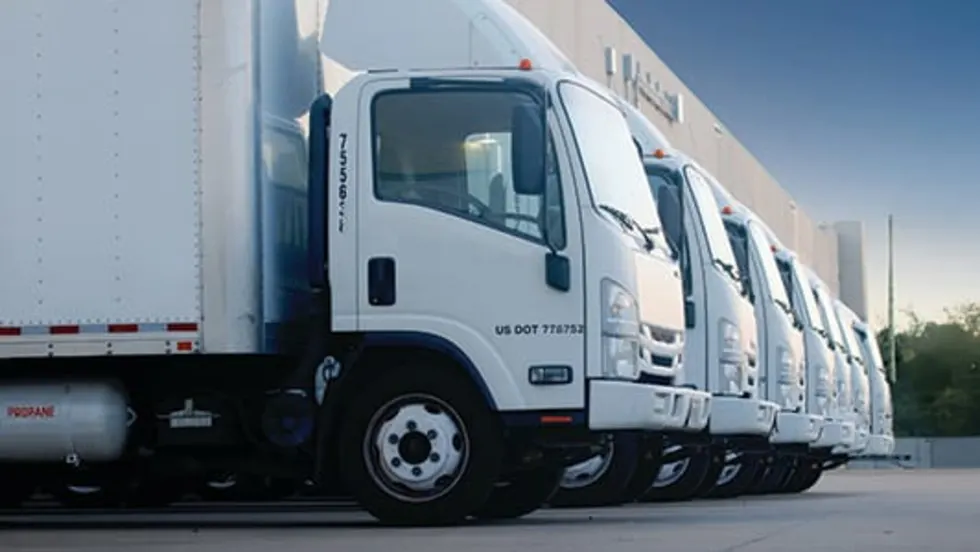
New Propane Autogas Program Offers Fleet Compensation
Qualified commercial fleets can receive $7,500 per eligible propane autogas vehicle and up to $10,000 for new refueling site prep. Learn how the program works and see whether your fleet qualifies.
Read More →
EV Charging Use Is Outpacing Infrastructure Growth
ChargePoint’s 2026 Charging Forward Report points to rising charger use, higher-powered charging, commercial vehicle electrification, and energy-management technology. Here’s what fleets should know.
Read More →
Merchants Fleet Reports 290M EV Miles as Fleets Navigate Changing Electrification Market
From millions in operating savings to hundreds of millions of EV miles, Merchants Fleet’s latest report reveals what’s working and what’s changing in fleet electrification.
Read More →

The EV Breakdown Nobody's Talking About: Why Most Electric Vehicle Roadside Calls Aren't Mechanical Failures
Here's why EV breakdowns are widely misunderstood.
Read More →
ChargePoint Now Available in Energy Pass
ChargePoint and additional planned charging network integrations were added to GM's Energy Pass.
Read More →

First Look: Slate Auto's Electric Fleet Pickup
Could an affordable, modular EV pickup make electrification more practical for fleets?
Read More →
Slate Debuts Colorful, Unique EV Models
A recent media and client event, studded with electric vehicles dressed up on platforms, planted a new position for the manufacturer in the wider EV market. Fleets will find cost-saving advantages.
Read More →
Slate Electric SUV, Pickup Switchable Model Aims For Light-Duty Fleets
Everything about this EV is counterintuitive and understated, making it stand out from the crowd.
Read More →
Inspiration Mobility Acquires Key Electrada Assets
Inspiration Mobility Group has acquired select assets of Electrada, adding the fleet electrification provider's team, technology, and charging infrastructure development capabilities to its energy management business.
Read More →