




Isuzu Launches Spanish Version of Commercial Website
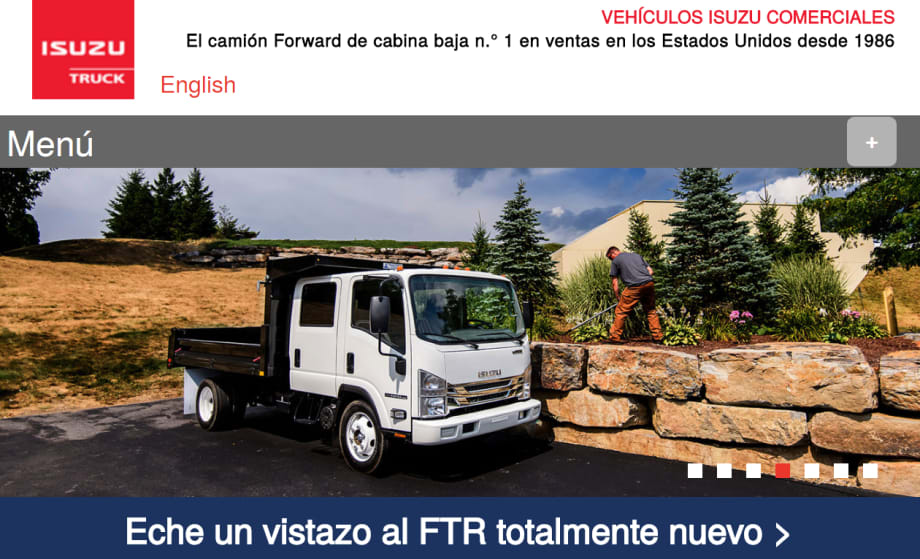
Isuzu Commercial Truck of America has announced that www.isuzucv.com is now available in Spanish as well as English.
Screenshot via Isuzucv.com
Screenshot via Isuzucv.com
Isuzu Commercial Truck of America has announced that www.isuzucv.com is now available in Spanish as well as English.
“Spanish is the second most-spoken language in the United States,” said Shaun Skinner, president of Isuzu Commercial Truck of America. “Over fifty million Americans speak Spanish as a first or second language. In fact, there are more Spanish speakers in our country than there are in Spain. So it is only natural for us to want to offer information about our trucks to consumers in the language of their choice.”
Users can easily see each page in Spanish by clicking the link next to the Isuzu logo at the top of the page.
For nearly a year, Isuzu has posted Spanish-language driver orientation and emissions system informational videos on its site. Now, the entire site is available in Spanish. On the home page, users may simply click on the video link at the bottom of the home page for English, Spanish, and French.
The www.isuzucv.com website offers visitors product information and specifications about Isuzu N-Series Class 3 through 5 trucks and the all-new Class 6 Isuzu FTR. Functionality includes a dealer locator; comparison tool; “get-a-quote” feature; information about Isuzu parts, accessories and class-leading warranties; videos; an owners’ section; details about available financing and leasing programs; and much more.
“Isuzu durability, economy, performance and low cost of ownership are universal,” Skinner said. “We’re pleased that now we are able to deliver that message to our Spanish-speaking customers nationwide.”
More Operations

Here's When You Should Make an Exception to Fleet Policy
Fleet policies are designed to create consistency, but not every driver or situation fits neatly within standard rules.
Read More →
AI-Native or AI-Acquired: What Should Fleet Managers Look for in an AI Platform?
Six questions can help fleet managers look beyond AI marketing claims to evaluate integration, data access, and real-world operational performance.
Read More →
A buyer's guide to fleet management software in 2027
Buying fleet management software in 2027 means looking beyond features and price. As fleet operations, technology and expectations evolve, this guide explores what today’s fleet professionals should consider when choosing a system that can deliver value now and adapt to what comes next.
Read More →

What Will Shape the Next Era of Fleet Management?
EVs, AI, and autonomous vehicles are reshaping fleet management. Discover what’s ahead—and how fleet leaders can prepare for the next era.
Read More →
How Fleets Can Recruit and Train Veterans for Technician Roles
Here's how the technician shortage has affected uptime for fleets, and what to do about it.
Read More →
Avis Budget Group Deploys Neology Toll Management Technology Across Major Brands
Neology’s neoFleet platform will manage toll transactions and toll-authority operations for vehicles across Avis, Budget, Payless, Budget Truck and Zipcar.
Read More →
Fleet Personal-Use Charges Edge Higher in 2026
Nearly eight in 10 surveyed fleets allow personal use of company vehicles, while just over half of respondents report charging employees for the privilege.
Read More →
The Future of Fleet + What’s Changing Right Now | AF News Recap
Could developments overseas offer a preview of what’s coming for U.S. fleets? This week, we’re looking at the future of AI, autonomy, and electrification, plus Ford Pro’s new certified pre-owned program, smarter vehicle offboarding, and a new way for fleets to manage toll expenses.
Read More →
How to Handle Vehicle Offboarding
What do fleet managers need to do when a driver leaves?
Read More →
Fleet Manager’s Ultimate Playbook: Navigating the New Standard in OEM Connectivity
Rising operating costs, driver safety concerns, and unplanned downtime are putting unprecedented pressure on modern fleets. Discover how fleet managers use embedded OEM connectivity and real-time vehicle data to cut TCO, prevent downtime, and protect drivers without aftermarket telematics hardware.
Read More →