




Intelligent Interaction - Restraint Systems from Audi
HERNDON, VA - Audi engineers in Ingolstadt have focused particular attention on safety belts, airbags, and seats/headrests. These components interact intelligently in model lines such as the A4, A5, and Q5 to provide maximum protection for the occupants during an accident.
HERNDON, VA - Audi engineers in Ingolstadt have focused particular attention on safety belts, airbags, and seats/headrests. These components interact intelligently in model lines such as the A4, A5, and Q5 to provide maximum protection for the occupants during an accident.
In today's traffic conditions, rear impact is a frequent type of accident, especially in urban areas. This type of crash typically occurs at collision speeds of 15 to 50 km/h (9 to 31 mph), for instance at traffic lights. In such impacts, the seatback is accelerated to between 7 and 25 km/h (4 to 15 mph) in barely a tenth of a second. If the head is violently flung backwards instead of being supported in line with the thorax, the victim frequently suffers a whiplash injury, which often requires protracted and costly therapy. Insurance companies estimate the annual cost in Germany to exceed EUR 500 million.
The occupants of an Audi are safer in such a crash, according to the manufacturer. The seats and headrests are specifically designed for a rear impact. The shape of the seatback frame, a resilient back pad and an energy-absorbing foam layer allow the back to sink slightly into the seatback, so that the head can be intercepted a moment earlier by the sturdy headrest just behind it. In severe rear impacts, the seatbelt tensioners in the A4, A5 and Q5 are released to optimize the positions of the occupants.
Audi uses its integral headrest system in most of its models. The brand has already received the top rating of "Good" in independent tests, including by the prestigious International Insurance Whiplash Prevention Group (IIWPG), which specializes in whiplash prevention. In Germany, the ADAC and leading trade magazines have reached similar conclusions, as has the US Insurance Institute for Highway Safety (IIHS).
Among severe traffic accidents, the frontal impact remains the most common type of crash, with a share of 50 percent. Fortunately this type of accident is no longer the most dangerous, since deformation zones, safety steering, columns, seatbelts and airbags have greatly reduced its peril. But Audi isn't settling for the existing solutions and has developed an adaptive restraint system for the A4, A5 and Q5 model series. It provides the best possible protection for different sized occupants; in smaller, lighter persons especially it significantly reduces the severity of injuries. Audi engineers have attuned the subsystems to each other in an innovative, high-precision network. In this work they have also benefited from the results of in-house crash research by the AARU (Audi Accident Research Unit, see Audi Technology ABC).
The rails of the front seats are equipped with sensors that detect whether the seat is in the forward or rearward position. Their data flow into the calculations of the restraint control system. Since the computer knows the approximate position of the occupant in relation to the airbag, it can ensure optimal use of the available forward displacement region - the distance in which the upper body is decelerated by the belt and the airbag - which significantly reduces the effect of the impact on the occupants.
The operation of the adaptive airbags in the current Audi model series is based on a new, graduated strategy. The airbags - with a volume of 64 liters (2.26 cubic feet) on the left side and 120 liters (4.24 cubic feet) on the right - unfold differently than in the conventional two-step systems: they always deploy fully at first to ensure prompt deceleration of the occupants. However, if the impact is less than severe, or when a (usually less than average-size) passenger sits close to the airbag, a lower restraint force suffices. In these cases, a portion of the air volume is expelled through special valves: the airbag softens and intercepts the head and thorax more gently. In a severe crash, on the other hand, or with large occupants farther back in their seat, these valves remain closed longer, and the airbag exerts its maximum restraining effect.
The belt force limiters too react flexibly. In this subsystem, two small torsion bars are interconnected by gears. For smaller and lighter persons, the torsion bars are disengaged promptly. This provides more slack in the seatbelt, enabling the upper body to sink deeply into the airbag, which reduces the force on the thorax. In more violent crashes, the torsion bars are disengaged later or not at all, increasing the belt's restraining force.
The IIHS has recently awarded no less than four Audi models the "Top Safety Pick" rating again for the second time in a row for their high level of occupant safety. And in the Euro NCAP test the Audi A4 earned the highest rating of five stars.
Audi Technology ABC
Crashtest-Dummys are highly specialized measuring instruments. The BioRID II dummy is specially designed for rear impact tests. Its outstanding feature is its flexible vertebral column with 24 vertebral bodies. In the neck, a set of springs mimics the human flexion and extension muscles. The dummy is 1.75 meters (5 feet 10 inches) tall and weighs 78 kilograms (172 pounds). So this dummy corresponds to the statistical average of male drivers, the socalled 50-percent man.
The Audi Accident Research Unit (AARU) investigates real accident cases especially within Bavaria that involve Audi models. It is a joint venture of Audi, the Regensburg University Hospital and the Bavarian police. Its three expert teams include professionals from medicine, technology, and traffic psychology. The AARU investigates about 100 accidents annually, using a very thorough procedure. The results of this research flow directly into Audi's engineering development.
More Safety

Nexar-Nauto Merger Aims to Give Fleets Better Safety Intelligence Through Larger Driving Dataset
Stefan Heck tells Automotive Fleet that combining more than 10 billion miles of driving history with Nexar's AI models will give fleets deeper insights into driver risk and roadway conditions than either company could provide independently.
Read More →
Don't Wait for a Crisis: 5 Ways to Build Mental Health Into Your Fleet Safety Program
For Suicide Prevention Month, fleet and safety leaders have an opportunity to put mental health where it belongs: at the center of workplace safety.
Read More →
How Camera Data Can Strengthen a Fleet’s Insurance Renewal
Insights from a commercial insurance carrier and a broker show how fleets can turn video telematic data, driver coaching, and improved claims results into a stronger case at insurance renewal.
Read More →
The Safest Fleets Aren’t the Ones with the Most Technology
You’ve made the telematics investment. Here’s how to capture the other half of its value and build the safest fleet on the road.
Read More →
Hidden in Plain Sight: Fleet Compliance Risks
Fleet compliance isn't just about having policies — it's about consistently enforcing them. This practical guide reveals six hidden compliance risks common in public sector and shared fleet operations and outlines proven strategies to improve visibility, accountability, and audit readiness
Read More →
NETS Sets 2026 Fleet Safety Benchmark Conference for Indianapolis
The Sept. 15–17 program will feature fleet benchmarking data, case studies, emerging technologies, and implementation strategies while running alongside the NSC Safety Congress & Expo.
Read More →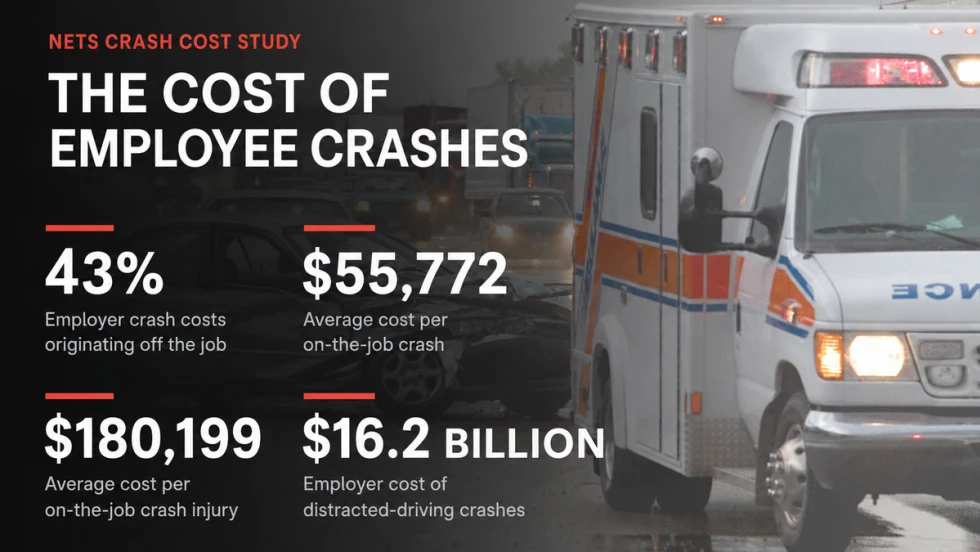
Off-the-Job Crashes Account for 43% of Employers’ $61.7 Billion Crash Burden
NETS quantifies costs dispersed across fleet, risk, HR, and other departments while providing new per-crash benchmarks for employers.
Read More →
Ram Recalls More Than 1.27 Million 1500 Pickups for Seat Belt Anchor Issue
The recall affects certain 2019-2026 Ram 1500 pickups that may have improperly attached second-row seat belt buckle anchors.
Read More →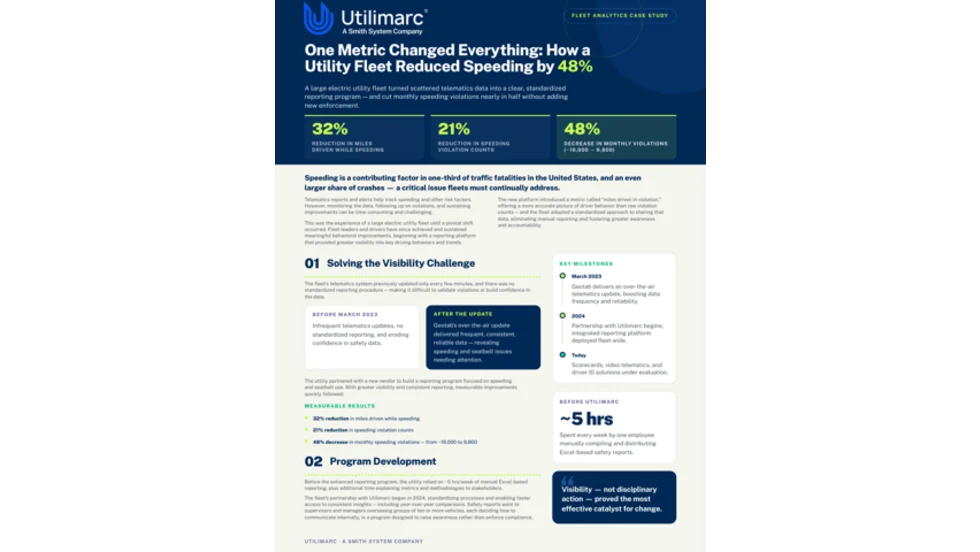
How Better Visibility Cut Speeding Violations by 48%
Fleet leaders don't need more data, they need clearer visibility into what the data is saying. This case study explores how one utility replaced speeding-event counts with a single metric — miles driven in violation — to strengthen safety and significantly reduce speeding violations.
Read More →
Operation Safe Driver Week: Why the Industry's Oldest Safety Campaign Still Matters to Fleets
A look at how a 2007 enforcement initiative became one of the most consequential weeks on the fleet safety calendar, and what it means for your drivers in 2026.
Read More →