




IIHS Study: Weak Guards on Truck Trailers Pose Deadly Underride Threat in Crashes
New research from the Highway Institute for Highway Safety raises concerns about U.S. safety standards for semitrailer underride guards. Most semitrailers fail to prevent passenger vehicles from sliding underneath them in crashes involving just a small portion of the truck's rear, IIHS says.
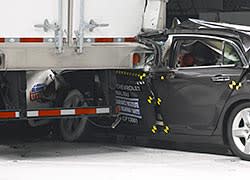
Modern semitrailers generally succeed in keeping passenger vehicles from sliding underneath them, bolstering the chances of car occupants surviving a crash into the back of a large truck, recent tests by the Insurance Institute for Highway Safety (IIHS) show. But in crashes involving only a small portion of the truck's rear, most semitrailers fail to prevent potentially deadly underride, IIHS said.
Most semitrailers are required to have underride guards. These are steel bars that hang from the backs of trailers to prevent the front of a passenger vehicle from moving underneath during a crash. Earlier research concluded that the minimum strength and dimensions required for underride guards are inadequate, prompting IIHS to petition the National Highway Traffic Safety Administration (NHTSA) in 2011 for tougher standards. The institute also asked the agency to consider applying the standards to other types of large trucks, such as dump trucks, which aren't required to have any underride guards.
Although NHTSA hasn't responded yet, trailer manufacturers already are installing guards that are much stronger than the agency requires, IIHS said. These guards generally work well to prevent underride, except in crashes occurring at the outer edges of trailers, the crash tests show.
One likely reason manufacturers are installing guards that are stronger than required is a tougher standard that trailers in Canada have had to meet since 2007. More recently, IIHS crash tests have drawn attention to the issue, and at least one manufacturer has started selling a trailer with an improved underride guard since the tests began.
To see how well the latest guards work, IIHS engineers put trailers from the eight largest manufacturers through a series of progressively tougher crash tests. All of the trailers had underride guards that met both U.S. and Canadian standards. Both standards require a guard to withstand a certain amount of force at various points. Under the Canadian regulation, a guard must withstand about twice as much force as required by the U.S. rule at the point where it attaches to its vertical support.
In each crash test, a 2010 Chevrolet Malibu struck a parked truck at 35 mph. In the first scenario, the car was aimed at the center of the trailer. All eight guards successfully prevented underride, including one from Hyundai Translead, whose previous model failed a full-width test by IIHS. In the second test, in which only half the width of the car overlapped with the trailer, all but one trailer passed. However, when the overlap was reduced to 30%, every trailer except one from the Canadian manufacturer Manac failed, IIHS said.
Manac sells dry van trailers in the U.S. under the name Trailmobile. IIHS uses a 30% overlap for the most challenging underride test because it is the minimum overlap under which a passenger vehicle occupant's head is likely to strike a trailer if an underride guard fails.
"Our tests suggest that meeting the stronger Canadian standard is a good first step, but Manac shows it's possible to go much further," said David Zuby, IIHS chief research officer.
The Danger of Underride
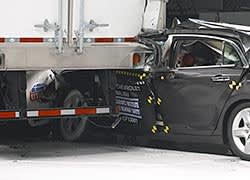
All the improvements in occupant protection that have helped drive down crash deaths in recent decades count for little when the front of a passenger vehicle ends up under a truck. When this happens, the top of the occupant compartment gets crushed because the structures designed to absorb the energy of a crash are bypassed. The airbags and safety belts can't do their jobs, and people inside can experience life-threatening head and neck injuries, IIHS said.
The crash tests show how this occurs. The 2010 Malibu was an IIHS Top Safety Pick. In the 40 mph moderate overlap barrier test used to evaluate the Malibu's frontal crashworthiness, measurements recorded by a dummy in the driver seat indicated serious injuries were unlikely. Similarly, in the underride tests in which the guards held up, the Malibu's structure and airbags protected the dummy, and injury measures were generally low and not life-threatening. In contrast, when the guards failed, head and neck injury measures were so high that real drivers would have died, IIHS said.
In 2011, 260 of the 2,241 passenger vehicle occupants killed in large truck crashes died when the fronts of their vehicles struck the rears of trucks. That's down from 460 out of 3,693 in 2004. The decline is likely due in part to changes in both truck and passenger vehicle traffic resulting from the weak economy, IIHS said.
Gaps in federal crash data make it difficult to pinpoint exactly how many of these crashes involve underride. A 2011 IIHS study of 115 crashes in which a passenger vehicle struck the back of a heavy truck or semitrailer found only about one-fifth involved no underride or negligible underride. Nearly half of the vehicles had severe or catastrophic underride damage, and those vehicles accounted for 23 of the 28 fatal crashes in the study.
Crash test results
IIHS previously released the results of an initial round of crash testing on three semitrailers conducted in 2010 and 2011. The weakest guard tested at that time was from Hyundai, IIHS said. It met the U.S. standard for strength but not the Canadian one. When the Malibu hit the center of the Hyundai trailer at 35 mph in a full-width crash, the guard broke, resulting in catastrophic underride. In 50% overlap tests, IIHS said, the underride guard on a Vanguard trailer allowed moderate underride at 25 mph and severe underride at 35 mph.
In contrast, a Wabash trailer had no underride in either the full-width or the 50% overlap test. However, when the Wabash was put through a 30% overlap test, the underride was catastrophic. That's because the Malibu hit the guard outside its vertical attachment bar, causing the unsupported end of the guard to bend forward. The Wabash underride guard hasn't been redesigned since then.
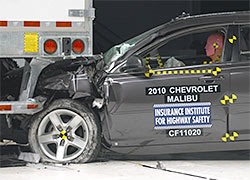
The underride guard on the Manac trailer, above, was the only one of eight tested to prevent underride in a 30% overlap crash. The performance of the Utility trailer, below, was more typical. IIHS photos.
Since the initial evaluations, IIHS tested Hyundai and Vanguard trailers again after those companies made changes to their underride guards. Trailers from five more companies also were tested. All eight manufacturers now have underride guards meeting the Canadian standard, and none of the current designs had any difficulty passing the full-width test.
Most passed the 50% overlap test, too. The exception was the Vanguard, IIHS said. The guard's vertical support broke off the trailer when the guard was hit by the car, just as it did in the test of the previous design.
"Vanguard's older and newer underride guards were certified to the Canadian standard, so clearly the Canadian regulation, while an improvement over the U.S. rule, isn't stringent enough," Zuby said. "Failing the 50% test is a big problem because in our analysis of real-world crashes with the rears of trucks, about half of those with severe underride had overlaps of 50% or less."
Although the rest of the trailers passed the 50% overlap test, most had the same difficulty with the 30% overlap that the Wabash trailer experienced in the initial round of testing. The problem stems from the location of the underride guards' vertical supports, IIHS said. On most trailers, the supports are attached to the slider rails, which run lengthwise under the trailer and allow the position of the wheels to be changed depending on the load. Using this structure as the underride guard's attachment point means the vertical supports are located an average of 28 inches from the trailer's edge.
Manac, the only trailer to pass the 30% test, takes a different approach. The supports of its underride guard are attached to a reinforced floor and spaced just 18 inches from the edge. The Malibu and the dummy inside it not only fared better, but the Manac trailer also had damage estimates among the lowest of all the trailers. It required only a replacement underride guard, IIHS said.
"If trailer manufacturers can make guards that do a better job of protecting passenger vehicle occupants while also promising lower repair costs for their customers, that's a win-win," Zuby said. "While we're counting on NHTSA to come up with a more effective regulation, we hope that in the meantime trailer buyers take note of our findings and insist on stronger guards."
More Safety

Ram Recalls More Than 1.27 Million 1500 Pickups for Seat Belt Anchor Issue
The recall affects certain 2019-2026 Ram 1500 pickups that may have improperly attached second-row seat belt buckle anchors.
Read More →
Top 50 Executive Fleets
It is that time of year again! Time for the 2026 list of the Top 50 Executive Fleets, presented by Automotive Fleet and Volvo as part of its annual Fleet 500. Download now to see this year's list of companies!
Read More →
How Better Visibility Cut Speeding Violations by 48%
Fleet leaders don't need more data, they need clearer visibility into what the data is saying. This case study explores how one utility replaced speeding-event counts with a single metric — miles driven in violation — to strengthen safety and significantly reduce speeding violations.
Read More →
Operation Safe Driver Week: Why the Industry's Oldest Safety Campaign Still Matters to Fleets
A look at how a 2007 enforcement initiative became one of the most consequential weeks on the fleet safety calendar, and what it means for your drivers in 2026.
Read More →
Nexar-Nauto Merger Aims to Give Fleets Better Safety Intelligence Through Larger Driving Dataset
Stefan Heck tells Automotive Fleet that combining more than 10 billion miles of driving history with Nexar's AI models will give fleets deeper insights into driver risk and roadway conditions than either company could provide independently.
Read More →
From Silos to Solutions: Relationship Management for Safer Fleets
From telematics adoption and driver accountability to policy consistency and risk mitigation, this episode breaks down what it really takes to build a safer fleet culture without slowing business down.
Read More →
IIHS Launches First Commercial Vehicle Safety Evaluations
The Insurance Institute for Highway Safety has begun evaluating heavy-duty pickups and cargo vans for driver protection. Which models earned top marks?
Read More →
Reducing Risk by Eliminating Phone Use Behind the Wheel
Hosted with the cofounder of Lifesaver Mobile, this episode addresses phone use behind the wheel and how to design a driving environment that actually helps prevents accidents.
Read More →
Cameras, Safety and Insurance: From Reactive Claims to Real-Time Prevention (Part 2 of 2)
Part Two: Commercial auto remains one of the most challenging and costly lines of coverage for fleet operators and insurers alike. Continue learning more about how to effectively address these issues from Onur Aksan, Enterprise Business Development Executive, Geotab
Read More →
How 5-Second Telematics Data Is Changing Fleet Safety
This episode connects with Steve Santostasi of Ford Pro and covers how a few seconds of data can make a difference in fleet safety.
Read More →