




IIHS Study: Red-Light Cameras in Arlington County, Va., Reduce Red-Light Running Rate
New research from the Insurance Institute for Highway Safety also concludes that the violation reductions are even greater the more time has passed since the light turned red.
Study results
In a newly released study, researchers at the Insurance Institute for Highway Safety (IIHS) found that red-light running rates declined at Arlington County, Va., intersections equipped with red-light cameras. The decreases were particularly large for the most dangerous violations -- those happening 1.5 seconds or longer after the light turned red.
"This study provides fresh evidence that automated enforcement can get drivers to modify their behavior," said Anne McCartt, senior vice president for research at IIHS and the study's lead author.
The number of U.S. communities using red-light cameras has grown to about 540, IIHS said.
Though some cities, including Los Angeles, have opted to suspend their red-light camera program, others, including Fort Lauderdale, are considering expansion.
A 2011 IIHS study of large cities with longstanding red-light cameras concluded that cameras reduced the fatal red-light running crash rate by 24% and the rate of all types of fatal crashes at signalized intersections by 17%.
The safety benefits of reducing red-light running violations are considerable. In 2010, 673 people were killed and an estimated 122,000 were injured in crashes involving a motorist running a red light, IIHS said.
In Arlington, cameras were installed at four heavily traveled intersections in June 2010. Each intersection got one camera covering a single approach. Following a 30-day warning period, the county began issuing citations carrying $50 fines for violations caught on camera.
A press release was issued when the cameras were turned on and then another when ticketing began. Signs were installed at the camera-enforced approaches, but nowhere else. In contrast, some jurisdictions place signs at their borders or on streets throughout the community.
To calculate how the cameras affected violation rates, researchers at IIHS, which is located in Arlington, videotaped traffic during the warning period, a month after ticketing began and again after a year. In addition to the four camera-enforced intersections, videotaping was performed at four other intersections in Arlington — two on the same corridors where cameras were located and two elsewhere — to see if there was any spillover effect from the cameras. Four control intersections in neighboring Fairfax County, which does not have a camera program, also were observed.
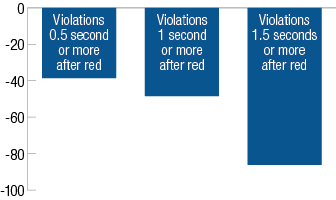
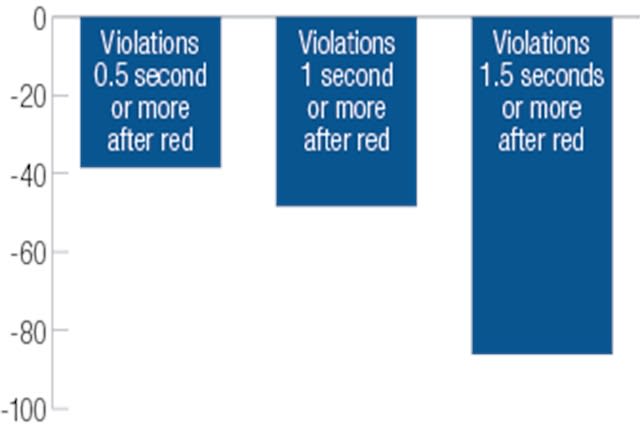
One year after the start of ticketing, the odds of a red-light running violation at the camera locations went down. Violations occurring at least 0.5 second after the light turned red were 39% less likely than would have been expected without cameras, according to the study. Violations occurring at least one second after were 48% less likely, and the odds of a violation occurring at least 1.5 seconds into the red phase fell 86%.
Study results
"What these numbers show is that those violations most likely to lead to a crash are reduced the most," McCartt said. "The longer the light has been red when a violator enters an intersection, the more likely the driver is to encounter a vehicle traveling in another direction or a pedestrian."
At the two non-camera sites on camera corridors, the odds of violations also were lower than would have been expected without the camera program, researchers found. As with the camera intersections, the further into the red phrase, the bigger the effect. However, these results were smaller than at the camera intersections and not always statistically significant. At the two other non-camera sites in Arlington, the odds of violations increased.
The lack of a broad spillover effect isn't surprising, given the modest scope of the program and accompanying publicity, IIHS said.
"Given the small number of cameras and signs, it's likely that many Arlington drivers didn't even know about the enforcement, while those who were aware probably knew the cameras were limited to a few locations," McCartt said.
That could soon change. The county's fiscal 2013 budget contains funds for additional cameras. "We would expect a broader effect to emerge after the program's expansion into other parts of Arlington," McCartt noted.
A number of previous studies have also found that the installation of red-light cameras reduces the incidence of red-light running violations. One study, released by the Federal Highway Administration in 2005, analyzed more than 130 red-light camera intersections across the country and found that the average number of right-angle or “T-bone” crashes went down 25% after cameras were installed.
It’s also noteworthy that the same federal study found that the prospect of the cameras recording a red-light violation increased the likelihood of a driver stopping suddenly to avert such a fine. As a result, the average number of rear-end crashes went up 15%. However, right-angle crashes are much more dangerous and life threatening than rear-end collisions. To access the Federal Highway Administration study, click here.
In November 2012, the New Jersey Department of Transportation released its own annual report analyzing the state's use of red-light cameras.
More Safety

Fleet Manager’s Ultimate Playbook: Navigating the New Standard in OEM Connectivity
Rising operating costs, driver safety concerns, and unplanned downtime are putting unprecedented pressure on modern fleets. Discover how fleet managers use embedded OEM connectivity and real-time vehicle data to cut TCO, prevent downtime, and protect drivers without aftermarket telematics hardware.
Read More →
From Driver Well-Being to EV Charging | AF News Recap
Mental health belongs in the fleet safety conversation. This week, we’re looking at five ways fleets can support employee well-being before a crisis, plus Holman’s expansion in Mexico, new one-day Fleet Forward passes, and why EV charging demand is outpacing infrastructure growth.
Read More →
Nexar-Nauto Merger Aims to Give Fleets Better Safety Intelligence Through Larger Driving Dataset
Stefan Heck tells Automotive Fleet that combining more than 10 billion miles of driving history with Nexar's AI models will give fleets deeper insights into driver risk and roadway conditions than either company could provide independently.
Read More →
Don't Wait for a Crisis: 5 Ways to Build Mental Health Into Your Fleet Safety Program
For Suicide Prevention Month, fleet and safety leaders have an opportunity to put mental health where it belongs: at the center of workplace safety.
Read More →
How Camera Data Can Strengthen a Fleet’s Insurance Renewal
Insights from a commercial insurance carrier and a broker show how fleets can turn video telematic data, driver coaching, and improved claims results into a stronger case at insurance renewal.
Read More →
The Safest Fleets Aren’t the Ones with the Most Technology
You’ve made the telematics investment. Here’s how to capture the other half of its value and build the safest fleet on the road.
Read More →
Hidden in Plain Sight: Fleet Compliance Risks
Fleet compliance isn't just about having policies — it's about consistently enforcing them. This practical guide reveals six hidden compliance risks common in public sector and shared fleet operations and outlines proven strategies to improve visibility, accountability, and audit readiness
Read More →
NETS Sets 2026 Fleet Safety Benchmark Conference for Indianapolis
The Sept. 15–17 program will feature fleet benchmarking data, case studies, emerging technologies, and implementation strategies while running alongside the NSC Safety Congress & Expo.
Read More →
Off-the-Job Crashes Account for 43% of Employers’ $61.7 Billion Crash Burden
NETS quantifies costs dispersed across fleet, risk, HR, and other departments while providing new per-crash benchmarks for employers.
Read More →
Ram Recalls More Than 1.27 Million 1500 Pickups for Seat Belt Anchor Issue
The recall affects certain 2019-2026 Ram 1500 pickups that may have improperly attached second-row seat belt buckle anchors.
Read More →