




IIHS Sets Stricter Top Safety Pick Criteria for 2025 Vehicles
IIHS raises the bar for back seat safety, leading to fewer 2025 Top Safety Pick qualifying models as automakers adapt to rigorous crash tests.

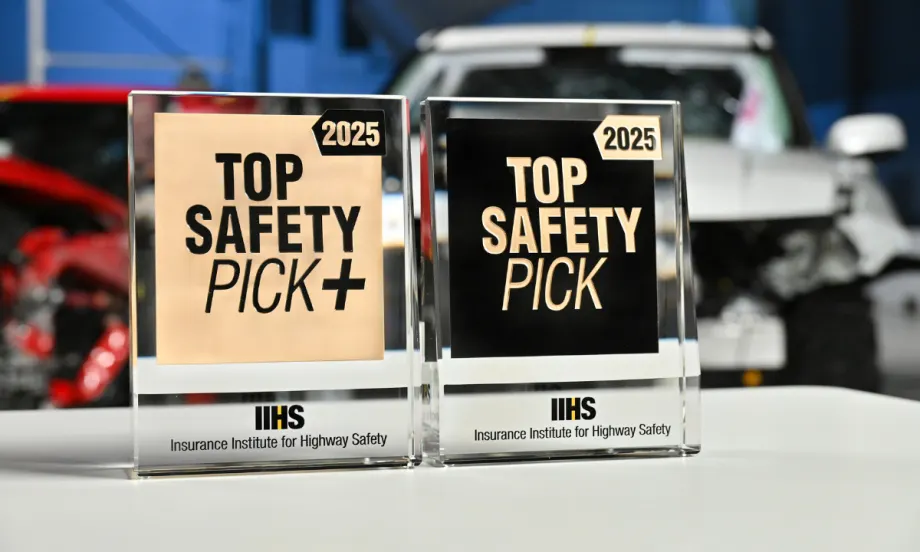
IIHS made changes to the updated moderate overlap front test by adding a second dummy behind the driver, emphasizing back seat safety for new model year vehicles.
Photo: Insurance Institute for Highway Safety
The Insurance Institute for Highway Safety (IIHS) requires better protection for second-row occupants for the 2025 Top Safety Pick and Top Safety Pick+ awards, encouraging automakers to make advanced seat belt technology and other safety innovations the norm in the back seat.
As a result, only 48 models qualify for 2025 awards so far, compared with 71 at this time last year. Of this year’s winners, 36 earn Top Safety Pick+, and 12 earn Top Safety Pick.
“We’re once again challenging automakers to make their new models even safer than those they were building a year ago,” IIHS President David Harkey said. “Every vehicle that earns a 2025 award offers a high level of safety in both the front seat and the second row.”
The Institute’s updated moderate overlap front test adds a second dummy behind the driver, emphasizing back seat safety. Last year, an acceptable or good rating in the updated test was a requirement for the higher-tier Top Safety Pick+ award. However, a good rating in the original test was still enough to earn the base award.
This year, vehicles must earn an acceptable rating in the updated test to qualify for Top Safety Pick, while a good rating is required for the “plus.” The original test has been phased out completely.
As before, to earn either award, vehicles must also earn good ratings in the small overlap front and updated side tests and an acceptable or good rating in the pedestrian front crash prevention evaluation, which gauges performance in both daytime and nighttime conditions. All trims must be equipped with acceptable- or good-rated headlights.
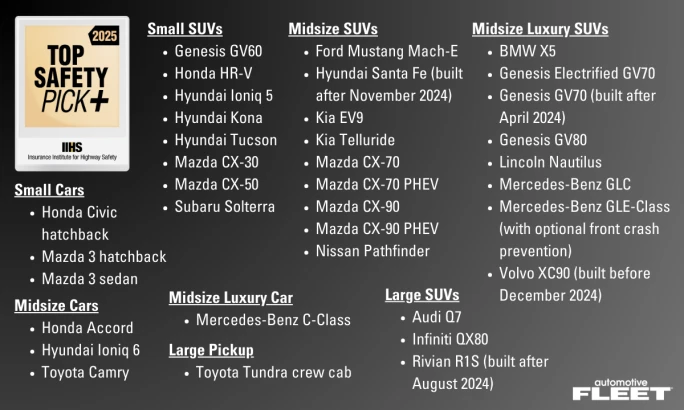
As of March 2025, 36 vehicles earned the Top Safety Pick+ award.
Source: Insurance Institute for Highway Safety / Automotive Fleet
Breaking Down the 2025 Winner’s Circle
Various models, ranging from small cars to large pickups and from economy cars to luxury vehicles, occupy the winner’s circle, and most major players in the U.S. market are represented.
SUVs comprise a large percentage of new models for sale, accounting for the bulk of the awards. Eight small SUVs, nine midsize SUVs, eight midsize luxury SUVs, and three large SUVs combine for 28 of the 36 total Top Safety Pick+ awards. Additional SUVs account for eight of the 12 Top Safety Picks.
In contrast, no minicars, large cars, minivans, or small pickups are among the winners, and only two large pickups, the Rivian R1T and Toyota Tundra, qualify for either accolade. The same two models and one small pickup were also the only pickups to earn acceptable or good ratings in the updated moderate overlap test last year.
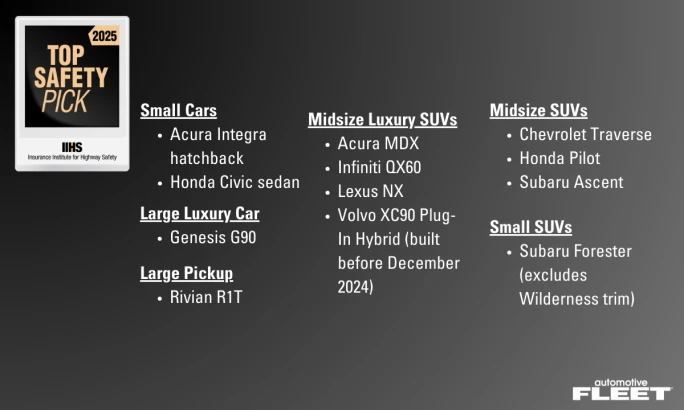
As of March 2025, only 12 vehicles earned the Top Safety Pick award.
Source: Insurance Institute for Highway Safety / Automotive Fleet
“The new emphasis on back seat protection appears to have winnowed minivans and pickups from the winners’ ranks,” Harkey said. “That’s unfortunate, considering that minivans are marketed as family haulers and extended cab and crew cab pickups are often used for that purpose.”
IIHS updated the moderate overlap front test in 2022. To excel in the original test, automakers strengthened vehicle structures, improved airbags, and developed advanced seat belts capable of absorbing crash forces.
However, many of those advancements were only applied in the front seat. As a result, in newer vehicles, the risk of a fatal injury is higher for belted adults in the rear seat than in the front.
The updated test is intended to push manufacturers to address that gap. Like its predecessor, it simulates a head-on collision in which the test vehicle strikes a vehicle of equal size and weight at 40 mph with 40% of its front widths overlapping.
The difference is that the new test includes an additional dummy representing a small woman or 12-year-old child positioned in the second row behind the driver and uses new metrics that focus on the injuries most frequently seen in rear-seat occupants.
Regardless of a vehicle’s performance in the updated test, the second row remains the safest position for children under 13.
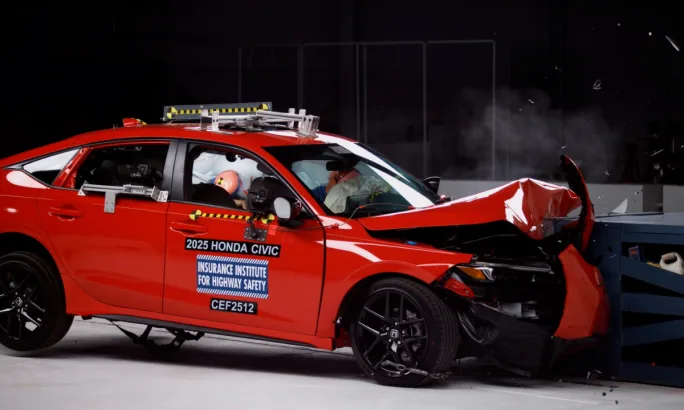
Two years after the moderate overlap front test update, around 60% of 2025 models tested earn acceptable or good ratings.
Photo: Insurance Institute for Highway Safety
Back Seat Safety Improves, But Gaps Remain in 2025 Crash Test Results
Two years after the moderate overlap front test update, around 60% of 2025 models tested earn acceptable or good ratings, heralding significant progress in back seat protection. However, including all 2023, 2024, and 2025 models tested so far, small and midsize SUVs account for most top performers, with no minivans and only a handful of cars and pickups notching up good or acceptable scores.
“There’s still progress to be made, but these results show that manufacturers are working hard to make their vehicles as safe for back seat passengers as they are for those up front,” Harkey said. “Consumers looking for a new vehicle offering the highest level of protection for their families should put these award winners at the top of their list.”
More details about how the updated moderate overlap front and other required tests are conducted can be found here. This resource also includes information about additional tests that are not yet included in the award criteria.
More Safety

Fleet Manager’s Ultimate Playbook: Navigating the New Standard in OEM Connectivity
Rising operating costs, driver safety concerns, and unplanned downtime are putting unprecedented pressure on modern fleets. Discover how fleet managers use embedded OEM connectivity and real-time vehicle data to cut TCO, prevent downtime, and protect drivers without aftermarket telematics hardware.
Read More →
From Driver Well-Being to EV Charging | AF News Recap
Mental health belongs in the fleet safety conversation. This week, we’re looking at five ways fleets can support employee well-being before a crisis, plus Holman’s expansion in Mexico, new one-day Fleet Forward passes, and why EV charging demand is outpacing infrastructure growth.
Read More →
Nexar-Nauto Merger Aims to Give Fleets Better Safety Intelligence Through Larger Driving Dataset
Stefan Heck tells Automotive Fleet that combining more than 10 billion miles of driving history with Nexar's AI models will give fleets deeper insights into driver risk and roadway conditions than either company could provide independently.
Read More →
Don't Wait for a Crisis: 5 Ways to Build Mental Health Into Your Fleet Safety Program
For Suicide Prevention Month, fleet and safety leaders have an opportunity to put mental health where it belongs: at the center of workplace safety.
Read More →
How Camera Data Can Strengthen a Fleet’s Insurance Renewal
Insights from a commercial insurance carrier and a broker show how fleets can turn video telematic data, driver coaching, and improved claims results into a stronger case at insurance renewal.
Read More →
The Safest Fleets Aren’t the Ones with the Most Technology
You’ve made the telematics investment. Here’s how to capture the other half of its value and build the safest fleet on the road.
Read More →
Hidden in Plain Sight: Fleet Compliance Risks
Fleet compliance isn't just about having policies — it's about consistently enforcing them. This practical guide reveals six hidden compliance risks common in public sector and shared fleet operations and outlines proven strategies to improve visibility, accountability, and audit readiness
Read More →
NETS Sets 2026 Fleet Safety Benchmark Conference for Indianapolis
The Sept. 15–17 program will feature fleet benchmarking data, case studies, emerging technologies, and implementation strategies while running alongside the NSC Safety Congress & Expo.
Read More →
Off-the-Job Crashes Account for 43% of Employers’ $61.7 Billion Crash Burden
NETS quantifies costs dispersed across fleet, risk, HR, and other departments while providing new per-crash benchmarks for employers.
Read More →
Ram Recalls More Than 1.27 Million 1500 Pickups for Seat Belt Anchor Issue
The recall affects certain 2019-2026 Ram 1500 pickups that may have improperly attached second-row seat belt buckle anchors.
Read More →