




More IIHS News: IIHS Developing Virtual Testing to Prevent Neck Injuries
IIHS Crash Test Rating Criteria Update Leads to Rating Changes on 13 Vehicles
A new metric on the updated moderate overlap front crash test factors in both the position of the shoulder belt on the rear dummy’s chest and chest compression.

Christy Grimes・Former Senior Editor
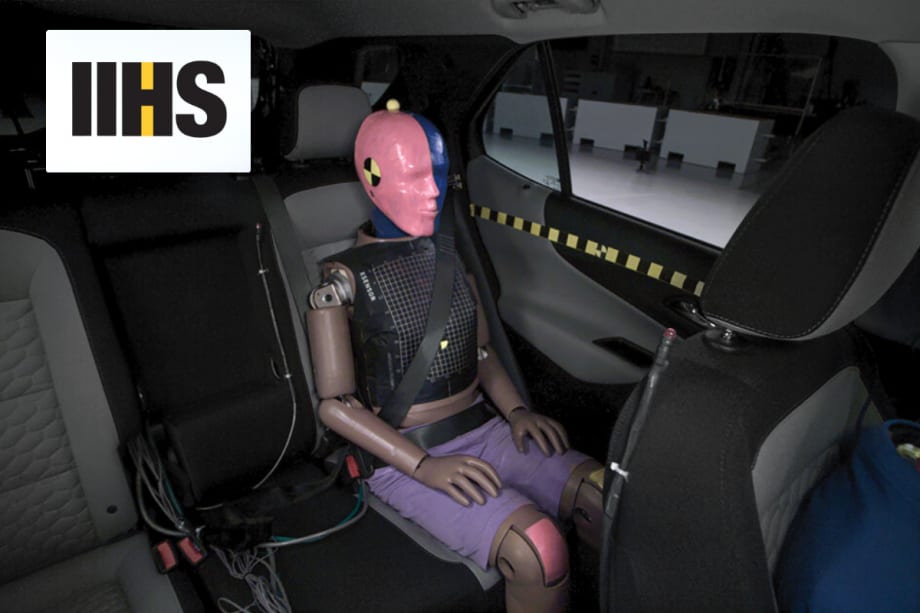
The new metric on the updated moderate overlap front crash test is called the chest index. It factors in both the position of the shoulder belt on the rear dummy’s chest and chest compression.
Photo: IIHS
4 min to read
The Insurance Institute for Highway Safety is rolling out new scoring criteria for one of its crash tests, leading crash test ratings on 13 vehicles to change.
The change is being made to the updated moderate overlap front crash test in order to better account for variations in the position of the rear shoulder belt.
It's important to note that these tests are geared toward the safety of second row passengers, which are not always present in fleet vehicles.
Details on the New Criteria
According to a news release from IIHS, the new metric on the crash test is called the chest index. It factors in both the position of the shoulder belt on the rear dummy’s chest and chest compression.
The belt position itself is also evaluated as part of the holistic analysis of how well the restraints control the motion of the dummy during the crash. Additionally, the range of shoulder belt positions considered acceptable has been expanded slightly.
“Most of these changes are part of a planned transition that we informed automakers we’d be making before we launched the updated test a year ago,” said Jessica Jermakian, IIHS vice president of vehicle research. “The new scoring eliminates an artificial benefit our initial ratings awarded for a high shoulder-belt position. Pressing ahead with a simpler program while we validated the new metric allowed us to start incentivizing vehicle improvements a year earlier.”
IIHS launched the updated moderate overlap front test in 2022 after research showed that in newer vehicles the risk of a fatal injury is now higher for belted occupants in the second row than for those in front.
That isn't because the second row has become less safe. Rather, the front seat has become safer due to improved airbags and advanced seat belts that are rarely available in the back.
Implementing the Updated Test
In the updated test, a dummy the size of a small woman or 12-year-old child is positioned in the second row behind the driver dummy.
For a vehicle to earn a good rating, there can’t be an excessive risk of injury to the chest, among other body regions, as recorded by the second-row dummy.
During the initial year of testing, IIHS engineers estimated the risk of chest injuries with a device that records the seat belt tension and the dummy’s own chest deflection sensor — which measures how much the rib cage is compressed by the force of the crash.
To avoid delaying the launch of the program, engineers used a pressure mat to track the position of the shoulder belt and penalized vehicles when it exceeded a maximum height.
Vehicles with shoulder belts higher than the cutoff could receive no better than a marginal rating for chest injury risk, regardless how little chest deflection the dummy’s internal sensor recorded.
The new chest index takes into account both chest deflection and belt position, using a formula that the Institute has been validating for the past year to adjust the deflection metric based on distance of the shoulder belt from the internal sensor.
The pressure mat is still used to determine the maximum shoulder belt position during the crash. However, engineers now evaluate maximum belt position separately as part of their assessment of how well the restraints control the motion of the dummy during the test, which reduces the influence of shoulder belt height on the overall rating.
In addition, the cutoff for a belt that is too high has been raised by 10 mm in recognition of the need for shoulder belts to accommodate occupants of various sizes. These changes were not part of the original phase-in plan.
The belt tension metric, which makes it very difficult for a vehicle without technology like pretensioners and belt force limiters to earn a good rating, remains unchanged.
Previously published ratings in the updated moderate overlap test, which was launched in 2022, have been adjusted on the Institute’s website in conjunction with the announcement. The ratings of five vehicles improve, and eight receive downgrades.
Which Vehicles Had Crash Test Ratings Changes
Overal ratings for the following vehicles have been updated:
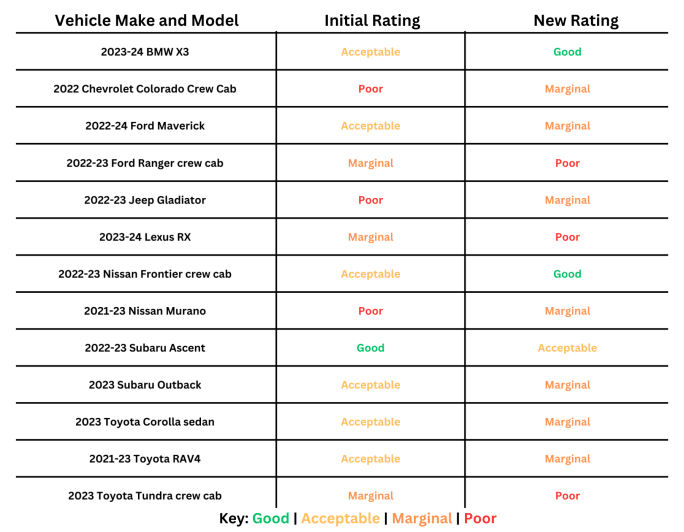
After taking into account the criteria changes, the crash test ratings of five vehicles improve, and eight receive downgrades.
Photo: Canva
More Safety

What’s Next for Fleet? Safety, AI & Industry Recognition | AF News Recap
Could your company's culture be encouraging distracted driving? This week, we're exploring how workplace expectations affect driver safety, what AI, EVs, and autonomous vehicles could mean for the future of fleet management, and how fleet professionals can strengthen their award nominations.
Read More →
Does Your Fleet's Culture Encourage Distracted Driving?
What happens when the people responsible for enforcing safety rules are the ones setting the wrong example? The answer may reveal why some of the biggest risks to fleet drivers have little to do with what's written in the employee handbook.
Read More →
Sponsored•October 1, 2026
Fleet Manager’s Ultimate Playbook: Navigating the New Standard in OEM Connectivity
Rising operating costs, driver safety concerns, and unplanned downtime are putting unprecedented pressure on modern fleets. Discover how fleet managers use embedded OEM connectivity and real-time vehicle data to cut TCO, prevent downtime, and protect drivers without aftermarket telematics hardware.
Read More →
From Driver Well-Being to EV Charging | AF News Recap
Mental health belongs in the fleet safety conversation. This week, we’re looking at five ways fleets can support employee well-being before a crisis, plus Holman’s expansion in Mexico, new one-day Fleet Forward passes, and why EV charging demand is outpacing infrastructure growth.
Read More →
Nexar-Nauto Merger Aims to Give Fleets Better Safety Intelligence Through Larger Driving Dataset
Stefan Heck tells Automotive Fleet that combining more than 10 billion miles of driving history with Nexar's AI models will give fleets deeper insights into driver risk and roadway conditions than either company could provide independently.
Read More →
Don't Wait for a Crisis: 5 Ways to Build Mental Health Into Your Fleet Safety Program
For Suicide Prevention Month, fleet and safety leaders have an opportunity to put mental health where it belongs: at the center of workplace safety.
Read More →
How Camera Data Can Strengthen a Fleet’s Insurance Renewal
Insights from a commercial insurance carrier and a broker show how fleets can turn video telematic data, driver coaching, and improved claims results into a stronger case at insurance renewal.
Read More →
The Safest Fleets Aren’t the Ones with the Most Technology
You’ve made the telematics investment. Here’s how to capture the other half of its value and build the safest fleet on the road.
Read More →
Sponsored•August 7, 2026
Hidden in Plain Sight: Fleet Compliance Risks
Fleet compliance isn't just about having policies — it's about consistently enforcing them. This practical guide reveals six hidden compliance risks common in public sector and shared fleet operations and outlines proven strategies to improve visibility, accountability, and audit readiness
Read More →
NETS Sets 2026 Fleet Safety Benchmark Conference for Indianapolis
The Sept. 15–17 program will feature fleet benchmarking data, case studies, emerging technologies, and implementation strategies while running alongside the NSC Safety Congress & Expo.
Read More →