




IIHS Evaluation: Auto Brake Tech Benefits Muted After Dark
Out of 23 vehicles that underwent a new nighttime test of pedestrian automatic emergency braking systems, only the superior-rated Pathfinder avoided a collision with the pedestrian dummy in both test scenarios at all test speeds.

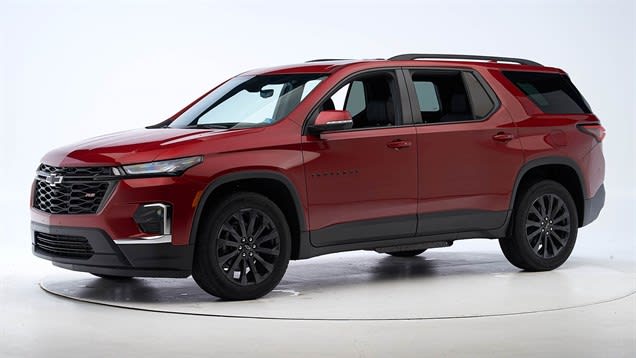
The 2022 Chevrolet Traverse is one of eight vehicles that earned just a basic score in a new nighttime test of pedestrian automatic emergency braking (AEB) systems.
Photo: IIHS
Twelve out of 23 midsize cars, midsize SUVs, and small pickups that recently underwent a new nighttime test of pedestrian automatic emergency braking (AEB) systems conducted by the Insurance Institute for Highway Safety (IIHS) garnered just a basic score or no credit.
Specifically, the Chevrolet Traverse, Ford Explorer, Ford Maverick, Ford Ranger, Mazda CX-9, Volkswagen Atlas, Volkswagen Atlas Cross Sport, and Volkswagen Tiguan earned basic scores. However, the pedestrian AEB systems in the Chevrolet Malibu, Honda Pilot, Nissan Altima, and Toyota Tacoma don’t perform well enough in the dark to earn any credit, according to IIHS engineers.
On the upside, four vehicles — Ford Mustang Mach-E, Nissan Pathfinder, Toyota Camry, and Toyota Highlander — captured superior ratings. Moreover, seven others scored advanced ratings. These include the Honda Accord, Hyundai Palisade, Hyundai Sonata, Nissan Frontier, Nissan Murano, Subaru Ascent, and Subaru Outback.
The 23 vehicles were the initial batch to undergo the new test, which aims to address the high percentage of pedestrian crashes that occur on dark roads. In 2021, some 7,300 pedestrians lost their lives on the nation’s roadways, accounting for nearly a fifth of all traffic fatalities. Moreover, 75% of those fatalities occur at night, when research shows most pedestrian AEB systems are less effective.
In fact, IIHS described the results of its first nighttime ratings as “discouraging.” These types of vehicles — SUVs and small pickups, specifically — are linked to worse crash outcomes with pedestrians. So, AEB systems that don’t perform well when the sun goes down increases the level of danger associated with larger vehicles for people on foot.
The IIHS nighttime test includes two common pedestrian crash scenarios, an adult crossing the road and an adult walking along the road at the edge of the travel lane. The ambient illumination surrounding the test track must remain below 1 lux — about the amount of light cast by a full moon — throughout the evaluation.
The crossing test is conducted at 12 mph and 25 mph, and the parallel test is conducted at 25 and 37 mph. Scores are awarded based on the average speed reductions in five repeated test runs on dry pavement.
Only the superior-rated Pathfinder avoided a collision with the pedestrian dummy in both test scenarios at all test speeds with both its low and high beams.
Automakers need to rise to the challenge and develop pedestrian AEB systems that work much harder in the dark. Ultimately, an advanced or superior rating in the nighttime test will become a requirement for the Top Safety Pick+ award in 2023, IIHS noted.
More Safety

Fleet Manager’s Ultimate Playbook: Navigating the New Standard in OEM Connectivity
Rising operating costs, driver safety concerns, and unplanned downtime are putting unprecedented pressure on modern fleets. Discover how fleet managers use embedded OEM connectivity and real-time vehicle data to cut TCO, prevent downtime, and protect drivers without aftermarket telematics hardware.
Read More →
From Driver Well-Being to EV Charging | AF News Recap
Mental health belongs in the fleet safety conversation. This week, we’re looking at five ways fleets can support employee well-being before a crisis, plus Holman’s expansion in Mexico, new one-day Fleet Forward passes, and why EV charging demand is outpacing infrastructure growth.
Read More →
Nexar-Nauto Merger Aims to Give Fleets Better Safety Intelligence Through Larger Driving Dataset
Stefan Heck tells Automotive Fleet that combining more than 10 billion miles of driving history with Nexar's AI models will give fleets deeper insights into driver risk and roadway conditions than either company could provide independently.
Read More →
Don't Wait for a Crisis: 5 Ways to Build Mental Health Into Your Fleet Safety Program
For Suicide Prevention Month, fleet and safety leaders have an opportunity to put mental health where it belongs: at the center of workplace safety.
Read More →
How Camera Data Can Strengthen a Fleet’s Insurance Renewal
Insights from a commercial insurance carrier and a broker show how fleets can turn video telematic data, driver coaching, and improved claims results into a stronger case at insurance renewal.
Read More →
The Safest Fleets Aren’t the Ones with the Most Technology
You’ve made the telematics investment. Here’s how to capture the other half of its value and build the safest fleet on the road.
Read More →
Hidden in Plain Sight: Fleet Compliance Risks
Fleet compliance isn't just about having policies — it's about consistently enforcing them. This practical guide reveals six hidden compliance risks common in public sector and shared fleet operations and outlines proven strategies to improve visibility, accountability, and audit readiness
Read More →
NETS Sets 2026 Fleet Safety Benchmark Conference for Indianapolis
The Sept. 15–17 program will feature fleet benchmarking data, case studies, emerging technologies, and implementation strategies while running alongside the NSC Safety Congress & Expo.
Read More →
Off-the-Job Crashes Account for 43% of Employers’ $61.7 Billion Crash Burden
NETS quantifies costs dispersed across fleet, risk, HR, and other departments while providing new per-crash benchmarks for employers.
Read More →
Ram Recalls More Than 1.27 Million 1500 Pickups for Seat Belt Anchor Issue
The recall affects certain 2019-2026 Ram 1500 pickups that may have improperly attached second-row seat belt buckle anchors.
Read More →