





Read More: How to Avoid Animal Collisions
IIHS Developing Virtual Testing to Prevent Neck Injuries
IIHS' long-term goal of the testing is to be able to evaluate how well each combination of a seat and head restraint protects people in a variety of seating positions and crash scenarios.
November 30, 2023
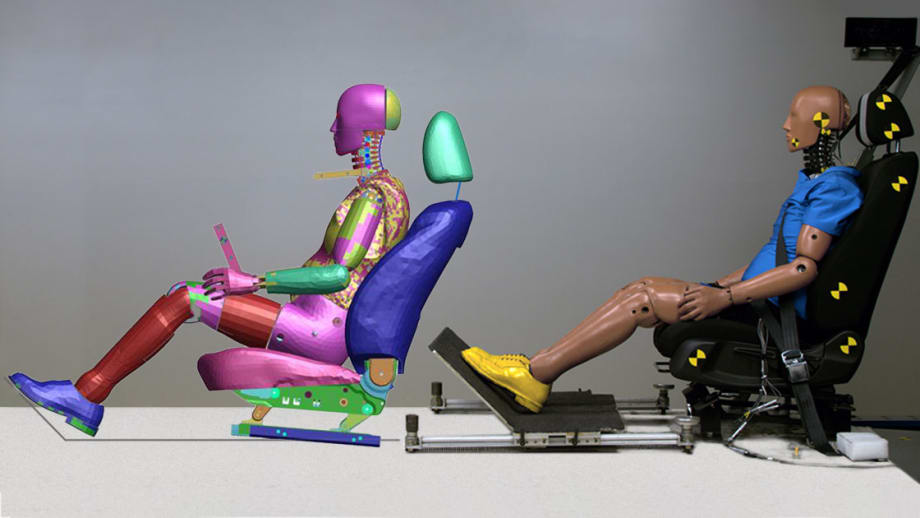
IIHS is planning to incorporate virtual tests into its head restraint ratings in stages.
Photo: IIHS
6 min to read
Marcy Edwards, senior research engineer of the Insurance Institute for Highway Safety (IIHS), recently announced the institute is developing a path for the future of IIHS rear-impact testing.
IIHS' long-term goal of the testing is to be able to evaluate how well each combination of a seat and head restraint protects people in a variety of seating positions and crash scenarios.
Getting there is a multi-step process and will require the use of virtual testing with computer models as well as the conventional tools used in its original head restraint test.
IIHS added it will need the help of scientists developing detailed computer models of the human body and the cooperation of vehicle manufacturers.
How IIHS Got Here
When IIHS began rating head restraints in 1995, it started with the basics. Neck injuries in rear impacts occur when the head lags behind the accelerating seat and torso. This lag can often be prevented by good head restraint geometry, so IIHS' first evaluations were measurements using a dummy representing a 50th-percentile man.
A restraint should be at least as high as the head’s center of gravity, or about 3½ inches below the top of the head. The backset, or the distance from the back of the head to the restraint, should be as small as possible.
In 1995, only 3% of the head restraints IIHS evaluated received good geometric ratings, while 82% were rated poor.
IIHS' ratings led manufacturers to pay attention to these measurements long before a 2010 government standard made good geometry a legal requirement.
Good geometry is necessary, but it’s not sufficient. Seats can differ in other ways too, such as structure placement, seatback stiffness, and energy-absorbing properties, all of which can affect outcomes for occupants.
In 2004, IIHS added a dynamic test for any vehicle with a good or acceptable geometric rating to evaluate how well the seat and head restraint managed crash energy and occupant motion.
This test consisted of a simulated rear impact with the vehicle seat mounted to a sled. A special dummy known as BioRID, which has a realistic spine, was buckled in the seat. The pulse used in the test was equivalent to a rear-end crash with a velocity change of 10 mph, or a stationary vehicle being struck at 20 mph by a vehicle of the same weight.
The combination of IIHS geometric ratings and its dynamic tests allowed it to identify the most effective head restraints. In a study of real-world crashes, injury rates were 15% lower for vehicles with good ratings compared with those rated poor, while long-term injuries, or those lasting three months or more, were 35% lower.
Beyond BioRID
Since IIHS began dynamic testing, manufacturers have gotten very good at designing seats for the 10 mph velocity change, and today’s vehicles all perform well in that test. However, there are still differences in real-world performance.
Insurance claims data collected by my colleagues at the Highway Loss Data Institute suggest that injury rates in rear-ended vehicles with good head restraint ratings vary widely.
So how can IIHS design a new evaluation to better differentiate among restraints?
One relatively easy update it intends to make is to add a second dynamic test with a larger velocity change since many real-world front-to-rear crashes occur at higher speeds.
By adding a 15 mph test on top of the 10 mph one, IIHS will be able to glean more information and encourage further progress. It plans to launch a new rating program based on the two tests within the next year or two.
Beyond test speed, other variables are harder to tweak. As is the case with all crash test dummies, BioRID has limited capabilities — for example, it’s only valid for fore-aft motion and lower-severity crashes — and doesn’t represent the diversity of the driving population. While it is an impressive tool with something that closely resembles a human spine, it represents the specific spine of a 50th-percentile male.
Real-world injury data tells IIHS that women are more likely than men to suffer neck injuries in crashes, but it doesn't really know why. Researchers in Sweden are currently developing a female dummy for use in rear-impact testing, which could someday help evaluate protection for women specifically.
However, no matter how sophisticated, physical dummies can’t capture soft tissue and nerve damage, which may play a role in whiplash injuries and in the differences between men’s and women’s susceptibility to them.
Perhaps more importantly, any physical dummy, male or female, represents just one particular body type.
On the other hand, computer models of the human body, which are currently under development, could be more easily varied to represent a range of body types and injury risk factors.
Virtual testing with these models could someday soon provide IIHS with the ability to see how seats and head restraints function for many different people sitting in different positions, according to Edwards.
IIHS' Path Forward
How can IIHS go from physical tests performed on actual seats to a much wider set of tests performed virtually?
One big challenge is that while IIHS can go out and purchase vehicles with physical seats to test, it cannot purchase computer models of those seats. Those models are the intellectual property of the manufacturers, so IIHS needs its cooperation.
At the same time, it will need to structure this cooperation so that it doesn’t compromise the independence of the testing program or the trust consumers place in the results.
IIHS allows established manufacturers to conduct tests according to its protocols and then supply it with video and other data so that it can verify the results and assign ratings. IIHS randomly audits those manufacturer-conducted tests by repeating some of them in its facility to make sure the outcomes match up.
IIHS said it intends to build on that model as it branches out into virtual testing.
IIHS is planning to incorporate virtual tests into its head restraint ratings in stages. As a first step, it will give manufacturers the option of submitting virtual test data for IIHS' new 15 mph test and its established 10 mph test. This phase will help IIHS get accustomed to working with virtual test data.
Later, IIHS will expand the number of required test scenarios, potentially varying things like speed, seat position, and occupant position — for example, a passenger leaning forward due to hard braking or a driver looking down at a phone in their lap.
Its plan is to eventually expand the required virtual tests to include scenarios that can’t be tested in the real world because of the limitations of the dummies and other tools IIHS has. This is where it will be able to evaluate performance with occupants of different body types and also in different positions that can’t be achieved by a physical dummy.
To make sure the virtual results for all these different test scenarios match reality, IIHS will conduct physical tests for some of them.
Replicating some results and then ensuring the same seat and dummy or human body models are used throughout the virtual evaluation will help it validate all the results, including the ones for scenarios it can’t physically test.
More Safety

Sponsored•October 1, 2026
Fleet Manager’s Ultimate Playbook: Navigating the New Standard in OEM Connectivity
Rising operating costs, driver safety concerns, and unplanned downtime are putting unprecedented pressure on modern fleets. Discover how fleet managers use embedded OEM connectivity and real-time vehicle data to cut TCO, prevent downtime, and protect drivers without aftermarket telematics hardware.
Read More →
From Driver Well-Being to EV Charging | AF News Recap
Mental health belongs in the fleet safety conversation. This week, we’re looking at five ways fleets can support employee well-being before a crisis, plus Holman’s expansion in Mexico, new one-day Fleet Forward passes, and why EV charging demand is outpacing infrastructure growth.
Read More →
Nexar-Nauto Merger Aims to Give Fleets Better Safety Intelligence Through Larger Driving Dataset
Stefan Heck tells Automotive Fleet that combining more than 10 billion miles of driving history with Nexar's AI models will give fleets deeper insights into driver risk and roadway conditions than either company could provide independently.
Read More →
Don't Wait for a Crisis: 5 Ways to Build Mental Health Into Your Fleet Safety Program
For Suicide Prevention Month, fleet and safety leaders have an opportunity to put mental health where it belongs: at the center of workplace safety.
Read More →
How Camera Data Can Strengthen a Fleet’s Insurance Renewal
Insights from a commercial insurance carrier and a broker show how fleets can turn video telematic data, driver coaching, and improved claims results into a stronger case at insurance renewal.
Read More →
The Safest Fleets Aren’t the Ones with the Most Technology
You’ve made the telematics investment. Here’s how to capture the other half of its value and build the safest fleet on the road.
Read More →
Sponsored•August 7, 2026
Hidden in Plain Sight: Fleet Compliance Risks
Fleet compliance isn't just about having policies — it's about consistently enforcing them. This practical guide reveals six hidden compliance risks common in public sector and shared fleet operations and outlines proven strategies to improve visibility, accountability, and audit readiness
Read More →
NETS Sets 2026 Fleet Safety Benchmark Conference for Indianapolis
The Sept. 15–17 program will feature fleet benchmarking data, case studies, emerging technologies, and implementation strategies while running alongside the NSC Safety Congress & Expo.
Read More →
Off-the-Job Crashes Account for 43% of Employers’ $61.7 Billion Crash Burden
NETS quantifies costs dispersed across fleet, risk, HR, and other departments while providing new per-crash benchmarks for employers.
Read More →
Ram Recalls More Than 1.27 Million 1500 Pickups for Seat Belt Anchor Issue
The recall affects certain 2019-2026 Ram 1500 pickups that may have improperly attached second-row seat belt buckle anchors.
Read More →