




Gearshift Interlocks Bolster Seat Belt Use: IIHS
An IIHS research project concludes that gearshift interlocks are better at raising seat belt use rates than enhanced seat belt reminder systems that use chimes and displays.
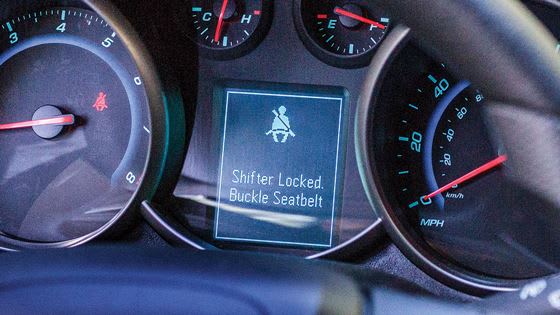
Photo courtesy of the Insurance Institute for Highway Safety.
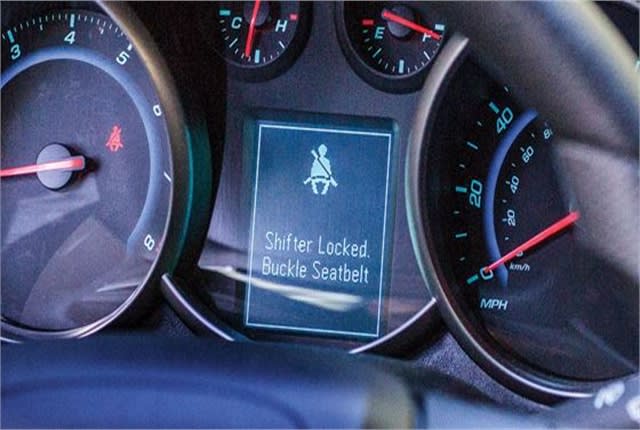
Photo courtesy of the Insurance Institute for Highway Safety.
In the quest to reach 100% seat belt compliance among fleet drivers, fleet managers might want to reconsider a solution that dates back to the Nixon administration era: gearshift interlocks.
A recent study by the Insurance Institute for Highway Safety concluded that gearshift interlocks, which prevent unbelted drivers from shifting out of “park,” are considerably more effective than enhanced seat belt reminder systems in prompting unbelted drivers to buckle up. Enhanced seat belt reminder systems exceed minimum federal safety requirements and use a combination of warning chimes and icon or text displays to remind drivers and front-seat passengers to wear a seat belt.
Gearshift interlocks, however, are largely viewed as safety technology from the early 1970s. And during that time, they were rather unpopular with the public.
In 1973, federal safety regulators mandated that all new cars without air bags or other passive restraints be equipped with an interlock. These interlocks prevented cars from starting if the driver or front-seat passenger was unbuckled.
In response to public outcry, Congress the following year prohibited the National Highway Traffic Safety Administration from requiring such interlocks — or even permitting automakers to use them to meet safety standards. Lawmakers also opted to restrict seat belt reminders. Keep in mind that seat belt use rates were much lower in those days compared to today.
But a change in federal regulations, tucked away in the 2012 highway reauthorization law, now allows automakers to equip vehicles with seat-belt gearshift interlocks as an alternative way to comply with certain federal safety standards. The interlocks can restrict operation of the vehicle either through the transmission, engine or entertainment system.
After the law change, General Motors decided to offer an interlock as an option for 2015 fleet-only vehicles sold in the U.S. GM’s Seat Belt Assurance System prevents shifting from “park” if the driver or right-front seat belt is unbuckled.
The recent IIHS seat belt study set out to determine whether the GM gearshift interlock was more effective at enticing part-time safety belt users to buckle up compared to an enhanced seat belt reminder system.
Researchers devised a clever way to ensure the study’s participants weren’t reliable seat belt users. IIHS recruited 32 people from a pool of Maryland drivers who had recently been cited for not wearing a seat belt. These drivers had previously admitted that they didn’t always buckle up.
But the study participants had no idea the research project was about seat belt use. They were led to believe they were test-driving a Chevrolet Cruze to compare two trim lines of the car.
For one week, all the study participants drove a Chevrolet Cruze equipped with an enhanced seat belt reminder system. The following week, they drove a different trim-level Cruze. Half of these cars were equipped with the same enhanced seat belt reminder, while the other half were equipped with a gearshift interlock.
The enhanced seat belt reminder system wasn’t easy to ignore. It used three 20-second cycles that were spaced a minute or more apart. Each cycle began with five chimes sounding during a seven-second period. At the same time, a red seat belt icon was displayed in the instrument cluster and flashed for 20 seconds.
So how did the two systems compare?
“The interlock increased the likelihood that a part-time belt user donned a belt at least once during travel — that is, from the time the car was placed into gear until it was last put in park — by 21 percent relative to the enhanced reminder,” IIHS reported in a summary of the research. “A second analysis examined if the interlock increased the amount of travel time the driver was belted compared with the enhanced-reminder group. By this measure, belt use in the reminder group decreased from 77 percent in week 1 to 69 percent in week 2.”
Additionally, in the interlock group, belt use grew from 85 percent in the first week to 89 percent in the second week, according to IIHS. That’s a 16 percent rise in belt use compared to what would be expected based on the performance of drivers in the enhanced-reminder group.
Six drivers in the study, however, occasionally circumvented the interlock. Their methods included sitting on the belt, waiting for the system to deactivate, and unbuckling during the trip at least once.
“Part-time belt users are the population we want to reach with interlock technology,” said David Kidd, an IIHS senior research scientist and the study’s lead author. “Interlocks should be intrusive enough to get the attention of unbelted drivers and front passengers, but at the same time they shouldn’t aggravate the vast majority of people who always use belts.”
More Safety

The Safest Fleets Aren’t the Ones with the Most Technology
You’ve made the telematics investment. Here’s how to capture the other half of its value and build the safest fleet on the road.
Read More →
Hidden in Plain Sight: Fleet Compliance Risks
Fleet compliance isn't just about having policies — it's about consistently enforcing them. This practical guide reveals six hidden compliance risks common in public sector and shared fleet operations and outlines proven strategies to improve visibility, accountability, and audit readiness
Read More →
NETS Sets 2026 Fleet Safety Benchmark Conference for Indianapolis
The Sept. 15–17 program will feature fleet benchmarking data, case studies, emerging technologies, and implementation strategies while running alongside the NSC Safety Congress & Expo.
Read More →
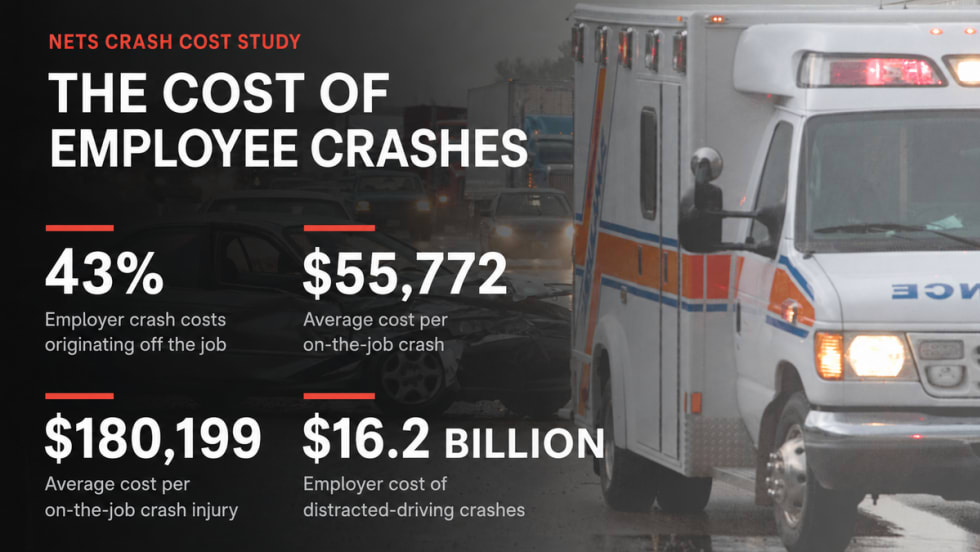
Off-the-Job Crashes Account for 43% of Employers’ $61.7 Billion Crash Burden
NETS quantifies costs dispersed across fleet, risk, HR, and other departments while providing new per-crash benchmarks for employers.
Read More →
Ram Recalls More Than 1.27 Million 1500 Pickups for Seat Belt Anchor Issue
The recall affects certain 2019-2026 Ram 1500 pickups that may have improperly attached second-row seat belt buckle anchors.
Read More →
How Better Visibility Cut Speeding Violations by 48%
Fleet leaders don't need more data, they need clearer visibility into what the data is saying. This case study explores how one utility replaced speeding-event counts with a single metric — miles driven in violation — to strengthen safety and significantly reduce speeding violations.
Read More →
Operation Safe Driver Week: Why the Industry's Oldest Safety Campaign Still Matters to Fleets
A look at how a 2007 enforcement initiative became one of the most consequential weeks on the fleet safety calendar, and what it means for your drivers in 2026.
Read More →
Nexar-Nauto Merger Aims to Give Fleets Better Safety Intelligence Through Larger Driving Dataset
Stefan Heck tells Automotive Fleet that combining more than 10 billion miles of driving history with Nexar's AI models will give fleets deeper insights into driver risk and roadway conditions than either company could provide independently.
Read More →
From Silos to Solutions: Relationship Management for Safer Fleets
From telematics adoption and driver accountability to policy consistency and risk mitigation, this episode breaks down what it really takes to build a safer fleet culture without slowing business down.
Read More →
IIHS Launches First Commercial Vehicle Safety Evaluations
The Insurance Institute for Highway Safety has begun evaluating heavy-duty pickups and cargo vans for driver protection. Which models earned top marks?
Read More →