




Ford Highlights How F-Series Shaped America
Ford recently highlighted how the F-Series has been a part of the U.S. workplace for nearly a century.
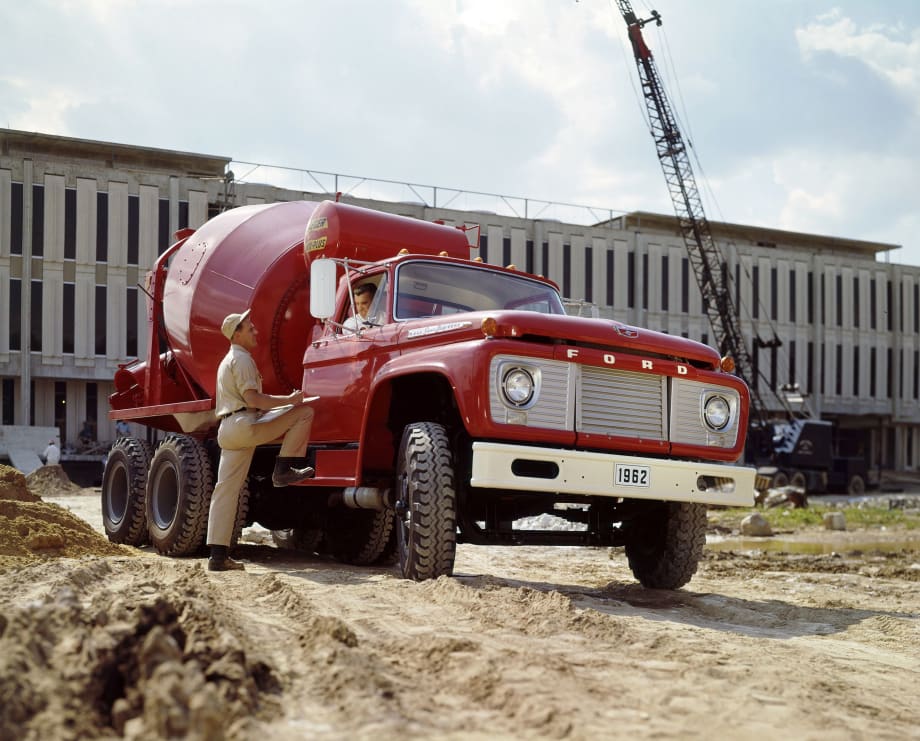
A 1962 Ford F-850 truck with concrete mixer at a job site. Photo: Ford Archives
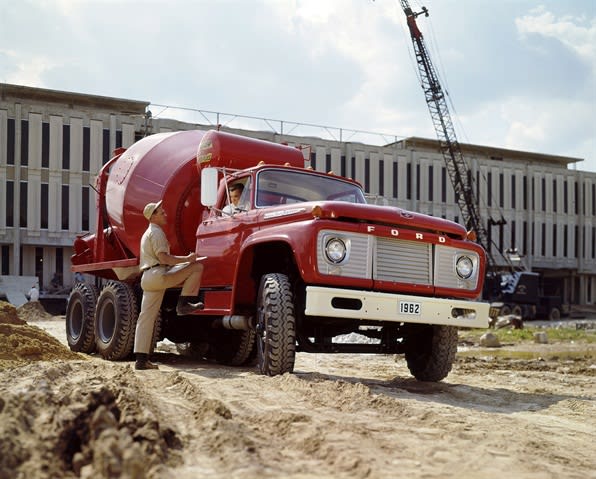
A 1962 Ford F-850 truck with concrete mixer at a job site. Photo: Ford Archives
Ford recently highlighted how the F-Series has been a part of the U.S. workplace for nearly a century.
One of the early landmark projects that involved the F-Series was the building of the Hoover Dam in 1931. According to Ford archives, estimates of the project included 5.5 million barrels of cement, 5 million cubic yards of concrete masonry, 15 million pounds of hydraulic equipment, 40 million pounds of electrical equipment, nearly 20 million pounds of gates and valves, and 30 million pounds of reinforcing steel.
The Alaska Road Commission used Ford trucks to help build and maintain more than 2,000 miles of road and 70,000 miles of trails. In 1939, a loaded, 2-ton Ford V-8 truck could make the 370-mile run from Valdez to Fairbanks, via gravel roads, at an average speed of over 20 mph, according to Ford records.
In 1933, Ford F-Series trucks were used in another major dam project near Glasgow, Montana, with the building of the Fort Peck Dam across the Missouri River. At the time, the Fort Peck Dam was the world's largest earthen dam, containing 123 million cubic yards of earth. During construction, Ford V-8 trucks hauled 14 million yards of earth to clear a path, according the automaker's records.
In addition to helping with the construction of the Hoover Dam, Ford F-Series trucks were used in the late 1930s on the construction of the Hoover Dam Transmission Line, which was designed to power the city of Los Angeles. Ford trucks were used as concrete mixers, were equipped with winch gear for hoisting power towers, and even as a portable service station for fueling field equipment in the high desert, according to the automaker.
Today, Ford F-Series trucks are employed across numerous industries, including waste management; street and highway construction; electric services; water, sewer, and pipeline construction; and in the crude petroleum and natural gas industry.
More Operations

Fleet Has a Talent Pipeline Problem. What Comes Next? | AF News Recap
Where will fleet’s next generation of leaders come from? This week, we’re looking at the industry’s talent pipeline, what certification can add to a fleet career, how to build an award-worthy track record, and the return of Automotive Fleet’s Personal Use Survey.
Read More →
Smith System Launches Driver Risk Management Program
Fleets have more driver data than ever, but identifying risky behavior doesn't necessarily correct it. Smith System's new Driver Risk Management program combines monitoring, training, and follow-up coaching to help fleets connect risk signals with driver intervention.
Read More →
Automotive Fleet Opens 2026 Personal Use Survey for Commercial Fleet Managers
Less than two weeks left! Commercial and corporate fleet managers are invited to share how their organizations handle company vehicle personal-use policies, charges, and driver eligibility.
Read More →
From AI Prompts to AI-Generated Safety Songs | AF News Recap
Can better prompts make AI more useful for fleet managers? This week, we’re breaking down smarter fleet analysis, an AI-assisted experiment that turned safety training into music, and what happened to fuel prices in August.
Read More →
How to Write Better AI Prompts for Fleet Analysis
Include these six elements in your fleet prompts to generate more relevant analysis and accurate answers.
Read More →
Fleet Meets: Eric Kilgore
This edition of the Fleet Meets series features one of the industry's best leaders driving multi-market and national operations.
Read More →
Why Reactive Fleet Management Is Becoming Too Expensive to Sustain
Research highlights a growing need for proactive management strategies to address rising costs in fleet operations effectively.
Read More →
What Your Fleet KPIs Aren’t Telling You
Tracking fleet metrics is only useful when the data leads to better decisions. This guide helps fleet leaders assess cost, utilization, and downtime more accurately, identify performance gaps, and prioritize the actions that can improve operational results.
Read More →
Hidden in Plain Sight: Fleet Compliance Risks
Fleet compliance isn't just about having policies — it's about consistently enforcing them. This practical guide reveals six hidden compliance risks common in public sector and shared fleet operations and outlines proven strategies to improve visibility, accountability, and audit readiness
Read More →
Turning Fleet Payment Data into Executive Insights
Does data alone drive results in operations?
Read More →