




Ford: Aftermarket Bumper Beams Absorb Less Crash Energy
DEARBORN, MI - In the latest development in the ongoing debate over the safety of aftermarket crash parts, Ford Motor Co. announced that its recent round of low-speed crash tests showed that a commonly used aftermarket bumper beam absorbs less crash energy than the vehicle's original bumper beam or a genuine Ford replacement bumper beam.
DEARBORN, MI - In the latest development in the ongoing debate over the safety of aftermarket crash parts, Ford Motor Co. announced that its recent round of low-speed crash tests showed that a commonly used aftermarket bumper beam absorbs less crash energy than the vehicle's original bumper beam or a genuine Ford replacement bumper beam.
According to Ford, its tests also showed that vehicles with the copy part were more likely to experience unintended airbag deployments during low-speed collisions.
All of this, Ford said, can lead to higher repair costs when accidents occur. Repair estimates show aftermarket copy bumper beams can more than double the repair costs after even a low-speed accident compared to a genuine Ford replacement bumper beam, according to the automaker.
"This should be an eye-opener for all consumers. These tests raise more questions about unintended airbag deployments in the event of a future crash," said Paul Massie, Ford powertrain and collision product marketing manager. "They also highlight the dangers of being penny-wise and pound-foolish, as less-expensive copy parts could lead to much higher repair costs down the road. All drivers should be aware that copy parts can compromise both the safety performance and the long-term repair costs of your vehicle."
In the past year the debate over aftermarket crash parts has heated up, at times pitting different factions of the automotive world against each other. Each of these factions -- automakers, aftermarket parts manufacturers, collision repair centers and auto insurers -- bring a different perspective to the issue. A number of automakers have released public statements advising owners of their vehicles to ensure the use of OEM parts instead of aftermarket replacement parts after a collision.
Aftermarket crash parts, which are unauthorized by the vehicle manufacturer, are "often constructed with substandard materials in order to be marketed as a cheaper alternative to authorized replacement parts," Ford said. On the other hand, Ford replacement crash parts, including all structural parts, are "identical to those used in new vehicle production and operate seamlessly with the vehicle's safety system."
[PAGEBREAK]
The crash tests, Ford said, underscore the results of Ford's previously released computer-aided engineering testing, showing that the copy parts are not "like kind and quality" to the original equipment manufacturer parts -- as is required by many states -- and will not return a vehicle to pre-accident condition.
Ford said its research efforts, spurred by concerns voiced about copy parts throughout the collision repair industry, examined OEM and aftermarket copy bumper beams for the Ford Mustang from the 2005 through 2009 model years. The parts were first put through a 6-mph frontal impact sled test. Then, corresponding bumper absorbers and bumper isolators were added for 5-mph and 8-mph full-vehicle flat barrier crash tests.
Data from the 8-mph crash barrier test demonstrated that the amount of crash energy absorbed by the aftermarket copy bumper beam is less than that of the OEM beam, Ford said. The data also showed that the frequency of airbag deployments at low speeds increases with the use of the copy bumper beam, absorber and isolator because the copy parts do not transmit the crash pulse as effectively to the crash sensors to indicate when an airbag should be deployed, according to Ford.
"Genuine Ford parts are designed to work properly with the entire vehicle structure, just like a brand-new car," said David Bauch, Ford sensor technical specialist. "The pulse to the airbag sensors will change with the aftermarket bumper, affecting the sensor's decision to deploy or not to deploy an airbag."
Side-by-side visual comparisons following each test also offered striking differences, with the aftermarket beam failing to perform in a manner consistent with that of the genuine Ford part, the automaker said.
"The copy bumper beam had an aftermarket absorber made of polystyrene and an aftermarket isolator," said Roger Chen, Ford crash development engineer. "The stacking up of these parts changed the crash characteristics of the entire bumper assembly, which is why Ford conducts both component-level crash testing and system-level testing on all of its vehicles."
The sled test is a component-level test aimed at determining how a single part will react under dynamic crash conditions. Ford said the test showed the aftermarket copy bumper beam failed to absorb energy like that of the genuine Ford beam, with deceleration and velocity measurements inconsistent with those of the OEM part. The copy part crushed nearly flat on each end and displayed little energy absorption, while the Ford part suffered only slight intrusion on the sides and absorbed more crash energy before rebounding close to its original form, according to Ford.
In each test, the genuine Ford parts performed as designed and resulted in a substantially lower estimated repair bill, while the copy parts led to significantly higher repair costs, Ford said.
Damage estimates following the 5-mph crash test put the repair cost for the vehicle fitted with aftermarket copy parts at $2,982 (using aftermarket prices for the bumper beam, absorber and isolator, and OEM parts for the remainder), nearly two-and-a-half times the $1,224 (using all OEM parts) estimate for the vehicle with genuine Ford parts, according to Ford. Estimates after the 8-mph crash came in at $3,816 for the aftermarket vehicle and $3,441 for the Mustang with genuine Ford parts. However, in cases where the crash resulted in unwarranted deployment for both front airbags, the repair cost for the vehicle with copy parts would jump to at least $5,394, the automaker said.
Statistics show the vast majority of injury accidents occur at speeds below 35 mph. In low-speed accidents, the bumper beam plays a significant role in absorbing crash energy and ensuring the proper operation of the safety system of the vehicle as a whole.
"A vehicle is required to pass a multitude of crash tests before the vehicle is sold to consumers," said Massie. "In sharp contrast, aftermarket copy parts face no crash test requirements prior to distribution, and have not been proven to work effectively with the rest of the vehicle's components. Copy parts should be subjected to the same government safety tests as the original parts so consumers can see the true costs that come with using many copy parts."
Ford said it is working with the National Highway Traffic Safety Administration, collision industry trade associations, state governmental and regulatory agencies, elected officials, the Alliance of Automobile Manufacturers and others to help improve the oversight of aftermarket copy structural parts and monitor their impact on the safety of the driving public.
In the meantime, there doesn't appear to be much chance for a quick resolution to the aftermarket crash parts controversy. Associations on the other side of the issue continue to release their own research results. Earlier this month, the Automotive Body Parts Association (ABPA) highlighted the results of Heartland Institute research that cast a positive light on the use of aftermarket crash parts. A report from the think tank concluded that use of aftermarket and recycled replacement parts can foster greater competition in the marketplace and save consumers money without compromising auto safety. The report argues against more government regulation of aftermarket and recycled auto parts.
In addition, the Certified Automotive Parts Association (CAPA) recently released a certification standard, CAPA 501, for aftermarket bumpers. CAPA engaged the help of the Insurance Institute of Highway Safety to conduct crash tests aimed at demonstrating that aftermarket bumper beams conforming to the CAPA 501 standard perform the same as OEM equipment. Click here for a summary of this research.
More Safety

Nexar-Nauto Merger Aims to Give Fleets Better Safety Intelligence Through Larger Driving Dataset
Stefan Heck tells Automotive Fleet that combining more than 10 billion miles of driving history with Nexar's AI models will give fleets deeper insights into driver risk and roadway conditions than either company could provide independently.
Read More →
Don't Wait for a Crisis: 5 Ways to Build Mental Health Into Your Fleet Safety Program
For Suicide Prevention Month, fleet and safety leaders have an opportunity to put mental health where it belongs: at the center of workplace safety.
Read More →
How Camera Data Can Strengthen a Fleet’s Insurance Renewal
Insights from a commercial insurance carrier and a broker show how fleets can turn video telematic data, driver coaching, and improved claims results into a stronger case at insurance renewal.
Read More →
The Safest Fleets Aren’t the Ones with the Most Technology
You’ve made the telematics investment. Here’s how to capture the other half of its value and build the safest fleet on the road.
Read More →
Hidden in Plain Sight: Fleet Compliance Risks
Fleet compliance isn't just about having policies — it's about consistently enforcing them. This practical guide reveals six hidden compliance risks common in public sector and shared fleet operations and outlines proven strategies to improve visibility, accountability, and audit readiness
Read More →
NETS Sets 2026 Fleet Safety Benchmark Conference for Indianapolis
The Sept. 15–17 program will feature fleet benchmarking data, case studies, emerging technologies, and implementation strategies while running alongside the NSC Safety Congress & Expo.
Read More →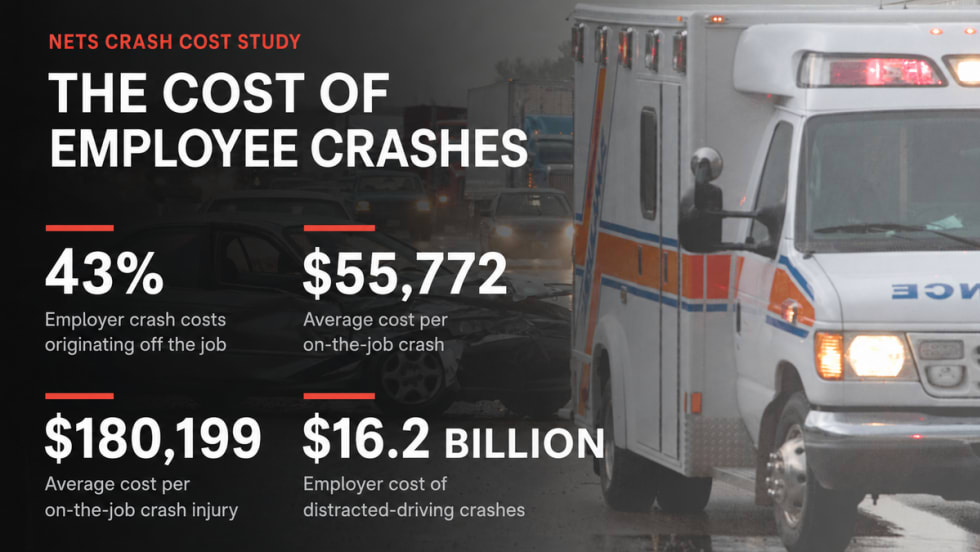
Off-the-Job Crashes Account for 43% of Employers’ $61.7 Billion Crash Burden
NETS quantifies costs dispersed across fleet, risk, HR, and other departments while providing new per-crash benchmarks for employers.
Read More →
Ram Recalls More Than 1.27 Million 1500 Pickups for Seat Belt Anchor Issue
The recall affects certain 2019-2026 Ram 1500 pickups that may have improperly attached second-row seat belt buckle anchors.
Read More →
How Better Visibility Cut Speeding Violations by 48%
Fleet leaders don't need more data, they need clearer visibility into what the data is saying. This case study explores how one utility replaced speeding-event counts with a single metric — miles driven in violation — to strengthen safety and significantly reduce speeding violations.
Read More →
Operation Safe Driver Week: Why the Industry's Oldest Safety Campaign Still Matters to Fleets
A look at how a 2007 enforcement initiative became one of the most consequential weeks on the fleet safety calendar, and what it means for your drivers in 2026.
Read More →