




Fleet Vehicles Attractive Target for Thieves
While the FBI doesn’t track commercial/fleet vehicle thefts specifically, they continue to be a concern.

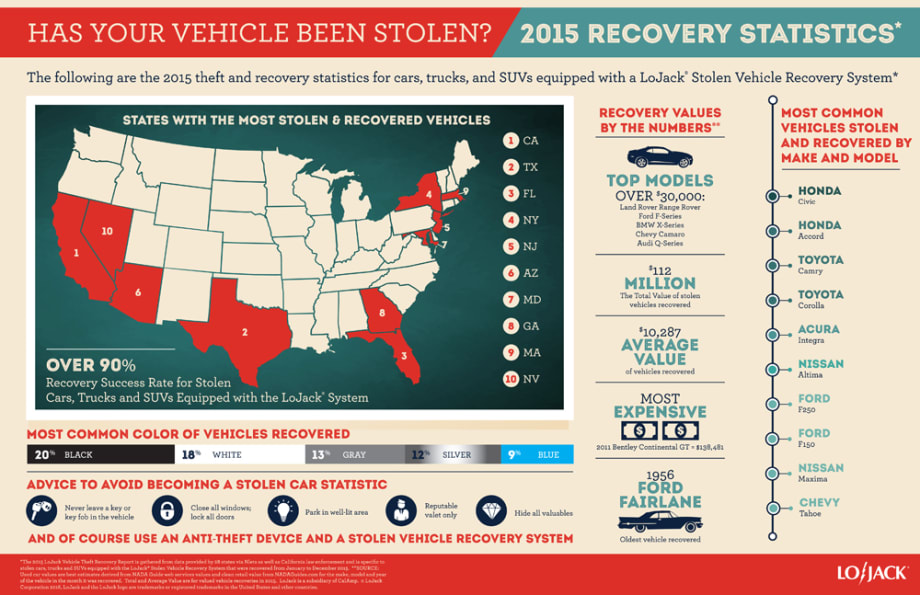
Infographic: LoJack
Infographic: LoJack
Recently, the Federal Bureau of Investigation (FBI) released data reporting that vehicle thefts were up 3.1% in 2015 over the previous year. The total estimated number of vehicles stolen in 2015 was 707,758 nationwide or about 220.2 per 100,000 inhabitants, costing more than $4.9 billion in losses. Of the stolen vehicles, 74.7% were automobiles.
While the FBI doesn’t track commercial/fleet vehicle thefts specifically, they continue to be a concern, according to LoJack.
“These vehicles are highly valuable not only as a single unit, but for their parts. LoJack has warned about the fact that vehicle thieves are becoming more sophisticated in their tactics, and this is true for commercial vehicle thefts as well,” said Patrick Clancy, vice president of LoJack Law Enforcement.
The cause of these thefts is also different than those of consumers’ vehicles, often an “inside job,” involving an employee. For commercial fleets, it’s not just the thefts of vehicles, but thefts from vehicles that are another challenge that they face.
“Thefts from vehicles are another growing problem noted within the FBI data,” said Clancy. “Thefts from motor vehicles accounted for 24% of all larceny-thefts in 2015, with targeted thefts of motor vehicle accessories making up an additional 7%. Theft of valuables from cars also increased by 3.7% compared to 2014. Property crimes overall decreased by 3.4%, but when we look at motor vehicles in particular, those rates are going up.”
Reflecting its growing scope, the FBI has begun tracking cargo thefts.
Connectivity and the potential for hacking vehicle systems has changed the theft landscape with criminals utilizing tech-enabled methods to steal vehicles.
“Once you give a vehicle connectivity, you’re creating an opportunity for that vehicle to be hacked into, and the data stored within to be stolen,” said Clancy. “Fleet managers need to be aware of the latest cyber threats and ensure their fleet vehicles are protected. The fact that commercial fleets cycle their vehicles faster than consumers certainly creates challenges. Thieves are increasingly targeting newer commercial vehicle models because of their resale value.”
These varied and ever-evolving threats may be keeping fleet managers up at night, but there are tools at fleets’ disposal that can combat these threats; chief among them is telematics.
“Many telematics providers offer location data on demand, so fleet managers have complete visibility into where resources are located at all times,” said Clancy. “Telematics-enabled tools like geo-fencing also allow fleet managers to set invisible boundaries on certain vehicles and equipment, to help prevent unauthorized use. Many systems also utilize real-time notifications, so managers can be quickly notified in the case of theft.”
More Safety

Nexar-Nauto Merger Aims to Give Fleets Better Safety Intelligence Through Larger Driving Dataset
Stefan Heck tells Automotive Fleet that combining more than 10 billion miles of driving history with Nexar's AI models will give fleets deeper insights into driver risk and roadway conditions than either company could provide independently.
Read More →
Don't Wait for a Crisis: 5 Ways to Build Mental Health Into Your Fleet Safety Program
For Suicide Prevention Month, fleet and safety leaders have an opportunity to put mental health where it belongs: at the center of workplace safety.
Read More →
How Camera Data Can Strengthen a Fleet’s Insurance Renewal
Insights from a commercial insurance carrier and a broker show how fleets can turn video telematic data, driver coaching, and improved claims results into a stronger case at insurance renewal.
Read More →
The Safest Fleets Aren’t the Ones with the Most Technology
You’ve made the telematics investment. Here’s how to capture the other half of its value and build the safest fleet on the road.
Read More →
Hidden in Plain Sight: Fleet Compliance Risks
Fleet compliance isn't just about having policies — it's about consistently enforcing them. This practical guide reveals six hidden compliance risks common in public sector and shared fleet operations and outlines proven strategies to improve visibility, accountability, and audit readiness
Read More →
NETS Sets 2026 Fleet Safety Benchmark Conference for Indianapolis
The Sept. 15–17 program will feature fleet benchmarking data, case studies, emerging technologies, and implementation strategies while running alongside the NSC Safety Congress & Expo.
Read More →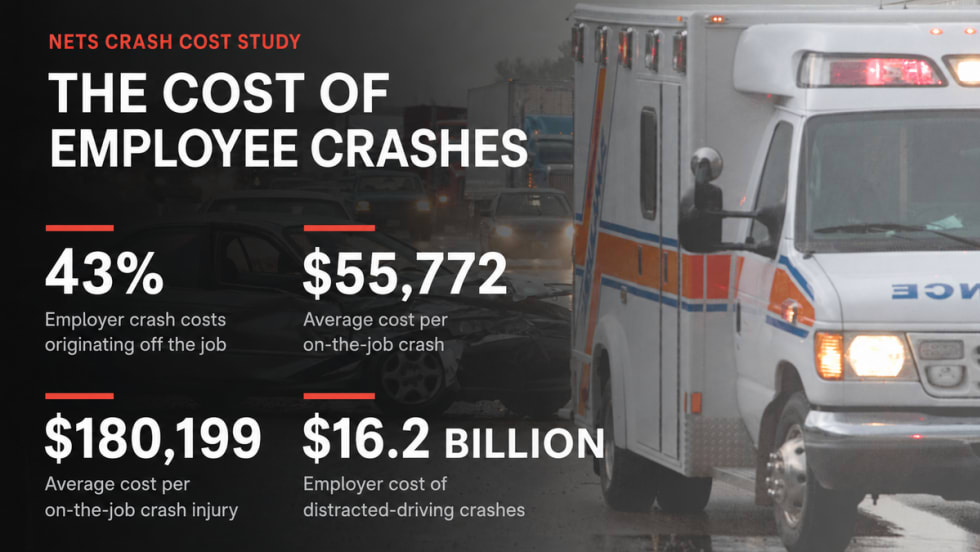
Off-the-Job Crashes Account for 43% of Employers’ $61.7 Billion Crash Burden
NETS quantifies costs dispersed across fleet, risk, HR, and other departments while providing new per-crash benchmarks for employers.
Read More →
Ram Recalls More Than 1.27 Million 1500 Pickups for Seat Belt Anchor Issue
The recall affects certain 2019-2026 Ram 1500 pickups that may have improperly attached second-row seat belt buckle anchors.
Read More →
How Better Visibility Cut Speeding Violations by 48%
Fleet leaders don't need more data, they need clearer visibility into what the data is saying. This case study explores how one utility replaced speeding-event counts with a single metric — miles driven in violation — to strengthen safety and significantly reduce speeding violations.
Read More →
Operation Safe Driver Week: Why the Industry's Oldest Safety Campaign Still Matters to Fleets
A look at how a 2007 enforcement initiative became one of the most consequential weeks on the fleet safety calendar, and what it means for your drivers in 2026.
Read More →