




Fleet Safety Tip of the Week
This week’s safety tip concerns how to deal with emergency stops on a freeway. This can, of course, be a very stressful experience for a driver, especially if the spot where the vehicle breaks down happens to be out of cell phone range or the driver’s phone battery is drained.
This week’s safety tip concerns how to deal with emergency stops on a freeway. This can, of course, be a very stressful experience for a driver, especially if the spot where the vehicle breaks down happens to be out of cell phone range or the driver’s phone battery is drained.
Some freeways have emergency call boxes so help is still just a call away. On the other hand, these units aren’t always maintained and operable – and they’re certainly not ubiquitous. So you may want to pass this advice along to your fleet drivers as a friendly reminder so they’re better prepared for those unexpected detours through Murphy’s Law Expressway.
Here’s some advice from the Arizona Driver License Manual:
• If you need assistance, pull over onto the right shoulder as far as possible. Avoid stopping your vehicle on or near freeway ramps.
• To signal for assistance on the freeway, turn on your emergency flashers. If possible, tie a white handkerchief or scarf to the radio antenna, or raise the hood of the car. To signal after dark, turn on your inside dome light and/or set out flares or portable warning signals. Law enforcement officers and tow truck operators will recognize these signals.
• Wait for help. Do not start walking along the freeway.
• While driving on the freeway, watch for disabled vehicles. If you are the first motorist to approach a disabled vehicle, reduce your speed and turn on your emergency flashers; then proceed around the disabled vehicle with caution.
Here’s some advice from the National Safety Council:
• Don’t try to flag down other drivers for help. Watch for police or other emergency personnel. All interstate highways and major roads are patrolled on a routine basis.
• Wait for help inside the vehicle and keep the doors locked. Don’t stand behind or next to your vehicle. If another motorist stops to offer help, roll down the window and ask the person to call the police.
• Walking along the side of a freeway is always inadvisable, especially during inclement weather. But if a source of help is just a short walk away and you’re certain you won’t be jeopardizing your safety, walk on the right side of the roadway as far from traffic as possible. But never attempt to cross a multi-lane, high-speed roadway. Even if that gas station sign on the other side looks tempting. Even if you ran track in high school. Don’t even think about it.
More Safety

From Driver Well-Being to EV Charging | AF News Recap
Mental health belongs in the fleet safety conversation. This week, we’re looking at five ways fleets can support employee well-being before a crisis, plus Holman’s expansion in Mexico, new one-day Fleet Forward passes, and why EV charging demand is outpacing infrastructure growth.
Read More →
Nexar-Nauto Merger Aims to Give Fleets Better Safety Intelligence Through Larger Driving Dataset
Stefan Heck tells Automotive Fleet that combining more than 10 billion miles of driving history with Nexar's AI models will give fleets deeper insights into driver risk and roadway conditions than either company could provide independently.
Read More →
Don't Wait for a Crisis: 5 Ways to Build Mental Health Into Your Fleet Safety Program
For Suicide Prevention Month, fleet and safety leaders have an opportunity to put mental health where it belongs: at the center of workplace safety.
Read More →
How Camera Data Can Strengthen a Fleet’s Insurance Renewal
Insights from a commercial insurance carrier and a broker show how fleets can turn video telematic data, driver coaching, and improved claims results into a stronger case at insurance renewal.
Read More →
The Safest Fleets Aren’t the Ones with the Most Technology
You’ve made the telematics investment. Here’s how to capture the other half of its value and build the safest fleet on the road.
Read More →
Hidden in Plain Sight: Fleet Compliance Risks
Fleet compliance isn't just about having policies — it's about consistently enforcing them. This practical guide reveals six hidden compliance risks common in public sector and shared fleet operations and outlines proven strategies to improve visibility, accountability, and audit readiness
Read More →
NETS Sets 2026 Fleet Safety Benchmark Conference for Indianapolis
The Sept. 15–17 program will feature fleet benchmarking data, case studies, emerging technologies, and implementation strategies while running alongside the NSC Safety Congress & Expo.
Read More →
Off-the-Job Crashes Account for 43% of Employers’ $61.7 Billion Crash Burden
NETS quantifies costs dispersed across fleet, risk, HR, and other departments while providing new per-crash benchmarks for employers.
Read More →
Ram Recalls More Than 1.27 Million 1500 Pickups for Seat Belt Anchor Issue
The recall affects certain 2019-2026 Ram 1500 pickups that may have improperly attached second-row seat belt buckle anchors.
Read More →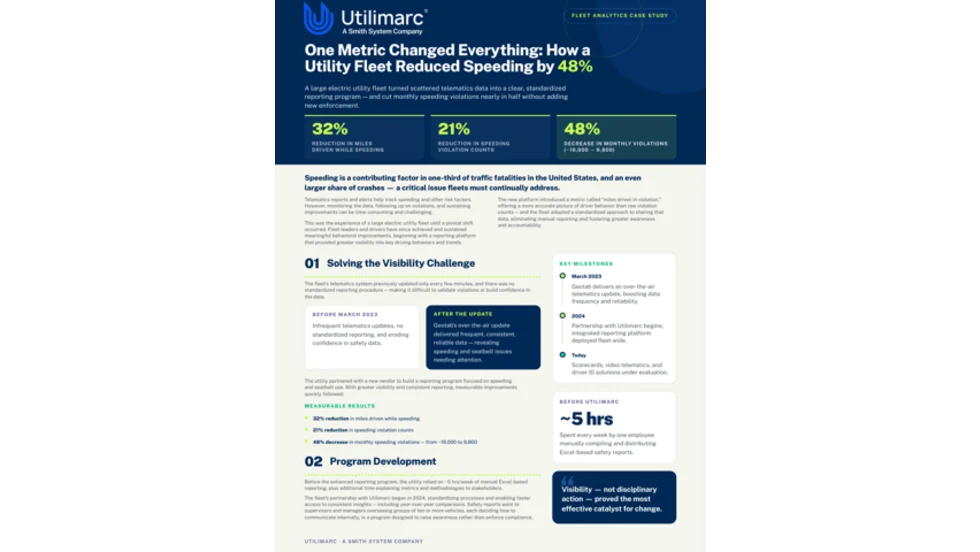
How Better Visibility Cut Speeding Violations by 48%
Fleet leaders don't need more data, they need clearer visibility into what the data is saying. This case study explores how one utility replaced speeding-event counts with a single metric — miles driven in violation — to strengthen safety and significantly reduce speeding violations.
Read More →