





More on Crash Testing: Half of Small Pickups Tested Score Good Ratings on New IIHS Side Crash Test
Five Popular Fleet Vehicles Score Poorly on New Crash Test
Some 15 small SUVs underwent a new, more rigorous moderate overlap front crash test with the goal of bringing better protection to back seat passengers. Only two vehicles took home good ratings.
December 15, 2022
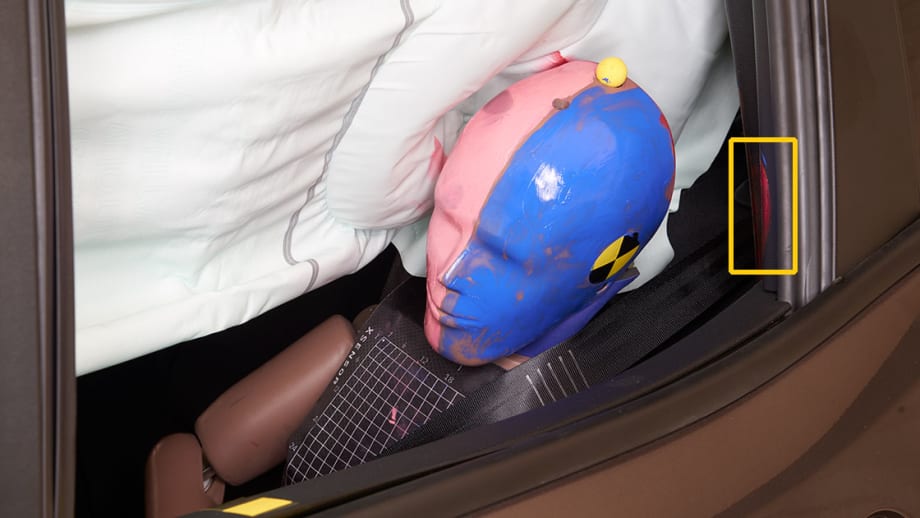
The Jeep Renegade is one of several fleet vehicles that scored a poor rating in the new crash test. The head protection was found to be inadequate and puts the head at risk of possible contact with outside objects.
Photo: IIHS
4 min to read
Nine out of 15 small SUVs scored a poor rating from the Insurance Institute for Highway Safety (IIHS) after undergoing the IIHS’s new moderate overlap front evaluation. Moreover, several of those that took home a poor rating are popular fleet vehicles including the Buick Encore, Chevrolet Equinox, Jeep Compass, Jeep Renegade, and Mazda C-X5.
Additional vehicles that garnered the poor rating include the Honda CR-V, Honda HR-V, Hyundai Tucson, and Mitsubishi Eclipse Cross.
The updated overlap front evaluation aims to address a growing gap in the protection provided for front and rear occupants, according to IIHS. The original moderate overlap front test led to many improvements by automakers. Due to those higher standards and improvements, drivers in most vehicles are nearly 50% less likely to be killed in a frontal crash today than they were 25 years ago.
Now, the updated test is a challenge to manufacturers to bring those same benefits to the back seat of vehicles.
Two vehicles — the Ford Escape and Volvo XC40 — earned a good rating on the new test. IIHS engineers say that “the stellar performance” by these two SUVs proves that manufacturers can indeed find ways to build vehicles that protect the rear occupants as well as they protect front-seat occupants.
Four additional vehicles scored somewhere in between poor and good. Specifically, the Toyota RAV4 earned an acceptable rating, and the Audi Q3, Nissan Rogue, and Subaru Forester rated marginal.
Recent real-world crashes showed that in many cases, back-seat passengers were injured more severely than front-seat occupants, according to IIHS. That is why it is critical to focus the new evaluation on boosting protection for back seat occupants. Overall, the findings from the new test indicate that most of the vehicles evaluated don’t provide adequate protection for the rear passenger’s head and neck — the most vulnerable areas of the body.
In the not-so-distant past, passengers seated in the rear were substantially less likely to be killed in a frontal offset crash than the driver or front-seat passenger because the biggest factor in survival was the crumpling of the front of the occupant compartment. Now, though, there is barely any deformation of the occupant compartment in the moderate overlap test.
In addition, automakers have added airbags and advanced seat belts in the front seats but not often in the rear. As a result, in vehicles from model year 2007 onward, the risk of a fatal injury is 46% higher for belted occupants in the rear seat than in the front.
To push automakers to address that widening gap, the new test incorporates a second Hybrid III dummy representing a small woman or 12-year-old child positioned in the second row behind the driver and utilizes new metrics that focus on the injuries most frequently seen in rear-seat occupants.
IIHS also sees this test as an opportunity to rapidly deliver big safety benefits by adapting technologies that we already know to be effective.
For example, in the front seat, crash tensioners tighten the seat belts the instant a crash begins so that the occupant’s body begins to slow with the vehicle. Then, as the tightened belt stops the occupant from flying forward, force limiters allow some of the webbing to spool out to reduce the risk of chest injuries. Rear-seat occupants would also benefit from these technologies. Features like rear seat airbags and seat belts that themselves inflate to mitigate the effects of crash forces could help, too.
What the Test Showed
In all nine poor-rated vehicles, injury measurements indicated high risks of head, neck, and chest injuries for the rear passenger, and the seat belt exerted excessive forces on the chest of the second-row dummy. In the CR-V and CX-5, the position of the rear dummy’s shoulder belt was also very high, which can make the restraint system less effective.
Moreover, in the Eclipse Cross, Encore, and Tucson, the rear passenger dummy came close to making contact with the front seatback, while in the Encore, Renegade, and Tucson, the rear passenger dummy’s head ended up between the side curtain airbag and the window following the initial impact. In the Renegade, this allowed the rear dummy’s head to make hard contact with the C-pillar that connects the vehicle body with the roof behind the rear window.
On the upside, the good-rated Escape and XC40 showed minimal risk injuries for the second-row passenger. There was also no excessive force on the dummy’s chest or misalignment of the safety belt shoulder strap and no submarining under the lap belt or malfunctioning of the side curtain airbag. However, in the Escape, the rear dummy’s head came closer to the front seatback than is desirable. The good rating for the Escape applies to vehicles built after May 2022, when Ford made adjustments to the rear seat belts.
More Safety

What’s Next for Fleet? Safety, AI & Industry Recognition | AF News Recap
Could your company's culture be encouraging distracted driving? This week, we're exploring how workplace expectations affect driver safety, what AI, EVs, and autonomous vehicles could mean for the future of fleet management, and how fleet professionals can strengthen their award nominations.
Read More →
Does Your Fleet's Culture Encourage Distracted Driving?
What happens when the people responsible for enforcing safety rules are the ones setting the wrong example? The answer may reveal why some of the biggest risks to fleet drivers have little to do with what's written in the employee handbook.
Read More →
Sponsored•October 1, 2026
Fleet Manager’s Ultimate Playbook: Navigating the New Standard in OEM Connectivity
Rising operating costs, driver safety concerns, and unplanned downtime are putting unprecedented pressure on modern fleets. Discover how fleet managers use embedded OEM connectivity and real-time vehicle data to cut TCO, prevent downtime, and protect drivers without aftermarket telematics hardware.
Read More →
From Driver Well-Being to EV Charging | AF News Recap
Mental health belongs in the fleet safety conversation. This week, we’re looking at five ways fleets can support employee well-being before a crisis, plus Holman’s expansion in Mexico, new one-day Fleet Forward passes, and why EV charging demand is outpacing infrastructure growth.
Read More →
Nexar-Nauto Merger Aims to Give Fleets Better Safety Intelligence Through Larger Driving Dataset
Stefan Heck tells Automotive Fleet that combining more than 10 billion miles of driving history with Nexar's AI models will give fleets deeper insights into driver risk and roadway conditions than either company could provide independently.
Read More →
Don't Wait for a Crisis: 5 Ways to Build Mental Health Into Your Fleet Safety Program
For Suicide Prevention Month, fleet and safety leaders have an opportunity to put mental health where it belongs: at the center of workplace safety.
Read More →
How Camera Data Can Strengthen a Fleet’s Insurance Renewal
Insights from a commercial insurance carrier and a broker show how fleets can turn video telematic data, driver coaching, and improved claims results into a stronger case at insurance renewal.
Read More →
The Safest Fleets Aren’t the Ones with the Most Technology
You’ve made the telematics investment. Here’s how to capture the other half of its value and build the safest fleet on the road.
Read More →
Sponsored•August 7, 2026
Hidden in Plain Sight: Fleet Compliance Risks
Fleet compliance isn't just about having policies — it's about consistently enforcing them. This practical guide reveals six hidden compliance risks common in public sector and shared fleet operations and outlines proven strategies to improve visibility, accountability, and audit readiness
Read More →
NETS Sets 2026 Fleet Safety Benchmark Conference for Indianapolis
The Sept. 15–17 program will feature fleet benchmarking data, case studies, emerging technologies, and implementation strategies while running alongside the NSC Safety Congress & Expo.
Read More →