




EPA Finalizes Volumes for Biofuel Blending
The U.S Environmental Protection Agency has finalized the volume requirements under its Renewable Fuel Standard (RFS) for blending with the nation's fuel supply that includes increases from existing levels but falls short of expectations from producers.
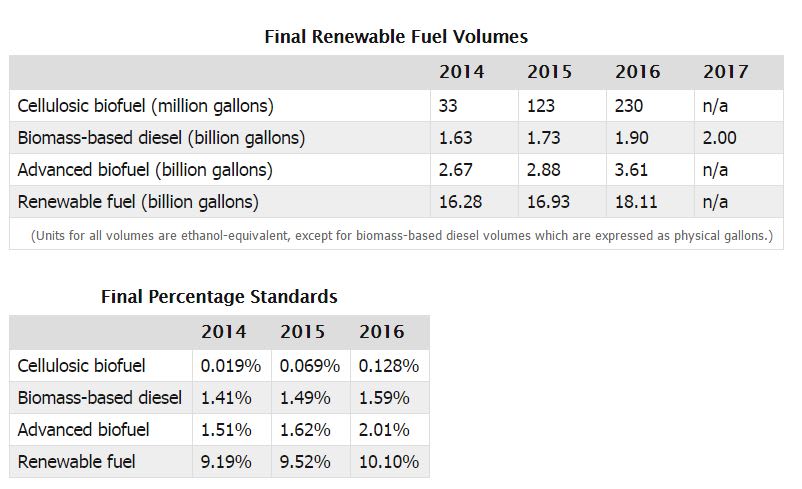
Charts courtesy of USEPA.
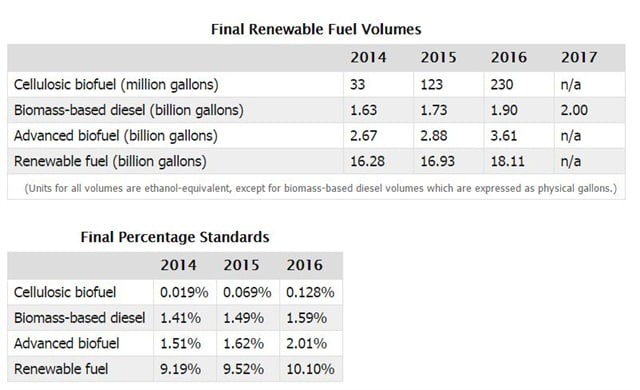
Charts courtesy of USEPA.
The U.S Environmental Protection Agency has finalized the volume requirements under its Renewable Fuel Standard (RFS) for blending with the nation's fuel supply that includes increases from existing levels but falls short of expectations from producers.
The agency finalized manadates for cellulosic biofuel, including ethanol for 2016, as well as final volume requirements for biomass-based diesel for 2016 and 2017.
“This rule finalizes higher volumes of renewable fuel than the levels EPA proposed in June, boosting renewable production and providing support for robust, achievable growth of the biofuels industry,” the agency said in a press release.
The final 2016 standard for the fuel with the lowest carbon emissions — cellulosic biofuel — is nearly 200 million gallons, or seven times more, than what the market produced in 2014.
The final 2016 standard for advanced biofuel is nearly 1 billion gallons, or 35%, higher than the actual 2014 volumes. The total renewable standard requires growth from 2014 to 2016 of more than 1.8 billion gallons of biofuel, which is 11% higher than 2014 actual volumes. Biodiesel standards grow steadily over the next several years, increasing every year to reach 2 billion gallons by 2017.
The National Biodiesel Board seemed to be fairly happy with the RFS rule, while backers of cellulosic ethanol expressed disappointment.
“It is a good rule," said Joe Jobe, CEO of the National Biodiesel Board. "It may not be all we had hoped for but it will go a long way toward getting the U.S. biodiesel industry growing again and reducing our dangerous dependence on fossil fuels.”
The Renewable Fuels Association president and CEO Bob Dinneen, on the other hand, said that the ruling, “turns our nation’s most successful energy policy on its head,” and fears that it “will deepen uncertainty in the marketplace and thus chill investment in second-generation biofuels.”
The final rule considered more than 670,000 public comments, and relied on the latest, most accurate data available, according to the EPA’s press release.
The agency finalized 2014 and 2015 standards at levels that reflect the actual amount of domestic biofuel used in those years, and standards for 2016 (and 2017 for biodiesel) that represent significant growth over historical levels.
More Operations

Here's When You Should Make an Exception to Fleet Policy
Fleet policies are designed to create consistency, but not every driver or situation fits neatly within standard rules.
Read More →
AI-Native or AI-Acquired: What Should Fleet Managers Look for in an AI Platform?
Six questions can help fleet managers look beyond AI marketing claims to evaluate integration, data access, and real-world operational performance.
Read More →
A buyer's guide to fleet management software in 2027
Buying fleet management software in 2027 means looking beyond features and price. As fleet operations, technology and expectations evolve, this guide explores what today’s fleet professionals should consider when choosing a system that can deliver value now and adapt to what comes next.
Read More →

What Will Shape the Next Era of Fleet Management?
EVs, AI, and autonomous vehicles are reshaping fleet management. Discover what’s ahead—and how fleet leaders can prepare for the next era.
Read More →
How Fleets Can Recruit and Train Veterans for Technician Roles
Here's how the technician shortage has affected uptime for fleets, and what to do about it.
Read More →
Avis Budget Group Deploys Neology Toll Management Technology Across Major Brands
Neology’s neoFleet platform will manage toll transactions and toll-authority operations for vehicles across Avis, Budget, Payless, Budget Truck and Zipcar.
Read More →
Fleet Personal-Use Charges Edge Higher in 2026
Nearly eight in 10 surveyed fleets allow personal use of company vehicles, while just over half of respondents report charging employees for the privilege.
Read More →
The Future of Fleet + What’s Changing Right Now | AF News Recap
Could developments overseas offer a preview of what’s coming for U.S. fleets? This week, we’re looking at the future of AI, autonomy, and electrification, plus Ford Pro’s new certified pre-owned program, smarter vehicle offboarding, and a new way for fleets to manage toll expenses.
Read More →
How to Handle Vehicle Offboarding
What do fleet managers need to do when a driver leaves?
Read More →
Fleet Manager’s Ultimate Playbook: Navigating the New Standard in OEM Connectivity
Rising operating costs, driver safety concerns, and unplanned downtime are putting unprecedented pressure on modern fleets. Discover how fleet managers use embedded OEM connectivity and real-time vehicle data to cut TCO, prevent downtime, and protect drivers without aftermarket telematics hardware.
Read More →